
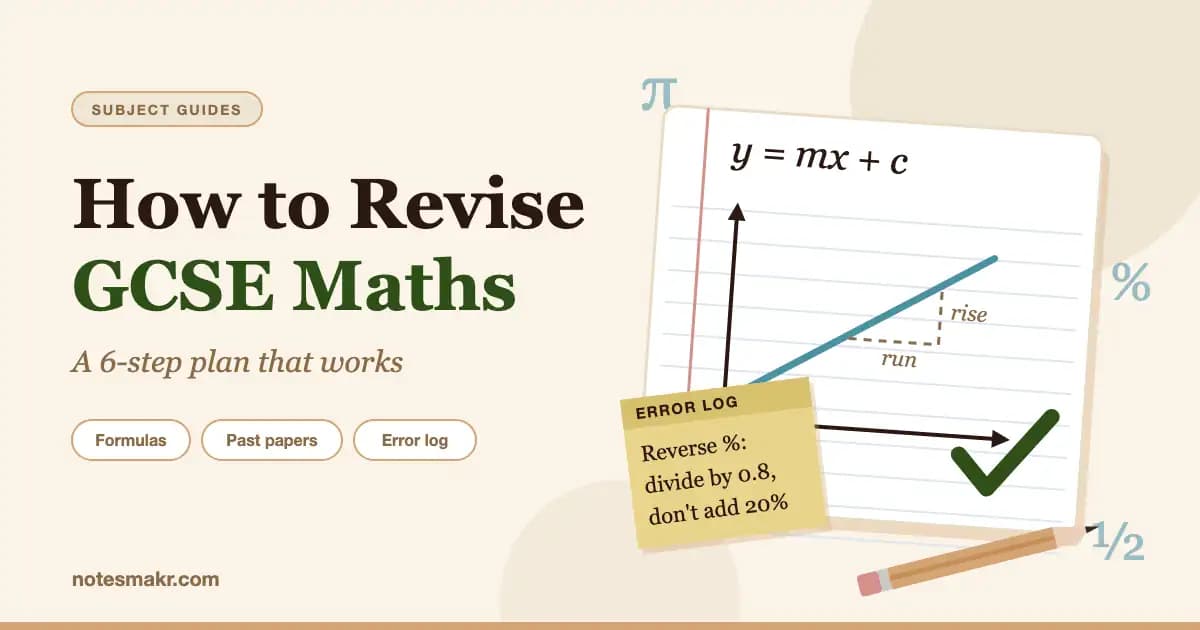
Here is the uncomfortable truth about how to revise GCSE maths. Reading your notes does almost nothing. You can read a chapter on reverse percentages, nod along, highlight the formula box and close the book feeling ready. Then the exam asks you to find the original price of a coat, and your mind goes blank.
Maths is a doing subject. The marks come from solving questions, not from recognising a method when you see it written down. That changes what good revision looks like, and it is why the advice that works for history or biology (read, summarise, repeat) works so badly here.
This guide gives you a six-step plan built around questions, a clear answer on which formulas you still have to memorise now that exam boards hand out a formulae sheet, and a realistic one-week version for when time is short. If you want the wider picture first, the guide on how to study maths covers the skill from Year 7 up.
How to Revise GCSE Maths: The Short Version
That is the whole method. The rest of this guide shows you how to run it, what to put on your flashcards and what to leave to practice.
What GCSE Maths Actually Tests
Before you plan anything, know the shape of the exam. AQA's specification sets out the layout, and Edexcel's follows the same pattern:
- Three papers, all at the same tier.
- Paper 1 is non-calculator. Papers 2 and 3 allow a calculator.
- Each paper is 1 hour 30 minutes and 80 marks. That is 90 minutes for 80 marks, so a little over a minute a mark.
- Any topic can appear on any paper. AQA's specification states that all content can be assessed on any of the three papers.
There are two tiers. Foundation covers grades 1 to 5 and Higher covers grades 4 to 9. You sit one tier for all three papers, so your teacher's tier decision shapes everything below. Ask early which one you are aiming for, because Higher-only topics (the sine and cosine rules, perpendicular gradients, frequency density) are wasted effort if you are on Foundation, and Foundation basics are not optional if you are on Higher. OCR and WJEC Eduqas may differ on the number of papers, marks and timings, so check your own specification.
Why Reading Doesn't Work in Maths
The research on revision is blunt about this. Dunlosky and colleagues (2013) reviewed ten popular study techniques. Only two were rated high utility: practice testing and distributed practice. Re-reading and highlighting, the two things most students actually do, were rated low.
Maths has three extra twists:
- Mixing beats blocking. Rohrer and Taylor (2007) ran two experiments in which students practised maths problems either grouped by type or shuffled together. A week later, the shuffled groups did far better. Rohrer, Dedrick and Stershic (2015) found the same in seventh-grade maths classes, with a large benefit when tested a month later.
- Worked examples speed up the start. Sweller and Cooper (1985) found that algebra beginners who studied worked examples alongside practice learned more efficiently than those who solved every problem alone. So when a topic is new, study a solved example before you attempt ten cold questions.
- Spacing matters. A topic you did in September has gone by February unless you revisit it.
Recognition is not recall. Seeing a solved question and thinking "yes, I'd have done that" is the most common way to fool yourself in maths.
The Formula Sheet: What You Still Need to Memorise
This is where most revision advice online is out of date or wrong, so check the primary sources. For 2026, both Pearson Edexcel and AQA put a formulae sheet inside the papers. Pearson's 2026 Higher exam aid and its Foundation equivalent say a copy is inserted into the question paper. AQA says the 2027 sheets are unchanged from 2026, and that boards must publish sheets a year ahead from 2028 onwards (AQA's update). Some third-party guides claim the sheet is being scrapped in 2028. Don't plan around that: AQA's own notice says otherwise.
What is on the sheet depends on your tier. Using Pearson's 2026 sheets:
| Tier | Formulas the sheet gives you |
|---|---|
| Foundation | Area of a trapezium, volume of a prism, circumference and area of a circle, Pythagoras, sin/cos/tan ratios, compound interest, P(A or B) |
| Higher | Everything above, plus the quadratic formula, sine rule, cosine rule, area of a triangle (½ab sin C) and P(A and B) |
AQA's 2026 Higher insert lists the same set. Now the part that matters. Everything else is yours to recall. Here is what is not on those sheets:
- Shapes: area of a rectangle, triangle and parallelogram; volume of a cuboid and cylinder; curved surface area of a cylinder; arc length and sector area; the angle sum and exterior angles of polygons
- Compound measures: speed, density and pressure
- Number and ratio: percentage change, multipliers, reverse percentages, direct and inverse proportion
- Algebra: y = mx + c, gradient, difference of two squares, the nth term of a linear sequence, index laws, the equation of a circle
- Statistics and probability: mean from a frequency table, median position, interquartile range, relative frequency, P(not A), the multiplication rule for independent events
- Trigonometry: the exact values of sin, cos and tan at 30°, 45° and 60°
AQA's specification adds one useful detail. The volume and surface area formulae for cones and spheres, and the kinematics formulae, are not memorised: they are given in the question where needed. Check your own board's specification to see how it handles these.
Knowing a formula is on the sheet does not mean you can skip it. You still have to know when to use the sine rule rather than a right-angled ratio, and how to substitute without slipping on a sign. But your memorising time is best spent on the list above.
Your 6-Step GCSE Maths Revision Plan
Find out your exam board, your tier and the dates of your mocks. Download the topic checklist from your board's website or ask your teacher for it. Print the formulae sheet for your board and tier, so you know exactly what you are, and are not, given.
Sit a past paper under exam conditions, then mark it with the mark scheme. Rate every topic red, amber or green based on where you lost marks. Don't guess your weak topics. The paper will tell you, and it is usually not the ones you expected.
Take one red topic. Read one worked example. Cover the solution and attempt a similar question. Then do a set of exam-style questions on that topic, closed notes. Corbettmaths and Maths Genie are two free sites with banks of questions and video explanations.
Once a topic is amber, stop practising it in isolation. Pull questions from several topics into one session, so you have to work out which method a question needs. That decision is half of what the exam tests, and blocked practice never trains it.
Use the mark scheme. Maths mark schemes award marks for method as well as answers, so check where your working earned or lost marks. Write each mistake in a log with its cause: knowledge gap, careless slip, misread the question or ran out of time. Redo your worst three questions a week later.
In the last weeks, work through complete timed papers. Paper 1 deserves extra attention because every fraction, surd and answer in terms of π has to be done by hand. If you want help scheduling all this, the guide to making a revision timetable gives you a template.
Watch: GCSE Maths Revision Advice
How to Revise for GCSE Maths, Corbettmaths
Corbettmaths publishes free videos and practice questions for GCSE maths. This is their guide to revising it. Their written version of the advice lines up with this plan: revise little and often, use the topic checklists to focus on weak areas, do past papers and mark them, and practise timing. One tip worth stealing is the shrinking cheat sheet. Start with a full A4 page of formulas, then rewrite it on half a page, then a quarter, until it all fits in your head.
A Practical Example: One Topic, Two Ways
Here is the same topic, reverse percentages, revised two different ways.
Tuesday: Forty-five minutes with the percentages chapter. Highlight the formula boxes. It all makes sense.
Saturday: A coat is reduced by 20% to £48. Find the original price. You work out 20% of £48, which is £9.60, and add it on. Answer: £57.60.
The notes felt familiar, but the method never got used. You also do not find out you are wrong until after the exam.
Tuesday: Read one worked example, then do eight questions with the notes closed. Mark them. You notice you keep adding the percentage on instead of dividing by the multiplier.
Log entry: "Reverse percentage: the sale price is 80% of the original, so divide by 0.8. Never add 20% to the sale price." Make a cloze card. Redo three similar questions on Saturday and one more two weeks later.
Now the coat question is easy: £48 ÷ 0.8 = £60.
The difference is not effort. Both students spent a similar amount of time. The second one found the error in a safe place, wrote it down and tested it again before it could cost marks.
Quick Reference: Revision Situations
| Situation | Best approach |
|---|---|
| Starting from scratch, months to go | Steps 1 and 2, then one red topic per week with questions |
| A topic is brand new | One worked example first, then similar questions |
| A topic feels fine but marks say otherwise | Mixed-topic practice and the error log |
| Weak on Paper 1 | Do questions by hand and check against the mark scheme |
| Formulas keep slipping | Cloze flashcards on the formulas not on the sheet |
| A month before mocks | Full timed papers, review each one properly |
How to Revise GCSE Maths in a Week
Let's be honest: a week will not turn a grade 3 into a grade 7. But a week used well can secure the marks you are already close to winning. Here is how to spend it.
- Day 1: Sit one past paper. Rate every topic red, amber or green.
- Days 2 to 5: Pick the two reddest topics each day. Study a worked example for each, then answer questions until you can do them with the notes closed.
- Day 6: Sit the non-calculator paper under timed conditions and mark it.
- Day 7: Review your error log, run through your formula cards and stop early enough to sleep.
Skip topics that you have not been taught, and don't try to cover everything. A week is for triage. The guide to revising for mocks has a longer six-week version, and the guide to revising for GCSEs covers the other subjects around maths.
How to Get a 9 in GCSE Maths
A grade 9 is a Higher tier grade, and the difference between a 7 and a 9 is rarely knowledge. It is how you handle unfamiliar, multi-step problems. Papers generally get harder as they go on, so the later questions are where the top grades are decided.
Spend your last practice sessions on the hardest questions from each past paper, and do them cold, before looking at hints. Then read the mark scheme for the method, not only the answer. If you can explain why each step is needed, you can handle a question dressed in a new context. The guide to deliberate practice for students explains why working at the edge of your ability is what moves you up.
Study this topic three ways
Reading is the slowest way to learn this. Once the ideas make sense, switch to active recall:
- GCSE Maths formulas flashcards: 38 key formulas with worked examples and memory hooks.
- GCSE Maths formulas quiz: 25 questions that make you apply the formulas rather than just recognise them.
How Notesmakr Helps You Revise GCSE Maths
Notesmakr is an AI notes maker and flashcard app for iPhone, iPad and Android. It cannot do your practice questions for you, and past papers from your exam board remain the gold standard. What it can do is take care of the bits around the questions.
- Cloze flashcards: Blank out the part you keep forgetting, such as "The gradient of a line is the change in ___ divided by the change in ___." Cloze cards are free, and so are the progressive letter hints that adapt to how well you know each card.
- Spaced repetition: Cards are scheduled with the SM-2 algorithm, so formulas you know come back less often and the shaky ones come back sooner. You can create as many cards as you like by hand. Make flashcards faster with AI: AI-generated flashcards, quizzes and mind maps are free within the free plan's limits (5 notes and 40 generations, lifetime), and the paid plans raise them.
- Exam planner: Set your exam date and the notes you want to cover. It spreads study sessions across the days before and sends daily reminders.
- Practice papers: Build a paper from your own notes, attempt it timed or untimed and get it marked with a breakdown. It is free today, counts against your AI limits, and is extra practice rather than a replacement for real past papers.
- Problem solving from a photo: Snap a maths problem you're stuck on and get it analysed. On the free plan it uses 1 note and 1 generation. AI can make maths errors, so check the working against your teacher or a mark scheme.
- Focus Timer: The built-in Pomodoro timer runs 25-minute focus blocks, a 5-minute break and a 15-minute break every four blocks.
If you already have a PDF of your formulae or class notes, turn it into flashcards, or make a self-test with the AI quiz maker. For a simple way to learn what you got wrong, see why practice tests beat re-reading.
Common GCSE Maths Revision Mistakes (And How to Fix Them)
Mistake 1: Reading the revision guide cover to cover
It feels like progress, and it is the lowest-value activity on the list.
The fix: Read one worked example, then close the book and attempt a question.
Mistake 2: Only practising your favourite topics
Strong topics feel good, which is exactly why they take up the time.
The fix: Let the red, amber and green list decide your schedule, not your mood.
Mistake 3: Never doing the non-calculator paper properly
Some students only practise with a calculator beside them, then lose marks on fractions and surds.
The fix: Do every Paper 1 practice question by hand, then check with a calculator afterwards.
Mistake 4: Marking the answer and ignoring the method
A wrong answer with good working still earns method marks, and a right answer with no working may not.
The fix: Read the mark scheme line by line and write your working in full, every time.
Mistake 5: Trying to memorise the whole formula sheet
You will be given those formulas, and the time is better spent on the ones you aren't.
The fix: Learn the formulas that are not on your board's sheet first, then practise using the ones that are. The guide to memorising formulas has memory techniques that work.
Mistake 6: Putting off full papers until the last week
By then it is too late to fix what they show you.
The fix: Sit your first full paper early and treat it as a diagnostic, not a verdict.
The Research Behind This Plan
- Learning techniques review (Dunlosky, Rawson, Marsh, Nathan and Willingham, 2013): Practice testing and distributed practice were rated high utility, while re-reading and highlighting were rated low. Read the paper.
- Mixed maths practice (Rohrer and Taylor, 2007): Shuffled practice beat blocked practice on a test a week later. Read the paper.
- Interleaved practice in classrooms (Rohrer, Dedrick and Stershic, 2015): Seventh-grade maths students who practised interleaved problems did better on a test a month later. Read the paper.
- Worked examples (Sweller and Cooper, 1985): Studying worked examples helped algebra beginners learn more efficiently than solving every problem alone. Read the paper.
- The testing effect (Roediger and Karpicke, 2006): Students who tested themselves remembered more after a week than students who re-read. Read the paper.
Frequently Asked Questions
What is the best way to revise GCSE maths?
Do questions, not reading. Study one worked example, then answer exam-style questions on the topic with your notes closed. Mark them against the mark scheme, log your mistakes, and mix older topics back in each week. Finish with full timed papers, including the non-calculator paper, so exam conditions feel familiar.
Can you revise GCSE maths in a week?
You can improve in a week, but you cannot cover everything. Sit one past paper on day one, rate each topic red, amber or green, then spend four days on the reddest topics using worked examples and questions. Use day six for a timed non-calculator paper and day seven for review and rest.
Do I need to memorise formulas for GCSE maths?
Yes, some. In 2026 Edexcel and AQA both give a formulae sheet, but it does not include area of a triangle, volume of a cylinder, speed, density, y = mx + c, index laws or the exact trig values. Memorise what is not on your board's sheet and practise using the formulas that are.
How do I get a 9 in GCSE maths?
A 9 needs consistent accuracy on the hardest Higher tier questions. Practise the last questions of past papers cold, read mark schemes for method rather than just answers, and mix topics so you have to choose the method. Keep an error log, because careless slips cost more marks than missing knowledge.
Should I revise differently for Foundation and Higher tier?
The method is the same, but the topics differ. Foundation covers grades 1 to 5 and Higher covers grades 4 to 9, and you sit one tier for all three papers. Use your board's topic checklist for your tier, and do not spend time on content that is Higher only if you are sitting Foundation.
Start Today
- Today: Find out your exam board, tier and mock dates, and print your board's formulae sheet.
- Tomorrow: Sit one past paper and rate every topic red, amber or green.
- This week: Take your reddest topic through steps 3 to 5: example, questions, mark, log.
- This weekend: Make cards for the formulas that are not on your sheet, starting with the circled ones from your 3-minute list.
- Every week: Add one mixed-topic session and redo your worst three questions.
- Four weeks before mocks: Switch to full timed papers and review each one properly.
Maths is not something you read your way into. It is something you do your way into.
"The only way to learn mathematics is to do mathematics."
— Paul Halmos, A Hilbert Space Problem Book (preface)