
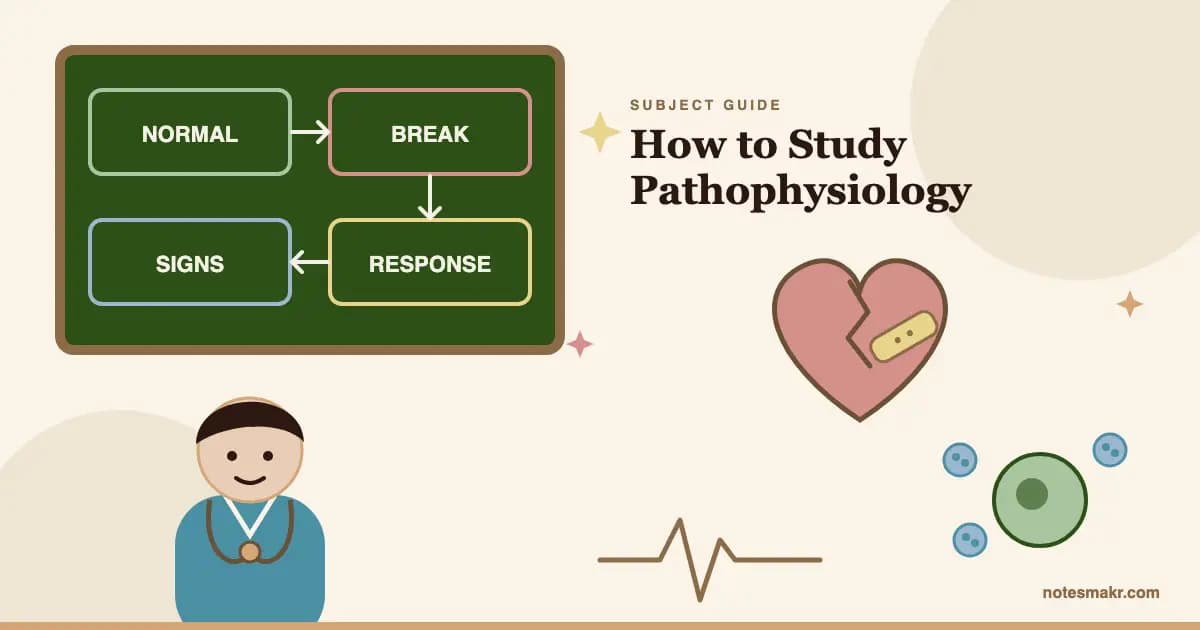
If you're trying to work out how to study pathophysiology, here's the uncomfortable truth: the students who struggle most are often the ones with the best symptom lists. They have color-coded sheets for heart failure, asthma and diabetes. They can recite twelve signs of each. Then the exam describes a patient who is short of breath, crackly at the lung bases and worse lying flat, and asks what's happening inside the body. The list has nothing to say.
Pathophysiology isn't a new subject stacked on top of physiology. It is physiology, broken in a specific way. Every disease starts with a normal process, something goes wrong with it, the body tries to compensate, and the signs you see at the bedside are the result of both the damage and the compensation.
Learn diseases in that order and the symptom lists write themselves. Learn the lists without the mechanism and you'll be memorizing forever, and still miss the questions that matter.
This guide gives you a four-step method for every disease, shows it working on left-sided heart failure, explains why it holds up under research, and covers the mistakes that sink most nursing and pre-health students in patho.
What Is Pathophysiology?
Pathophysiology is the study of how normal body functions are disrupted by disease or injury, and how those disruptions produce the signs and symptoms a patient shows. The name says it: patho (disease) plus physiology (normal function).
That makes it the bridge between the science courses you've already taken and the clinical work ahead. Anatomy tells you where things are. Physiology tells you how they work. Pathophysiology tells you what happens when they stop working, and why the patient in front of you looks the way they do.
Most patho courses open with the same two chapters before moving system by system: cellular injury (how cells adapt, get damaged and die) and inflammation (how the body responds to that damage). Those two ideas come back in nearly every disease you'll study afterwards, from a heart attack to pneumonia to rheumatoid arthritis.
Pathophysiology is physiology broken in a specific way. If you can explain the normal process and point to the exact step that fails, you can predict the symptoms instead of memorizing them.
Is Pathophysiology Hard? What the Research Says
Pathophysiology has a reputation as the course that weeds people out of nursing programs, and it's not imaginary. But the research on why it feels hard points straight at the fix.
Nursing educators have a name for it: the "bioscience problem." In a 2015 integrative review, McVicar, Andrew and Kemble noted that nursing students' difficulty with human biosciences had been a cause for concern for more than 20 years, and the problem still hadn't gone away. A big part of it is confidence. When Craft and colleagues (2013) surveyed 273 students starting a nursing degree, many already expected bioscience to be harder than their nursing subjects, expected it to need more content, and felt anxious about it before the first lecture.
Here's the encouraging part. A study by Woods, Brooks and Norman (2005) compared two ways of learning to diagnose disorders. One group learned each disorder through its underlying mechanism. The other learned which symptoms tend to go with which disease, much like memorizing a symptom list. On an immediate test, both groups scored about the same. One week later, the mechanism group still scored 0.52 for diagnostic accuracy, while the list group had dropped to 0.43.
The mechanism didn't make learning faster. It made it last, because students could rebuild the link between a symptom and a disease even after the details faded.
That lines up with the largest review of study techniques. Dunlosky and colleagues (2013) rated ten common learning strategies by how well they work:
| Study method | Dunlosky et al. utility rating | What it does for pathophysiology |
|---|---|---|
| Highlighting | Low | Marks the textbook, builds no recall |
| Rereading | Low | Feels familiar, fades within days |
| Summarizing | Low | Only helps if you already understand the mechanism |
| Distributed practice | High | Keeps every chapter alive through the final |
| Practice testing | High | Shows you which mechanisms you can't explain yet |
Ratings from Dunlosky et al. (2013), "Improving Students' Learning With Effective Learning Techniques."
So the plan is simple to state: understand the mechanism, then test yourself on it, a little at a time across the semester.
How to Study Pathophysiology: The Four-Step Disease Chain
Use the same four questions for every disease in the course. Write them as a chain, in this order, every time.
Before you read a word about the disease, write two or three sentences on the normal physiology. For heart failure, that's how the left ventricle pumps blood out and how blood returns from the lungs. If you can't write this part, stop and review it first. Everything else depends on it.
Name the specific step that fails. Not "the heart is weak," but "the left ventricle can't empty properly, so pressure builds up behind it." The more precisely you name the break, the more symptoms you'll be able to predict.
The body almost always tries to compensate: faster heart rate, retained fluid, faster breathing, inflammation. Many of the signs you'll be tested on come from this response, not from the original damage. Some responses help. Some make things worse over time.
Only now list the signs, symptoms and lab findings, and tag each one to the step that causes it. Every sign should trace back to the break or the response. If one doesn't, you've found a gap in your understanding.
Put the facts that must be memorized (normal lab values, key terms, classic signs) on spaced flashcards. Then close your notes and rebuild the whole chain from a blank page once a week. Cards hold the facts; the chain holds the reasoning.
Watch: Patho Study Tips and Inflammation in Action
Two videos worth your time. The first is study strategy from a nurse educator; the second walks through the vascular events of inflammation, one of the first big mechanisms every patho course covers.
How to Study for Pathophysiology in Nursing School (RegisteredNurseRN)
RegisteredNurseRN covers how to approach patho as a nursing student, from preparing before lectures to building a weekly routine. Key insight: know the normal physiology before class so the disease lecture has something to attach to.
Inflammation: Vascular Events (Ninja Nerd)
Ninja Nerd draws out what happens to blood vessels in the first minutes and hours of inflammation. Key insight: redness, heat and swelling aren't three separate facts; they all come from vessels dilating and becoming leaky.
A Practical Example: Left-Sided Heart Failure
Here's the chain on a disease that shows up in every patho course and on the NCLEX.
"Left-sided heart failure: dyspnea, orthopnea, crackles, cough, fatigue, tachycardia, pink frothy sputum."
Seven words to memorize, with nothing holding them together. Change the question to "why is this patient worse lying down?" and the list has no answer.
Normal: Blood drains from the lungs into the left side of the heart, and the left ventricle pumps it out to the body.
Break: The left ventricle can't pump effectively, so blood backs up into the pulmonary veins and capillaries. Pressure in the lung capillaries rises and pushes fluid into the lung tissue and air spaces.
Response: The body senses low output, so the sympathetic system speeds up the heart and the kidneys retain sodium and water. That raises blood volume, which adds to the backup over time.
Signs: Fluid in the alveoli gives crackles and shortness of breath. Lying flat returns more blood to the heart, so breathing gets worse (orthopnea). Low output causes fatigue. Sympathetic drive causes tachycardia.
See what happened? You now hold one story instead of seven facts. Every sign has an address. And when the exam asks why diuretics help, you already know: they reduce the fluid volume the failing ventricle has to handle.
Notice something else. The fluid that leaks into the lungs here is pushed out by pressure, not by inflamed, leaky vessels. That's the difference between a transudate and an exudate, one of the ideas you'll meet in the inflammation chapter. Patho keeps reusing the same handful of mechanisms, which is exactly why learning them properly pays off.
Quick Reference: The Disease Chain for Five Common Conditions
Use this table as a model, not as something to memorize. Notice how each row follows the same logic.
| Disease | Normal | Break | Body's response | Signs you'd see |
|---|---|---|---|---|
| Left-sided heart failure | Left ventricle pumps blood to the body | Ventricle can't empty; blood backs up into lungs | Faster heart rate, kidneys retain fluid | Crackles, dyspnea, orthopnea, fatigue |
| Asthma | Airways stay open for airflow | Airways inflame, constrict and fill with mucus | Faster breathing, accessory muscles | Wheeze, shortness of breath, prolonged expiration |
| Type 1 diabetes | Insulin moves glucose into cells | Immune system destroys insulin-making beta cells | Body burns fat, making ketones | High glucose, polyuria, thirst, weight loss |
| Hypothyroidism | Thyroid hormone sets metabolic rate | Too little thyroid hormone | Pituitary raises TSH | Fatigue, cold intolerance, weight gain |
| Iron deficiency anemia | Hemoglobin carries oxygen | Too little iron to make hemoglobin | Heart rate rises to deliver more oxygen | Pallor, fatigue, tachycardia, breathlessness on exertion |
Look across the rows and you'll see the pattern patho is really teaching: the body defends itself, and the defense is part of the clinical picture.
Start With Cellular Injury and Inflammation
If you're early in the semester, put extra time into the first two chapters. They're the foundation for everything that follows.
Cellular injury and adaptation
Cells under stress first try to adapt. They get bigger (hypertrophy), multiply (hyperplasia), shrink (atrophy) or switch to a tougher cell type (metaplasia). Push them further and they're injured. Mild injury, such as a cell swelling when its ATP runs low, can reverse. Severe injury crosses a point of no return, and the cell dies by necrosis (messy, inflammatory) or apoptosis (tidy, programmed).
Here's why this matters later. A heart attack is coagulative necrosis of heart muscle. A stroke is liquefactive necrosis of brain tissue. Tuberculosis causes caseous necrosis. Once you know the patterns, a lot of organ-system chapters become variations on a theme.
Inflammation
Inflammation is the body's response to that injury. Blood vessels dilate (redness and heat), become leaky (swelling), and white blood cells move out of the blood to the damaged tissue. Chemical mediators like histamine and prostaglandins drive it, and that's why drugs like antihistamines and ibuprofen work the way they do. This connects patho directly to pharmacology, which most nursing students take alongside it.
If an infection is part of the picture, the microbiology you learned explains the trigger; inflammation explains the body's reaction to it.
Pathophysiology Study Tips That Actually Work
1. Review the normal physiology before each lecture
Spend 20 minutes the night before reading the normal physiology for the system coming up. If you're covering the kidneys, refresh how a nephron filters and reabsorbs. Your lecture then becomes the "break" step instead of a wall of new information.
2. Draw the chain, don't just write it
Arrows force you to commit to cause and effect. Draw the normal process, cross out the step that breaks, and branch out to the response and the signs. A mind map is perfect for this, because one disease often branches into several compensations.
3. Group diseases by mechanism
Instead of studying every disease in isolation, group them by what goes wrong: obstruction, inflammation, loss of a hormone, fluid overload. Comparing two diseases with the same mechanism (asthma and COPD both narrow airways) teaches you more than either one alone.
4. Use flashcards for the facts that have to be memorized
Patho does have a recall layer: normal lab values, key terms, classic signs. These are perfect for spaced repetition. Cloze cards work especially well: "Potassium normal range is ___ mEq/L" or "Orthopnea occurs because lying flat increases ___ to the heart."
5. Explain each disease out loud in plain words
Pick a disease and explain it as if to a friend with no science background. Wherever you stall or reach for jargon, you've found a gap. This is the Feynman Technique applied to patho, and it works because a simple explanation is impossible to fake.
6. Practice NCLEX-style application questions
Most nursing exams ask what's happening or what will happen next, not "define X." Practice with questions that describe a patient. When you get one wrong, trace which step of the chain you missed.
Common Mistakes When Studying Pathophysiology
Mistake 1: Skipping the normal physiology
If you never really understood how the kidney or the heart works normally, every disease of that organ will feel random. The fix: before each new system, spend a session on its normal function. It's the highest-return hour you'll spend in the course.
Mistake 2: Memorizing symptom lists without mechanisms
Lists fade fast and can't answer "why." The fix: for every sign on your list, write the step of the chain that causes it.
Mistake 3: Treating every disease as a separate topic
Students who study 40 diseases as 40 unrelated stories run out of memory. The fix: group diseases by shared mechanism and notice how often the same few ideas repeat: inflammation, ischemia, fluid shifts, loss of a hormone.
Mistake 4: Cramming before each exam
Patho is cumulative. The cellular injury chapter comes back in the cardiac unit; inflammation comes back everywhere. The fix: review older chapters a little every week with spaced flashcards so nothing has to be relearned from scratch.
Mistake 5: Reading the textbook cover to cover
Patho textbooks are enormous. Reading every paragraph with equal attention is slow and passive. The fix: read with the four questions in front of you and pull out only the answers to Normal, Break, Response and Signs.
Study this topic three ways
Reading is the slowest way to learn this. Once the ideas make sense, switch to active recall:
- Cellular injury and inflammation flashcards: 39 key terms, from hypertrophy and metaplasia to necrosis patterns, opsonins and granulomas, each with a clinical example and a memory hook.
- Cellular injury and inflammation quiz: 25 questions that make you predict what happens to an injured cell or an inflamed tissue rather than just recognize a term.
How Notesmakr Helps You Study Pathophysiology
Notesmakr is an AI-powered notes maker that turns your lecture PDFs, slides and typed notes into flashcards, quizzes and mind maps, built around simplifying hard material until it makes sense.
For the recall layer, you can create cloze flashcards for disease mechanisms, classic signs and lab values on the free plan. They come with Diminishing Cues, progressive letter hints that fade as you learn, based on Fiechter and Benjamin's 2017 research on scaffolded retrieval. Every card is scheduled with SM-2 spaced repetition, so the cellular injury chapter you learned in week two is still there for the final. If you already have Anki decks from a classmate, you can import the .apkg file directly.
For the reasoning layer, Notesmakr's AI can simplify a dense textbook chapter into plain language using the Feynman approach, and generate AI mind maps that link a disease to its mechanism and its symptoms. These AI features are free within the free plan's limits (5 AI notes and 40 AI generations), and the paid plans (Scholar and Scholar+) raise those limits.
- Map a disease from mechanism to symptoms: generate a mind map
- Cut a long chapter down to its core: summarize your notes
- Turn lecture slides into cards: make flashcards from a PDF
New to building decks? Our guide to AI flashcards covers how to make cards that actually stick.
The Research Behind It
- Mechanisms help diagnoses last (Woods, Brooks & Norman, 2005): Students who learned disorders through their underlying mechanisms kept their diagnostic accuracy a week later (0.52), while students who learned symptom-disease associations dropped to 0.43. Read it
- The bioscience problem (McVicar, Andrew & Kemble, 2015): An integrative review found nursing students' difficulty with biosciences had been a concern for over 20 years. Read it
- Bioscience anxiety starts early (Craft et al., 2013): A survey of 273 commencing nursing students found many expected bioscience to be harder than nursing subjects and felt anxious about it. Read it
- Effective learning techniques (Dunlosky et al., 2013): Practice testing and distributed practice rated high utility; rereading and highlighting rated low. Read it
- The testing effect (Roediger & Karpicke, 2006): Retrieving information strengthens long-term memory more than restudying it. Read it
- Diminishing-cues retrieval practice (Fiechter & Benjamin, 2017): Fading hints improved memory under conditions where regular testing did not help. Read it
Frequently Asked Questions
Is pathophysiology hard?
Pathophysiology is one of the most demanding courses in nursing and pre-health programs, mainly because it asks you to understand mechanisms, not just memorize facts. Nursing educators have described a long-running "bioscience problem" for students. It becomes far more manageable when you master normal physiology first and learn every disease as a cause-and-effect chain.
How do I pass pathophysiology in nursing school?
Review the normal physiology before each lecture, then learn each disease in four steps: normal function, what breaks, how the body responds, and the signs that result. Put lab values and key terms on spaced flashcards, practice NCLEX-style application questions weekly, and review older chapters regularly because the course is cumulative.
Should I learn physiology before pathophysiology?
Yes. Pathophysiology assumes you understand how each system works normally, because every disease is a disruption of that normal process. If your physiology is shaky, spend time reviewing the relevant system before each patho unit. It makes the disease material easier to follow and much easier to remember.
How many hours a week should I study pathophysiology?
There's no fixed number, but short daily sessions beat long weekend cramming. Research on distributed practice shows spreading study over time improves long-term retention. Many students do well with 30 to 60 minutes most days: reviewing flashcards, rebuilding one disease chain from memory and doing a set of practice questions.
How do I memorize diseases in pathophysiology?
Don't memorize diseases as symptom lists. For each one, learn the mechanism first: what normally happens, what goes wrong, and how the body compensates. Then tag every sign to the step that causes it. Use flashcards only for facts that truly need memorizing, such as lab values and key terms.
Start Today
You don't need a different textbook. You need a different routine for your next patho lecture:
- Spend 20 minutes reviewing the normal physiology of the system coming up next.
- For each disease, write the chain: Normal, Break, Response, Signs.
- Tag every sign on your notes to the step of the chain that causes it.
- Put lab values and key terms on cloze flashcards with spaced repetition.
- Rebuild one disease chain from a blank page this week, then check it.
- Explain one disease out loud in plain words, with no jargon.
Patho stops being a pile of symptom lists the moment every symptom has a reason behind it.
"What I cannot create, I do not understand."
— Richard Feynman, written on his blackboard at the time of his death in 1988