
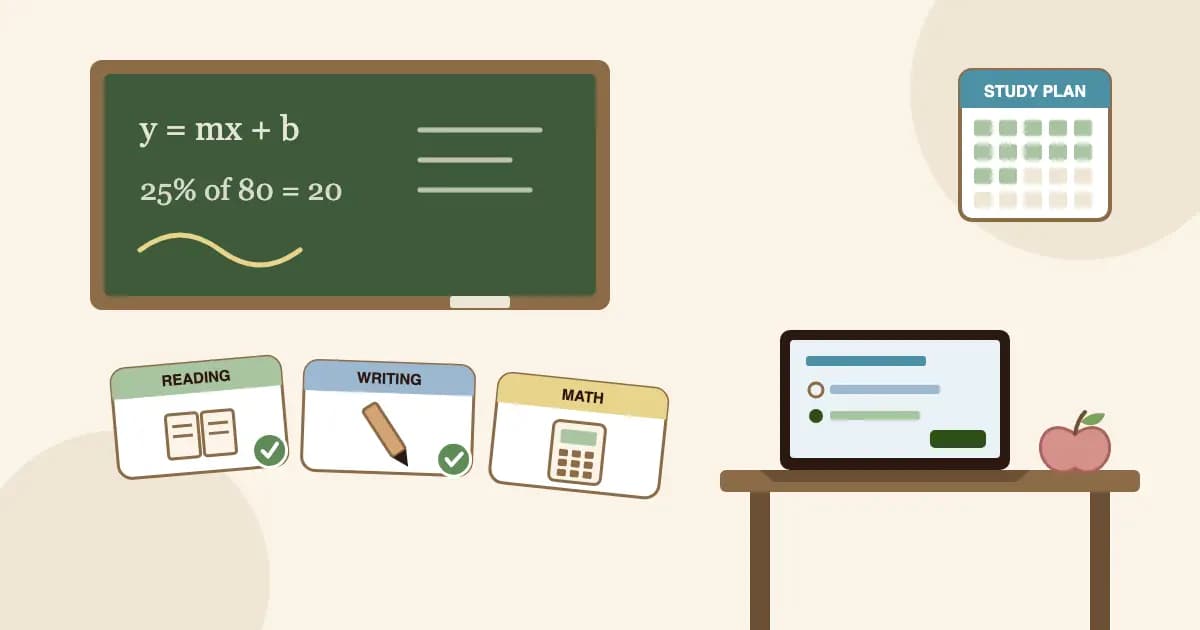
Here is the uncomfortable truth about the Praxis. Most future teachers who fail it are not weak at reading, writing, or math. They fail because they studied the content they already knew and skipped the format they had never seen.
If you want to know how to study for the Praxis in a way that gets you a pass on the first try, start with this: the Praxis Core is a timed skills test, not a test of how much you remember from high school. The Reading test answers every question from the passage in front of you. The Writing test grades two essays you write against the clock. The Math test gives you a basic four-function calculator and 90 minutes for 56 questions, many of them word problems.
This guide shows you how to study for the Praxis around those facts. You will get the real test structure from ETS's own study companions, what each subtest is really checking, and a six-week plan that fits around a job, student teaching, or a full course load.
What Is the Praxis?
The Praxis is a family of teacher certification tests run by ETS. Most states and many teacher preparation programs use them to decide who can enter a program or earn a teaching license. There are two main kinds:
- Praxis Core Academic Skills for Educators checks basic reading, writing and math. Programs often require it for admission.
- Praxis Subject Assessments check the content you will teach. For example, Elementary Education: Multiple Subjects (5001) is four separately timed subtests (reading and language arts, mathematics, social studies, and science) running 4 hours 35 minutes in total.
Most people searching for how to study for the Praxis mean the Core, so that is where this guide spends its time. Here is its structure, straight from the official ETS study companions:
| Praxis Core test | Code | Time | Questions | Format |
|---|---|---|---|---|
| Reading | 5713 | 85 min | 56 | Selected-response questions on passages and statements |
| Writing | 5723 | 100 min | 40 + 2 essays | 40-minute selected-response section, then two 30-minute essays |
| Mathematics | 5733 | 90 min | 56 | Selected-response and numeric-entry, on-screen four-function calculator |
Sources: ETS Praxis Study Companions for Reading 5713, Writing 5723 and Mathematics 5733.
Four facts that should shape your plan right now:
- Passing scores are set by your state or program, not by ETS. ETS says so directly on its passing scores page. Look up the exact number you need before you start, because it decides how much margin you have.
- You can take the three tests together or separately. The Core Combined test (5752) bundles all three, and it is offered for at-home testing. Taking them one at a time lets you study one at a time.
- The math calculator is four-function only. No graphing, no fraction keys. Fractions, percentages and order of operations still need to work in your head and on your note board.
- A retake means a 28-day wait. ETS requires at least 28 days between attempts at the same test (ETS rescheduling and retake rules), so a failed attempt costs you a month as well as the fee.
Why Praxis Study Plans Fall Apart
Most Praxis candidates are busy adults. They are finishing a degree, student teaching, working as a paraprofessional, or switching careers. So they do what feels efficient: buy a big prep book, read it in the evenings, and book the test when the book is done.
Two things go wrong.
First, reading a prep book trains recognition, not recall. You see an explanation of percent change and think "yes, I know that." On test day you have to produce the answer from a word problem with nobody explaining it first. That gap is called the illusion of competence, and it catches strong students as often as weak ones.
Second, people study what they are comfortable with. English majors polish their grammar and avoid math. Math-confident career changers skip the essays. The test does not care which subject you enjoy, and the passing score applies to each test on its own.
The research on what works is consistent. In a review of ten common study techniques, Dunlosky and colleagues (2013) rated only two as high utility: practice testing and distributed practice. Re-reading and highlighting, the default habits of almost every first-time Praxis candidate, were both rated low utility.
Chapters finished is not progress. Timed questions answered from memory, then checked and logged, is progress.
How to Study for Each Praxis Core Test
Each of the three tests rewards a different kind of practice. Here is where to point your effort.
Praxis Core Reading (5713): find the evidence
Every reading question can be answered from the passage. ETS states that "no question requires outside knowledge of the content." That changes how you should study. You are not learning facts. You are training a habit.
The test uses four kinds of material: paired passages of about 200 words in total, long passages of about 200 words, short passages of about 100 words, and single statements followed by one question. Some passages are visual, such as charts, maps or floor plans.
The questions fall into three areas: key ideas and details (about 35%), craft, structure and language skills (about 30%), and integration of knowledge and ideas (about 35%). In practice, that means:
- Main idea and author's purpose. Practise summarizing a passage in one sentence before you look at the answers.
- Inference questions. The right answer is the one the passage supports, not the one that sounds most reasonable.
- Paired passages. Note how the second author would respond to the first. That relationship is what most paired questions ask.
The habit to drill: read the question, then go back and put your finger on the line that proves your answer. If you cannot point to it, you are guessing.
Praxis Core Writing (5723): two essays and a grammar sprint
The Writing test has three separately timed sections. First come 40 selected-response questions in 40 minutes covering usage, sentence correction, revision in context, and research skills. Then two 30-minute essays:
- The argumentative essay asks you to take a position and support it with reasons and examples from your experience, observation or reading.
- The informative/explanatory essay gives you two sources. You have to pull information from both and cite them.
Each essay is scored holistically on a six-point scale, and both essay scores combine with the selected-response score for your Writing result. The source-based essay is where prepared candidates gain the most, because the task is predictable. Practise a simple structure:
- An introduction that names the issue and says what both sources contribute.
- Two body paragraphs, each built on specific information from a named source.
- A short conclusion that ties the two sources together.
Forgetting to cite both sources is the easiest way to lose points on that essay. Write at least three timed practice essays of each type before test day. For the grammar section, a short daily set of usage questions does more than reading a grammar handbook cover to cover.
Praxis Core Math (5733): fluency under a basic calculator
The Math test has 56 questions in 90 minutes across three areas: number and quantity (about 36%), data interpretation, statistics and probability (about 32%), and algebra and geometry (about 32%). That works out to under two minutes per question.
Three things trip people up:
- Fractions, ratios and percentages. Number and quantity is the single largest area. Percent change, unit rates and proportions show up again and again.
- Question formats. Some questions say "select one or more answer choices" and are marked with square boxes. Others are numeric entry, where you type your answer, sometimes as a fraction in two boxes. Practise these on a screen so they do not surprise you.
- Geometry formulas. ETS lists using the formulas for perimeter, circumference, area and volume as a tested skill. Know them cold so you spend test time on the problem, not on remembering the formula.
Practise in mixed sets rather than one topic at a time. A set that jumps from a probability question to an area question to a proportion feels harder, and it prepares you far better, because the real test never tells you what is coming next. The practice-first math method covers that structure in more depth.
How Long to Study for the Praxis
It depends on how far you are from your state's passing score, so take a practice test first. A realistic plan for a working adult or a busy student is two to six weeks per test:
| Starting point | Realistic study time |
|---|---|
| Practice score already at or above your state's passing score | 1 to 2 weeks of timed practice to confirm it |
| A few points below | 3 to 4 weeks of targeted practice |
| Well below, or many years since your last math class | 6 weeks or more on that test |
The total for all three Core tests is often six to ten weeks, because most people are strong in at least one. What matters more than the total is spreading it out. Cramming the night before produces a feeling of readiness that is gone a week later. Spacing the same hours across several weeks keeps it, which is what Cepeda and colleagues (2006) found across hundreds of spacing experiments.
Your 6-Week Praxis Study Plan
This plan assumes about an hour on five days a week, which is what most people can actually keep up alongside work or classes.
Take a timed practice test in all three subjects. Use the official ETS practice tests if you can, because they match the real format. Then look up your state's or program's passing score for each test on the ETS site, and write the gap next to each one.
The test with the biggest gap is your priority. The one already passing gets a short confirmation block later.
Each session follows one rhythm: 20 minutes on a single skill (one grammar rule, one type of math problem, one kind of reading question), 30 minutes of timed mixed practice, then 10 minutes writing every wrong answer into an error log.
The log is the most useful study tool you will own. For each miss, write the question type, why you got it wrong, and the correct method. Review it every weekend. Your mistakes repeat, and the log shows you the pattern.
Switch to the second test. If Writing is on your list, write one timed essay every other day, alternating argumentative and source-based. Keep a 10-minute daily review of your weakest test's error log so it does not fade.
Take a second full timed practice test. If you are comfortably above your passing score, book the real test. If you are close but below, give that one test two more weeks. Remember that a retake costs a 28-day wait, so booking early to "see how it goes" is the expensive way to find out.
If you are fitting this around a job, the studying while working guide covers the evening-study problem directly, and the study schedule guide shows how to block the time so it actually happens.
Watch: Praxis Core Prep in Action
How to Pass the Praxis Core Reading, Writing, and Math Tests, Teaching with Tenia
A teacher's walkthrough of how she approached all three Core tests and which resources she used. Key insight: treat the three tests as separate projects, each with its own plan and practice, rather than one big exam.
Praxis Core Math: 5 Challenging Questions Explained, Kathleen Jasper
Kathleen Jasper is a long-time Praxis prep educator. Watching someone reason through hard questions step by step shows you the habits the math test rewards. Key insight: most hard questions are two easy steps joined together, so the skill is spotting the first step.
Reading Week vs Practice Week
Same five evenings. Same five hours. Very different results.
Monday to Friday: Read the math chapters of the prep book from the start. Copy the worked examples into a notebook. Watch two videos on percentages. On Friday, re-read the notebook.
Saturday check: Felt confident. Got 9 of 20 timed practice questions right, because the questions mixed percentages with probability and area, and the select-all and numeric-entry formats were new.
Five hours produced familiarity with the explanations, not the skill the test checks.
Monday to Friday: 20 minutes on one skill. 30 minutes of timed mixed questions on screen. 10 minutes logging every wrong answer and why.
Saturday check: Got 15 of 20 right. The log showed four of the five misses were successive percentage changes, fixed on Sunday in fifteen minutes.
Same five hours. Every session ended with questions answered, not pages turned.
The difference is not how hard you worked. It is what your work produced.
Quick Reference: Where to Spend Your Time
| Your situation | What to prioritise |
|---|---|
| Strong reader and writer, weak at math | Book Reading and Writing first, give Math the longest runway |
| Math-confident, years since writing an essay | Timed essays from week one, both types, every other day |
| Already failed one test by a few points | Read your score report's content categories, target the weakest one, and plan for the 28-day wait |
| Only 30 minutes a day | Timed practice and the error log only. No passive reading |
| Testing at home | Rehearse on a laptop or desktop with only an erasable note board, as the at-home rules require |
| Subject Assessment next (for example, 5001) | Same method: practice test, error log, one subtest at a time |
How Notesmakr Helps You Study for the Praxis
Notesmakr is an AI-powered notes maker that turns your notes, handouts and PDFs into flashcards, quizzes, mind maps and study guides. For a test that rewards practice over reading, that is a useful shortcut.
Here is what maps to the Praxis:
- Free: manual and cloze flashcards. Cloze (fill-in-the-blank) cards suit the recall-shaped parts of the Praxis: geometry formulas, percentage and fraction conversions, grammar rules, commonly confused words, and the vocabulary that makes reading passages faster. Notesmakr's diminishing-cues system reveals letter hints step by step as your recall improves, based on Fiechter and Benjamin's (2017) research showing 44% better retention.
- Free: SM-2 spaced repetition. Your cards are scheduled automatically, so the formulas you learn in week two come back before test day instead of fading.
- Free: Focus Timer. The classic 25/5/15 Pomodoro cycle gives an after-work session a clear start and stop, which matters when you are tired.
- Free: your own error-log deck. Make a manual card from every logged mistake, written in your own words. Reviewing your own errors is the highest-value ten minutes in the plan.
- Free within limits: AI quizzes, flashcards and study guides. Upload the official ETS study companion PDF or your prep book chapter and generate practice questions or a condensed study guide from it. The free plan gives you 5 AI notes and 40 AI generations; Scholar raises the limits.
To turn a chapter into practice questions quickly, use the AI quiz maker. To condense a long reading or writing chapter into something you can revise from, try the study guide generator. If you are new to making decks, the AI flashcards guide walks through the whole process.
Common Praxis Study Mistakes (And How to Fix Them)
Mistake 1: Booking the test before taking a practice test
Without a baseline, you do not know which test needs the most work, or whether you need to study at all.
The fix: Take a timed practice test in week one and compare it with your state's passing score.
Mistake 2: Studying only your favourite subject
Polishing strengths feels productive. Each test has its own passing score, so a brilliant Reading score does not rescue a failed Math score.
The fix: Rank your three gaps and study the biggest one first.
Mistake 3: Never writing a timed essay
Thirty minutes goes quickly. A first essay written on test day usually runs out of time or forgets to cite both sources.
The fix: Write at least three timed essays of each type at home, using the structures above.
Mistake 4: Practising math with a better calculator
If you practise with a phone or graphing calculator, the four-function on-screen version will slow you down on test day.
The fix: Practise with a basic four-function calculator, and do fraction work by hand.
Mistake 5: Treating a retake as a cheap second chance
A retake costs another fee and a 28-day wait, which can push you past a program deadline.
The fix: Book only when your practice scores are comfortably above the passing score. The practice tests guide covers how to use them as a readiness check.
Mistake 6: Reading answer explanations without redoing the question
Reading why an answer is right feels like learning. It is recognition again.
The fix: After reading an explanation, close it and redo the question from scratch. Add it to your error log if you could not.
The Research Behind This Plan
This plan is applied cognitive science, not a set of test tricks:
- Practice testing and distributed practice (Dunlosky, Rawson, Marsh, Nathan and Willingham, 2013): Of ten study techniques reviewed, only these two were rated high utility. Re-reading and highlighting were rated low.
- The testing effect (Roediger and Karpicke, 2006): Students who practised retrieving material remembered substantially more a week later than students who spent the same time re-studying it. Read the study.
- Distributed practice (Cepeda, Pashler, Vul, Wixted and Rohrer, 2006): A meta-analysis of spacing experiments found spaced study beat massed study across retention intervals.
- Interleaved practice (Rohrer and Taylor, 2007): Mixed-topic math practice produced much better delayed-test scores than blocked practice, even though it felt harder at the time.
- Diminishing cues (Fiechter and Benjamin, 2017): Progressive letter hints on cloze cards produced 44% better retention.
For the methods behind these findings, read the guides on active recall, spaced repetition, and interleaving.
Frequently Asked Questions
How long should you study for the Praxis?
Take a practice test first, because the answer depends on your gap to the passing score. Most candidates need two to six weeks per Praxis Core test, studying about an hour on most days. If you are already scoring above your state's passing score in practice, one to two weeks of timed practice may be enough.
What is on the Praxis Core test?
The Praxis Core has three tests. Reading (5713) has 56 questions in 85 minutes. Writing (5723) has 40 selected-response questions plus an argumentative essay and a source-based essay, in 100 minutes. Mathematics (5733) has 56 questions in 90 minutes with an on-screen four-function calculator.
What score do you need to pass the Praxis?
There is no single national passing score. ETS states that passing scores are set by each state or agency, not by ETS. Use the passing scores tool on the official Praxis website, choose your state and test, and aim for a practice score comfortably above that number before you book.
Is the Praxis Core hard?
The content is mostly high school level, but the time limits and question formats make it harder than it looks. Math is the test candidates most often find difficult, because it uses a basic four-function calculator and mixes topics. Timed practice on the real formats is what closes the gap.
Can you retake the Praxis if you fail?
Yes. ETS requires you to wait at least 28 days after your previous attempt before taking the same test again, and the wait applies even if you cancelled your scores. You can register for a different Praxis test at any time, so you can keep working on your other tests meanwhile.
Start Today
Here is your first week in concrete steps:
- Today: Look up the Praxis tests your state or program requires and the passing score for each one.
- Tomorrow: Take a timed practice test in all three Core subjects. Write down your score and your gap for each.
- Day 3: Rank the gaps. The biggest one is your first study block.
- Day 4: Block five one-hour sessions a week in your calendar for the next six weeks.
- Day 5: Do your first session: 20 minutes on one skill, 30 minutes of timed mixed practice, 10 minutes on your error log.
- This weekend: Turn the week's mistakes into your first 20 flashcards and start reviewing them daily.
If you are coming to teaching from another profession, the CPA exam study plan uses the same practice-first method for another high-stakes licensing test. And if you are weighing a nursing or allied-health route instead, the TEAS study guide applies it to that entrance exam.
You do not need to relearn high school to pass the Praxis. You need to practise the formats it uses, under the clock it sets, until your practice scores clear the line your state has drawn.
"The art of teaching is the art of assisting discovery."
— Mark Van Doren