
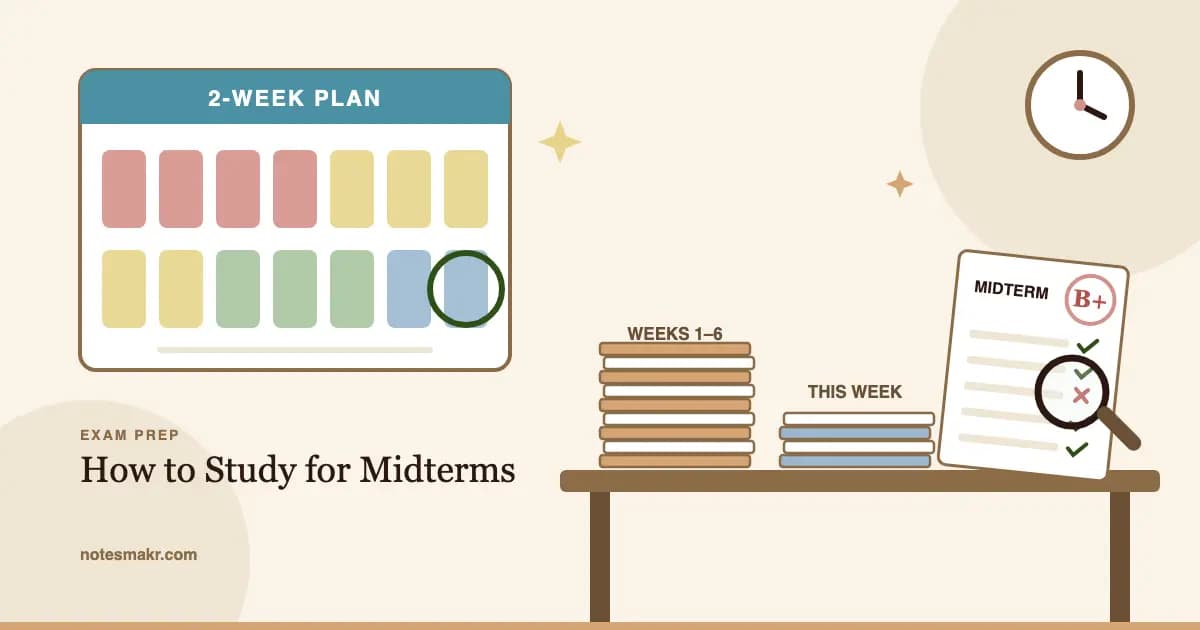
Here is the uncomfortable truth about midterms. The problem is not that you have too much to learn. The problem is that the course does not stop while you learn it. Lectures keep coming, problem sets keep coming, and the exam still covers week two.
If you want to know how to study for midterms without falling behind on everything else, you need a plan built for that overlap. Finals advice assumes classes are over and you can review all day. Midterm season gives you no such gap. You are reviewing old material and learning new material in the same week, often for three or four courses at once.
This guide gives you a two-week midterm study plan that runs alongside your normal classes, a one-week fallback if you are starting late, and the step almost every student skips: using your midterm score to fix the second half of the term.
What Makes Midterms Different From Finals?
A midterm is an exam given partway through a course, usually covering everything taught up to that point. In most US colleges midterm season runs from late September to early November, and many courses hold one or two midterms before the final.
Three things make midterms a different problem from finals:
- You are still learning new material. The course keeps moving during midterm week. Every hour you spend reviewing is an hour you are not spending on this week's lecture, so the plan has to protect both.
- It is often your first look at the professor's question style. Before the first midterm, you do not know whether this professor writes recall questions, applied problems, or long written answers. That uncertainty is why past papers and practice problems matter more now than at any other point in the term.
- The score is a diagnostic, not just a grade. A midterm tells you which of your study habits work in this course while there is still time to change them. A final tells you when it is too late.
If you are preparing for end-of-term exams instead, the finals study guide covers the different problem of reviewing a whole course at once.
Why Most Midterm Prep Fails
Most students study for midterms the same way: nothing until the weekend before, then long sessions of re-reading notes and slides, ending with a late night before the exam.
The research says each part of that habit works against you.
In a survey of 324 undergraduates, Hartwig and Dunlosky (2012) found that low-performing students were more likely to study late at night than high performers, and that all students, especially low performers, scheduled their studying around whatever deadline was closest. Students who used self-testing had higher GPAs.
A larger review by Dunlosky and colleagues (2013) rated ten common study techniques. Only two earned the top rating: practice testing and distributed practice (spreading study out over time). Re-reading and highlighting, the two things students do most before a midterm, were both rated low utility.
There is a third trap that matters more for midterms than for finals. Re-reading slides makes the material feel familiar, and familiarity feels like knowing. That is the illusion of competence. It is especially dangerous early in a course, because you have no exam results yet to tell you it is an illusion.
Feeling ready is not evidence. Answering questions you have not seen before, without your notes, is evidence.
How Many Days Before a Midterm Should You Study?
For most college midterms, start focused review 10 to 14 days before the exam, in sessions of 45 to 90 minutes on most days. Spreading the same hours over two weeks beats cramming them into two days, because spaced study is retained far longer. Cepeda and colleagues (2006) reached that conclusion across hundreds of spacing experiments.
How much you need depends on where you are starting:
| Your situation | When to start | Daily time |
|---|---|---|
| Kept up with lectures and problem sets | 7 to 10 days out | 45 to 60 minutes per course |
| Behind on one or two weeks of material | 14 days out | 60 to 90 minutes per course |
| Behind in several courses, or a heavy STEM midterm | 14 to 21 days out | 90 minutes, split into two sessions |
| Three or more midterms in one week | 14 days out, staggered by exam date | Rotate courses daily |
One more reason to start early: sleep. In a study of 88 students in an introductory chemistry course, Okano and colleagues (2019) tracked sleep with wearable devices and compared it with quiz and midterm scores. Sleep on the single night before a test showed no relationship with the score. Sleep quality and duration over the week and month before the test did. An all-nighter cannot make up for that, and a two-week plan does not need one.
Your 2-Week Midterm Study Plan
This plan runs alongside your normal classes. It assumes about 60 to 90 minutes a day per course you are preparing for, and it keeps 20 minutes a day for this week's new material so you do not fall behind.
Find out exactly what is covered. Check the syllabus, the course page and any review sheet. If the scope is unclear, ask the professor or TA directly: which weeks, which question types, and whether it is open or closed book.
Then list every topic on one page. That list is your study plan. Mark each topic red (don't understand it), amber (understand it but can't do problems), or green (can do problems without notes).
Start with the oldest red topics, because week-two material has had the longest to fade. For each one, rework the lecture example without looking at the solution, then do two practice problems. If a topic is still red after that, take it to office hours this week, not the day before the exam.
Keep 20 minutes a day for this week's lecture. That is the part of the plan that stops midterm season from wrecking the second half of the course.
Switch from learning to testing. Do practice problems, past papers or end-of-chapter questions, mixed across topics rather than one topic at a time. Mixing feels harder, and it works better. Rohrer and Taylor (2007) found that interleaved math practice produced much better delayed-test scores than blocked practice.
Write every mistake into an error log: the question, why you got it wrong, and the correct method. The practice tests guide shows how to get the most from each set.
Take one past midterm or a self-made practice exam under real conditions: timed, no notes, no phone. Mark it honestly. Then spend the next two days only on what the practice exam exposed, using your error log as the to-do list.
Review your error log and a short set of flashcards on definitions and formulas. Stop studying new material. Go to bed at your normal time. The work is already done, and sleep is part of the plan, not a break from it.
If you have several midterms, give each course its own slot in the day and rotate. The study schedule guide shows how to block the time so it actually happens.
How to Study for a Midterm in One Week
Started late? A week is enough for most midterms if you cut everything that is not practice.
- Day 1: Map the exam and rate every topic red, amber or green, as above. Be ruthless. You will not have time for green topics.
- Days 2 to 4: Red topics only. For each, one worked example and two practice problems. No re-reading full chapters.
- Days 5 and 6: Mixed practice questions and one timed practice exam. Log every mistake.
- Day 7: Error log and flashcards only. Normal bedtime.
Two sessions of 60 to 90 minutes a day is realistic for one course. If you only have a night or two, the last-minute exam guide covers how to triage when a full week is not an option. Treat that as an emergency plan, not the default.
Watch: Exam Study That Actually Works
How to Study for Exams: An Evidence-Based Masterclass, Ali Abdaal
A former medical student walks through the study methods he used, built around active recall and spaced repetition. Key insight: test yourself from the start instead of saving practice questions for the end, because testing is how you learn, not just how you check.
Study Less, Study Smart, Marty Lobdell
A psychology professor's lecture on why long study sessions waste time. Key insight: study in short focused blocks with real breaks, and check whether you can recall an idea, not just recognise it. Both habits fit neatly into a midterm plan that runs alongside your classes.
The Cram Weekend vs the Two-Week Plan
Same student. Same hours. Different midterm.
Two weeks before: Keeps up with new lectures. Doesn't touch old material.
The weekend before: Twelve hours over Saturday and Sunday re-reading slides and highlighting notes. Skips the problem set due Monday to make time.
Night before: Up until 3 a.m. on the last three topics.
Result: Recognises most of the material but can't start two of the applied problems. Falls a week behind in the course afterwards.
Two weeks before: Maps the exam, rates topics, books office hours for the two red ones.
Days 5 to 12: An hour a day of mixed practice and a timed practice exam, plus 20 minutes on this week's lecture.
Night before: Error log, flashcards, bed at 11.
Result: Has already seen the applied problem types. Still up to date in the course the following week.
The difference is not effort. It is that one plan tested the material and the other only looked at it.
Quick Reference: Midterm Situations
| Situation | What to do |
|---|---|
| You have no idea what the questions will look like | Ask for past midterms or sample questions in week one of your plan, and go to office hours |
| Three midterms in one week | Start 14 days out, order courses by exam date, rotate them daily |
| The midterm is open book | Still practise without notes. Open-book exams punish students who have to look everything up |
| You are behind on lectures | Catch up on the oldest material first, then keep 20 minutes a day for the newest |
| You only have 2 days | Practice questions and error log only. No re-reading |
| You already took the midterm | Do the post-midterm review below before the next lecture |
After the Midterm: Use Your Score
This is the step almost no midterm guide covers, and it is the one that most changes your final grade.
When the graded midterm comes back, most students look at the number and file the paper. Instead, take fifteen minutes and answer three questions. Carnegie Mellon learning scientist Marsha Lovett calls this an exam wrapper, and describes it in her chapter Make Exams Worth More Than the Grade (Lovett, 2013):
- How did you prepare? List what you actually did and roughly how many hours each took.
- What kinds of mistakes did you make? Sort every lost mark: didn't know it, knew it but misread the question, ran out of time, careless error.
- What will you do differently before the next exam? One or two concrete changes.
Be honest about the evidence: exam wrappers have been studied less rigorously than practice testing, and results vary between courses. But the logic is the same as the error log. Your midterm is the most accurate practice test you will get all term, because the person who writes the final wrote it. Treat it as data.
If most of your lost marks were "didn't know it", you need more practice testing. If they were "knew it but misread", practise timed questions. If they were "ran out of time", do a full timed practice exam before the final. The exam study guide covers each fix in more depth.
How Notesmakr Helps You Study for Midterms
Notesmakr is an AI-powered notes maker that turns your notes, lecture slides and PDFs into flashcards, quizzes, mind maps and study guides. For a midterm plan built on practice instead of re-reading, here is what fits:
- Free: manual and cloze flashcards. Turn the first half of the syllabus into cards as you go: definitions, formulas, key dates. Cloze (fill-in-the-blank) cards use diminishing cues, revealing letter hints less and less as your recall improves, based on Fiechter and Benjamin's (2017) research showing 44% better retention.
- Free: SM-2 spaced repetition. Cards are scheduled automatically, so week-two material comes back before the exam instead of fading while you learn week six.
- Free: Focus Timer. The classic 25/5/15 Pomodoro cycle gives each study block a clear start and stop, which helps when you are fitting review around classes.
- Free within limits: AI quizzes and study guides. Upload lecture slides or a PDF chapter and generate practice questions or a condensed study guide from it. The free plan gives you 5 AI notes and 40 AI generations, so point them at your hardest course first; Scholar raises the limits.
To turn a chapter into practice questions quickly, use the AI quiz maker. To condense a long set of lecture notes, try the study guide generator. If you are new to building decks, the complete guide to AI flashcards walks through the whole process.
Common Midterm Study Mistakes (And How to Fix Them)
Mistake 1: Pausing the course to study for the exam
Skipping this week's lectures and problem sets to review feels sensible. It means you start the second half of the term behind.
The fix: Keep 20 minutes a day for new material, every day of your plan.
Mistake 2: Re-reading slides as your main method
Slides are written to be recognised, not recalled. Reading them again builds familiarity, not the ability to answer a question.
The fix: Close the slides and work problems. Use slides only to check answers.
Mistake 3: Not finding out what the exam covers
Students lose hours on topics that are not on the midterm, or miss a whole unit that is.
The fix: Confirm the scope and question types on day one. Ask if it is unclear.
Mistake 4: Studying one topic at a time until the end
Blocked practice tells you which method to use before you start. The exam will not.
The fix: Mix topics in your practice sets from day 5 onward.
Mistake 5: Pulling an all-nighter
The one-night sleep debt does not help, and the habit of late studying is linked with lower grades.
The fix: Finish new material by day 12. The last two days are light review and normal sleep.
Mistake 6: Ignoring the graded midterm
The score arrives, you feel good or bad about it, and nothing changes.
The fix: Do the three-question exam wrapper before your next lecture in that course.
The Research Behind This Plan
This plan is built on applied cognitive science, not study hacks:
- Practice testing and distributed practice (Dunlosky, Rawson, Marsh, Nathan and Willingham, 2013): Of ten techniques reviewed, these two were rated high utility. Re-reading and highlighting were rated low.
- Study habits and GPA (Hartwig and Dunlosky, 2012): In a survey of 324 undergraduates, self-testing was associated with higher GPA, and low performers were more likely to study late at night.
- The testing effect (Roediger and Karpicke, 2006): Students who practised retrieval remembered substantially more a week later than students who re-studied for the same time. Read the study.
- Distributed practice (Cepeda, Pashler, Vul, Wixted and Rohrer, 2006): Across hundreds of experiments, spaced study beat massed study.
- Interleaved practice (Rohrer and Taylor, 2007): Mixed math practice produced much better delayed-test scores than blocked practice.
- Sleep and exam performance (Okano, Kaczmarzyk, Dave, Gabrieli and Grossman, 2019): Sleep across the week and month before a test was associated with better scores; sleep on the night before was not.
- Exam wrappers (Lovett, 2013): Short post-exam reflections that ask students how they prepared, what errors they made, and what they will change.
For the methods behind these findings, read the guides on active recall and spaced repetition.
Frequently Asked Questions
How many days before a midterm should I start studying?
Start focused review 10 to 14 days before most college midterms, studying 45 to 90 minutes a day for each course. Start closer to three weeks out if you are behind or have several midterms in one week. Spreading the same hours over two weeks is retained far longer than cramming them into two days.
How do I study for a midterm in one week?
Spend day one mapping what the exam covers and rating each topic. Use days two to four on the topics you understand least, with worked examples and practice problems. Use days five and six for mixed practice and a timed practice exam, then spend the final day on your error log, flashcards and a normal night's sleep.
What is the best way to study for midterms?
Practice testing and spaced study are the two methods with the strongest research support. Answer practice questions without your notes, mix topics within each session, log every mistake, and spread your study over about two weeks. Re-reading notes and highlighting feel productive but are rated low utility by learning researchers.
Should I pull an all-nighter before a midterm?
No. A study of college chemistry students found that sleep the night before a test was not related to the score, while sleep across the previous week and month was. An all-nighter costs you alertness during the exam without adding much learning. Finish new material two days early and sleep normally.
Are midterms harder than finals?
Not usually in content, since midterms cover less material. They feel hard because you are still learning new topics while reviewing old ones, and because the first midterm is often your first look at the professor's question style. Practice questions and past papers matter most for that reason.
Start Today
Here is your first week in concrete steps:
- Today: Write down the date of every midterm you have this term, and count back 14 days from each.
- Tomorrow: For your nearest midterm, list every topic on one page and rate each one red, amber or green.
- Day 3: Book office hours for your two reddest topics.
- Day 4: Block 60 to 90 minutes a day in your calendar, plus 20 minutes for new lectures.
- Day 5: Do your first session on your oldest red topic: one worked example, two practice problems, no notes.
- This weekend: Turn the week's definitions and formulas into flashcards and start reviewing them daily.
If midterms are your first exams at university, the college study guide covers the habits that make every exam after this one easier.
A midterm is not a verdict on how good you are at a subject. It is the first real feedback the course gives you, and the students who do best are the ones who use it.
"Learning is not attained by chance, it must be sought for with ardor and attended to with diligence."
— Abigail Adams