
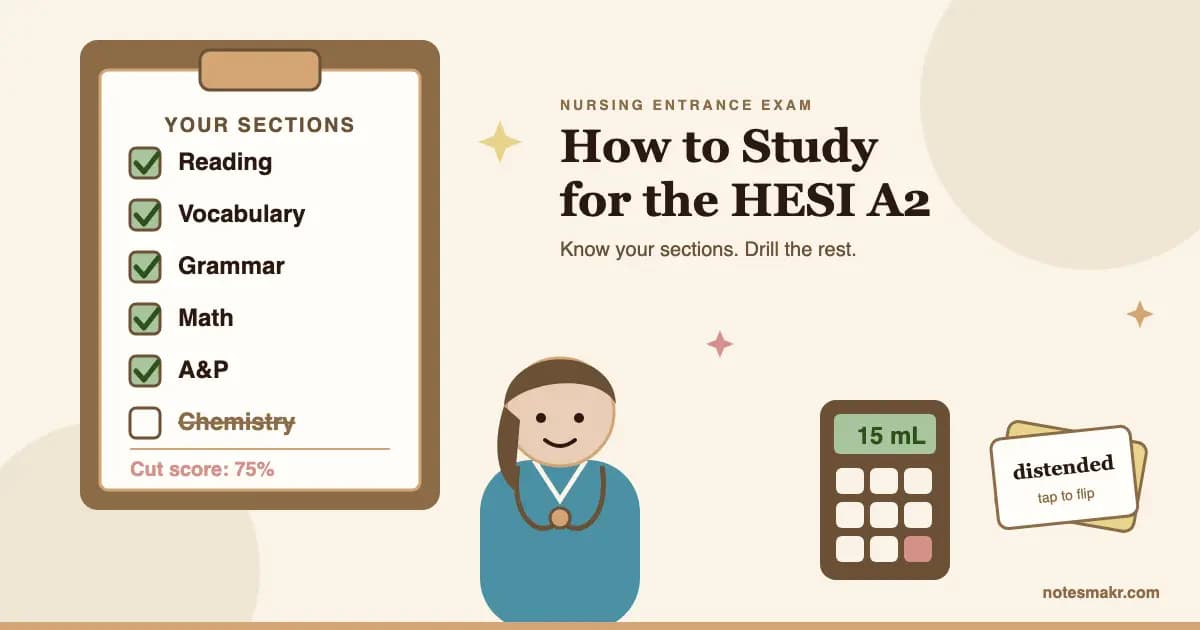
Here is the uncomfortable truth about how to study for the HESI. Two people can both say "I took the HESI A2" and have sat completely different exams. One took five sections. The other took eight. One needed 75% in each. The other needed an 85% composite with an extra bar on math.
That is because the HESI A2 is not one fixed test. It is a menu. Your nursing program picks which sections you take and sets its own passing score. So the most common study mistake is not lack of effort. It is studying hard for an exam you were never going to sit.
This guide fixes that first. Then it gives you a section-by-section method built on retrieval instead of re-reading, a 6-week plan you can compress, and the specific traps (vocabulary, conversions, a tiny A&P section) that decide most HESI scores.
What Is the HESI A2?
The HESI A2 (HESI Admission Assessment) is an entrance exam published by Elsevier that many US nursing and allied-health programs use to screen applicants. It measures the academic skills a program thinks you need on day one: reading, vocabulary, grammar, math, and, depending on the school, science.
Here is the menu schools choose from, with the item counts and times published by the colleges that administer it:
| Section | Items | Scored items | Time |
|---|---|---|---|
| Reading Comprehension | 55 | 50 | 60 min |
| Vocabulary and General Knowledge | 55 | 50 | 50 min |
| Grammar | 55 | 50 | 50 min |
| Math | 55 | 50 | 50 min |
| Anatomy and Physiology | 30 | 25 | 25 min |
| Biology, Chemistry (if your school requires them) | 30 each | 25 each | 25 min each |
| Learning Style and Personality Profile | 14 and 15 | Not scored | 15 min each |
Sources: South Texas College, "HESI Admission Assessment Info and FAQs", Western Technical College HESI A2 guide, and Tarrant County College HESI A2 exam information.
Four facts in that table should shape your whole plan:
- Every section carries 5 unscored pilot items. You can't tell which ones they are. So never sink three minutes into one brutal question. It may not count.
- The science sections are small. Anatomy and Physiology has only 25 scored questions. Each miss costs you 4 percentage points on that section.
- Math gives you a calculator. Both Tarrant County College and Western Technical College state an on-screen calculator is available. Your job in math is setting the problem up, not arithmetic.
- The two profile sections are diagnostic only. They don't affect your score. Answer honestly and move on.
Step 0: Find Out Which HESI You Are Taking
Before you buy a book or open a single practice set, answer three questions. Your program's admissions page, nursing advisor, or application packet will have the answers.
- Which sections are required? Many programs require only the English sections, Math, and Anatomy and Physiology. Some add Biology and Chemistry. Tarrant County College states plainly that "individual programs will determine the sections required for application."
- What is the cut score, and how is it calculated? Some schools want 75% on every section. Some average sections into a composite. South Texas College, for example, requires 75% or higher on each section, then averages an English composite, a science score, and a math score to award application points.
- What is the retake policy? It varies more than you'd expect. Tarrant County College requires 60 days between attempts. South Texas College allows a retest after a 2 to 3 week wait, then makes you wait for the next eligibility period after a second fail.
Here's why the scoring method matters so much. If your school averages sections, a strong reading score can carry a weak grammar score. If it requires a minimum on each section, it can't. One 72% sinks the whole application no matter how well you did elsewhere. Those two rules call for two different plans.
Why Most HESI Study Plans Fail
Most HESI plans look the same: buy the official review book, read it front to back, take one practice test the week before. It feels thorough. It is the slowest possible route.
The problem is a mismatch between how you prepare and what the exam asks. Reading a chapter builds recognition: the warm feeling that you've seen this before. The HESI asks for recall under a clock: 55 math questions in 50 minutes, 55 vocabulary items in 50 minutes. Recognition collapses under that pressure.
Re-reading tells you what you've seen. Testing tells you what you know. The HESI only rewards the second one.
The research on this is unusually clear. When Dunlosky and colleagues (2013) rated ten common study techniques, only two earned a "high utility" rating: practice testing and distributed practice. Re-reading and highlighting both rated low. Roediger and Karpicke (2006) found that students who were tested on a passage remembered substantially more a week later than students who spent the same time re-studying it.
So the HESI plan below is built the other way round. Questions first. Reading only to fix what the questions reveal.
How to Study Each HESI A2 Section
Each section rewards a different kind of practice. Treat them separately.
Vocabulary and General Knowledge: a closed word list
This is the section people underestimate most. The HESI vocabulary section uses words common in both everyday English and health-care settings, which means the pool is large but not infinite. Words like lethargic, exacerbate, bilateral, impending, occluded and distended come up because nurses actually use them.
That makes vocabulary the most "flashcard-able" section on the exam. Don't read word lists. Drill them.
- Put each word on a card with a health-care sentence on the back, not a dictionary gloss. "The patient's abdomen was distended after surgery" sticks better than "swollen."
- Learn prefixes and suffixes as their own cards: brady- (slow), tachy- (fast), hyper- (above), -itis (inflammation). One root unlocks dozens of words.
- Review on a spaced schedule so old words come back before you forget them. Our guide on how to memorize vocabulary walks through the method.
Reading Comprehension: train the question types, not the passages
Reading gets 60 minutes for 55 items, the most generous timing on the exam. Most lost points come from question types, not hard passages: main idea, author's purpose, inference, and meaning of a word in context.
Practise by question type. After each set, label every miss: was it a main-idea error, an inference you over-reached on, or a detail you misread? Patterns appear within two or three sets, and you fix the pattern rather than "doing more reading."
Grammar: rules you can test yourself on
HESI grammar covers parts of speech, common usage errors, and sentence structure. Almost every item reduces to a rule: subject-verb agreement, pronoun case (who vs whom, I vs me), commonly confused words (affect vs effect, their/there/they're), and comma use.
Rules are perfect for cloze cards: a sentence with the key word blanked out. "Neither the nurse nor the doctors ___ available" (answer: were) forces you to apply the rule, not recognise it.
Math: clinical conversions plus fractions and ratios
HESI math is built for health care. The topics CCRI's tutoring centre lists include order of operations, fractions, decimals and percentages, ratios and proportions, simple algebra and word problems, and conversions: metric to household, Celsius to Fahrenheit, and military to standard time. Roman numerals also appear.
The conversions are pure memory, so they belong on cards:
| Conversion | Value |
|---|---|
| 1 teaspoon | 5 mL |
| 1 tablespoon | 3 teaspoons (15 mL) |
| 1 fluid ounce | 30 mL |
| 1 cup | 8 fluid ounces |
| 1 kilogram | 2.2 pounds |
| 1 inch | 2.54 cm |
Source: CCRI Tutoring, HESI Math resources.
Everything else (fractions, ratios, word problems) is procedural, so it needs worked problems, not cards. If fractions and proportions feel shaky, rebuild them first with our guide to studying math. Ratio and proportion is the engine of every dosage problem you'll meet later in nursing school, so it's worth getting right now.
Anatomy and Physiology: small section, high cost per miss
With only 25 scored items, A&P is where a single gap does the most damage. The section covers general terminology and the major structures and systems. Prioritise:
- Directional and regional terms: anterior, posterior, proximal, distal, medial, lateral.
- Pathways: blood through the heart, air through the respiratory tree, food through the digestive tract.
- Organ-function pairs across all the major systems.
Pathways are where cloze cards shine: "Blood leaves the right ventricle through the ___" (answer: pulmonary valve). Our anatomy study guide has a system-by-system method.
If your school also requires Biology or Chemistry, give each a short block per week. Cell structure, cellular respiration and basic genetics dominate biology; atomic structure, the periodic table, bonding and balancing equations dominate chemistry.
How Long to Study for the HESI A2
Most applicants who already passed the prerequisite courses do well with 4 to 6 weeks of focused work at roughly 1 to 2 hours a day. If you've been out of school for years, or math was never your subject, plan for 8 weeks.
The right number depends on one thing: your diagnostic score. Take a timed practice test before you plan anything else, then use this table.
| Your diagnostic | Weeks to plan | Where the time goes |
|---|---|---|
| 85%+ on every required section | 2 to 3 | Timed mixed sets, weak-topic cards |
| 75 to 84% | 4 to 6 | Full plan below |
| Below 75% on one or more sections | 6 to 8 | Rebuild weak sections first, then full plan |
Your 6-week HESI plan
Take one timed practice test covering only your required sections. Mark every miss by topic. Start two decks: vocabulary (with prefixes and suffixes) and math conversions. Aim for 20 new vocabulary cards a day.
Spend half your time on your lowest section. Use the other half on 20-question mixed sets. Review cards daily. Don't skip review days to "learn new stuff."
Every practice set now runs on a clock that matches the real section pace: about 55 seconds per item for Math, Vocabulary and Grammar, about 65 seconds for Reading, and 50 seconds for A&P. Add A&P pathway cloze cards.
Interleave sections inside each session: 10 math, 10 grammar, 10 A&P, 10 vocabulary. It feels harder. That's the point. Mixed practice beat blocked practice clearly on a delayed test in Rohrer and Taylor's (2007) study.
Take a second full timed practice test under real conditions: one sitting, no phone, only an on-screen style calculator. Compare section by section with week 1. Move your remaining time to whatever didn't move.
No new material after Wednesday. Keep daily card reviews, do one short mixed set a day, and sleep normally the last three nights. Check your ID matches your registration name exactly.
HESI vs TEAS: Which Exam Are You Preparing For?
Some programs accept either the HESI A2 or the ATI TEAS, and many students prep for the wrong one. The two exams overlap, but they reward different things.
| HESI A2 | ATI TEAS 7 | |
|---|---|---|
| Publisher | Elsevier | ATI |
| Sections | Chosen by your school | Fixed four sections for everyone |
| Separate vocabulary section | Yes, 55 items | No |
| Math calculator | On-screen calculator | Basic on-screen four-function |
| Science | A&P, plus Biology and Chemistry if required | One 50-item section covering all sciences |
| Scoring rule | Set by your school (per section or composite) | Set by your school |
TEAS figures from ATI; see our TEAS study guide for the full breakdown.
The biggest practical difference is vocabulary. The TEAS doesn't give it a section of its own. The HESI gives it 55 items. If your program accepts both and your vocabulary is strong, that may tip your decision.
Watch: HESI Prep in Action
Sometimes it helps to see someone walk through the content. These two are worth your time.
HESI Admission Assessment Exam Review, RegisteredNurseRN
RegisteredNurseRN walks through HESI-style questions across math, anatomy and physiology and the other core sections. Use it actively: pause before each answer is revealed and commit to your own. The key insight: watching a solution is not the same as producing one, so treat every pause as a mini practice question.
HESI A2 Vocab: How to Pass and Words to Study, Smart Edition Nursing
Smart Edition Nursing focuses on the vocabulary section and the kinds of words to study for it. Keep a deck open while you watch and add every word you couldn't define on the spot. The key insight: the words you already half-know are the ones that cost points, because they feel familiar until you have to pick between four close options.
Passive Week vs Retrieval Week
Here is the same week of A&P and vocabulary prep done two ways.
Monday to Friday: Read the cardiovascular and respiratory chapters in the review book. Highlight key terms. Re-read the vocabulary list twice. Saturday: Watch a review video. Sunday: Take a practice quiz, score 64%, feel confused because "I studied all week."
Every hour was spent on recognition. Nothing forced recall, so nothing showed what was missing until the weekend.
Monday: 20-question A&P set first, cold. Read only the pages behind the misses. Turn each miss into a cloze card. Tuesday to Friday: 15 minutes of card review, then a 20-question mixed set, then fix misses. Saturday: Timed mini-test on everything from the week. Sunday: Rest, plus review.
Every session starts with a question. Gaps surface on Monday, not Sunday, and get fixed the same day.
Same hours. Very different week. The second one also tells you exactly what to do next, which the first never does.
Quick Reference: What to Do With the Time You Have
| Time until test | What to do |
|---|---|
| 8+ weeks | Diagnostic, then rebuild weakest section, then 6-week plan |
| 6 weeks | Full plan above |
| 3 weeks | Diagnostic, weakest two sections, daily timed mixed sets, daily card review |
| 1 week | Conversions and vocabulary cards daily, one timed set per required section, sleep |
| Night before | Light card review only. Check ID, route, start time |
How Notesmakr Helps You Study for the HESI
Notesmakr is a notes maker that turns your prep-book pages, A&P notes and word lists into flashcards, quizzes and study guides, built around the Feynman Technique of explaining things simply. For an exam that rewards recall, here is what maps to what:
- Free: manual and cloze flashcards. Cloze cards suit grammar rules, A&P pathways and vocabulary-in-context sentences. Notesmakr's diminishing-cues system reveals letter hints as your recall improves, based on Fiechter and Benjamin's (2017) research showing 44% better retention than standard cards.
- Free: SM-2 spaced repetition. The vocabulary you learned in week 1 comes back in week 3 before you forget it, without you tracking anything.
- Free: Focus Timer. The 25/5/15 cycle fits the "set first, then review" blocks in the plan.
- Free: revision plan. Set your HESI date and the app spreads study sessions across the days before it, with daily reminders.
- Free within limits: AI quizzes and flashcards from a PDF. Upload a prep-book chapter and generate practice questions or a deck in seconds. The free plan gives you 5 AI notes and 40 AI generations; Scholar raises the limits.
To turn a chapter into questions fast, use the AI quiz maker or the PDF to flashcards tool. If you're new to building decks, the complete guide to AI flashcards covers what makes a good card.
Common HESI Mistakes (And How to Fix Them)
Mistake 1: Studying sections your school doesn't require
Hours on chemistry for a program that only scores English, Math and A&P are hours stolen from the sections that decide your application.
The fix: Do Step 0 before anything else. Write your required sections on the first page of your notebook.
Mistake 2: Treating vocabulary as "general knowledge"
The section name sounds like something you either know or don't. It isn't. The word pool leans heavily on health-care language, and it rewards drilling.
The fix: 20 new cards a day with health-care sentences, plus daily spaced review. Five days a week, that's about 600 words across the 6-week plan.
Mistake 3: Skipping the conversion table
Students who are good at math lose easy points to "how many mL in 2 tablespoons?" because they never memorised that a tablespoon is 15 mL.
The fix: Put every conversion on a card in week 1. Drill until each one takes under two seconds.
Mistake 4: Under-weighting a 25-question section
A&P looks small, so it gets the least time. But each miss is worth 4 points on that section, and many schools put it in your composite.
The fix: Give A&P a short daily slot from week 1, focused on pathways and directional terms.
Mistake 5: Never practising at full length
The HESI runs for hours in one sitting. Students who only ever practise 20-question sets fade badly in the last sections.
The fix: Do at least two full-length timed practice tests, the second in week 5. Our guide to practice tests as a study technique explains how to review them so they teach you something.
The Research Behind This Plan
Every part of this plan rests on well-replicated learning research:
- Practice testing and distributed practice rank highest (Dunlosky, Rawson, Marsh, Nathan and Willingham, 2013): Of ten common techniques reviewed, only these two earned a "high utility" rating. Re-reading and highlighting rated low.
- The testing effect (Roediger and Karpicke, 2006): Students tested on a passage retained substantially more a week later than students who re-studied it for the same time. Read the study.
- Distributed practice (Cepeda, Pashler, Vul, Wixted and Rohrer, 2006): A review of 184 articles on spacing found spaced study beat massed study across the retention intervals tested.
- Interleaved practice (Rohrer and Taylor, 2007): Mixing problem types in practice produced much better delayed-test scores than blocked practice, even though it felt harder.
- Diminishing cues (Fiechter and Benjamin, 2017): Progressive letter hints on cloze cards produced 44% better retention than standard cards.
For the underlying methods in full, read our guides to active recall and spaced repetition.
Frequently Asked Questions
How long should you study for the HESI A2?
Most applicants need 4 to 6 weeks at 1 to 2 hours a day. Take a timed diagnostic first. If you score 85% or higher on every required section, 2 to 3 weeks of timed practice may be enough. If any section is below 75%, plan 6 to 8 weeks and rebuild that section first.
What sections are on the HESI A2?
Elsevier offers Reading Comprehension, Vocabulary and General Knowledge, Grammar, Math, Anatomy and Physiology, Biology, Chemistry, and unscored learning style and personality profiles. Your nursing program chooses which sections you take. Many require the English sections, Math, and Anatomy and Physiology, so check your program before you start studying.
What is a passing score on the HESI A2?
There is no single passing score. Each program sets its own. Many set the bar at 75%, either on every section or as a composite average, and some competitive programs set it higher. Check whether your school averages sections or requires a minimum on each, because that changes your plan.
Is the HESI A2 harder than the TEAS?
Neither is clearly harder. They test different things. The HESI A2 has a full 55-item vocabulary section and lets your school choose the sections, while the TEAS uses four fixed sections for everyone and one combined science section. Students with strong vocabulary often find the HESI more manageable.
Can you use a calculator on the HESI A2 math section?
Yes. Colleges that administer the HESI A2, including Tarrant County College and Western Technical College, state that an on-screen calculator is available during the exam. That means accuracy comes from setting problems up correctly, especially conversions and proportions, rather than from mental arithmetic.
Start Today
- Find your three numbers. Required sections, cut score rule, retake wait. Write them down.
- Take a timed diagnostic on only your required sections. Mark every miss by topic.
- Build your conversion deck tonight. It's under 20 cards and it's free points.
- Start 20 vocabulary cards a day with health-care sentences on the back.
- Begin every study session with questions, then read only what your misses point to.
- Book a full-length practice test for week 5 now, so it actually happens.
"Success is the sum of small efforts, repeated day in and day out."
— Robert Collier, author