
To find knowledge gaps when you study, stop counting hours and start comparing time with results. Here's the uncomfortable truth: the chapter you spent the most time on is rarely the chapter that will cost you marks. The costly one is the chapter you avoided, the one you only skimmed, or the one you reread five times and still can't explain.
You can't see that from the inside. Rereading feels like learning. Familiar material feels known. So you keep studying what feels good, and the gaps stay exactly where they were.
This guide shows you how to catch them. You'll learn a five-step loop built on techniques with real evidence behind them, and how to feed it with your own study data. Notesmakr is an AI-powered notes maker that turns your material into notes, flashcards, quizzes and mind maps. Its Study insights page shows where your time went, so you can run the loop with numbers instead of guesses.
What is a knowledge gap?
A knowledge gap is a specific idea you believe you understand but can't produce from memory when you need it. It is not "I'm bad at biology." It is "I can't explain how light-dependent reactions feed the Calvin cycle."
The difference matters. A vague weakness is overwhelming. A named gap is a small job you can finish in an evening.
Gaps hide because of the gap between recognition and recall. Recognising a right answer on a page is easy. Producing it from nothing is hard. Most students test recognition (reading, highlighting, rereading) and then get surprised when the exam asks for recall.
Feeling stuck is not the same as being weak. A topic is weak when it keeps costing you marks every time you test yourself, however it feels while you read it.
Why hours studied is a poor signal
If hours predicted learning, the student with the longest timetable would always win. They don't, because what you do with the hours matters far more than how many you log.
Dunlosky and colleagues reviewed ten popular study techniques and rated how useful each is. Practice testing and distributed practice (spacing your study over time) received the highest utility rating. Rereading, highlighting and summarising were rated low (Dunlosky et al., 2013). Those low-rated methods are also among the most common things students actually do.
| Technique | Utility rating (Dunlosky et al., 2013) | What it feels like |
|---|---|---|
| Practice testing | High | Hard, a bit uncomfortable |
| Distributed practice | High | Slower than cramming |
| Rereading | Low | Smooth and reassuring |
| Highlighting | Low | Productive |
| Summarising | Low | Tidy |
Source: Dunlosky, Rawson, Marsh, Nathan & Willingham (2013), "Improving Students' Learning With Effective Learning Techniques", Psychological Science in the Public Interest.
There is a second trap. In a classic experiment, Roediger and Karpicke (2006) had students either restudy a passage or take recall tests on it. Restudying helped on a test five minutes later. But testing led to much better retention on tests two days and one week later, even though restudying made students feel more confident. The method that felt best was not the method that worked best.
That is why a minutes-only dashboard can mislead you, and why a good one puts time next to quiz scores. Time tells you where you sat. Scores tell you what stuck. For the full picture of how self-checking fits into learning, see our guide to metacognition for students and our post on practice tests.
What Study insights shows you
Study insights is a page in the Notesmakr app that shows where your study time went. It records time while you study notes, flashcards, quizzes, mind maps and Q&A in the app, and groups it by subject and chapter. It has two tabs: Topics (what you studied) and Focus (how your Focus Timer blocks went).
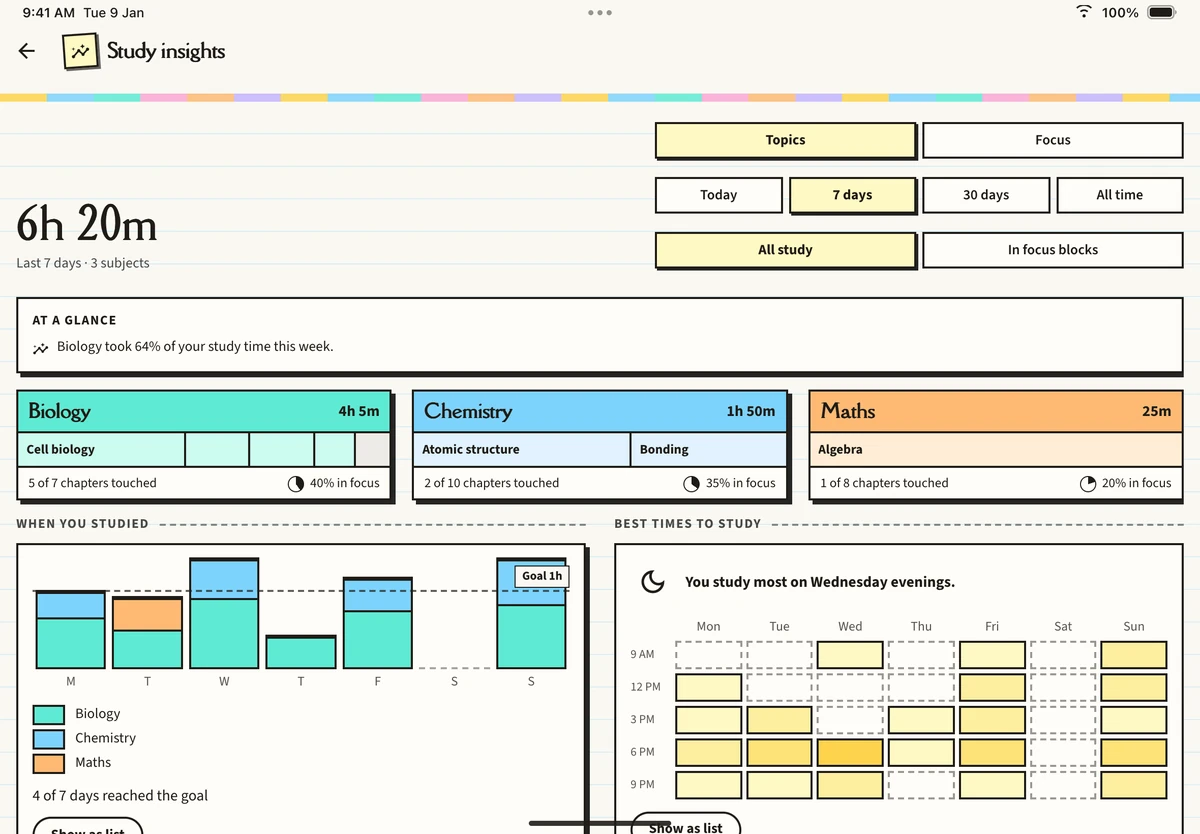
Example data for a fictional student, not a real account.
Here is what the Topics tab gives you:
- At a glance: one to three plain-language lines, such as which subject took most of your time.
- One card per subject: total time, a strip showing how time was split across chapters, and how many chapters you have touched.
- Range switches: Today, 7 days, 30 days or All time, plus a filter for time spent inside Focus Timer blocks.
- Extras: when you studied, how long your sessions were, and your best times of day.
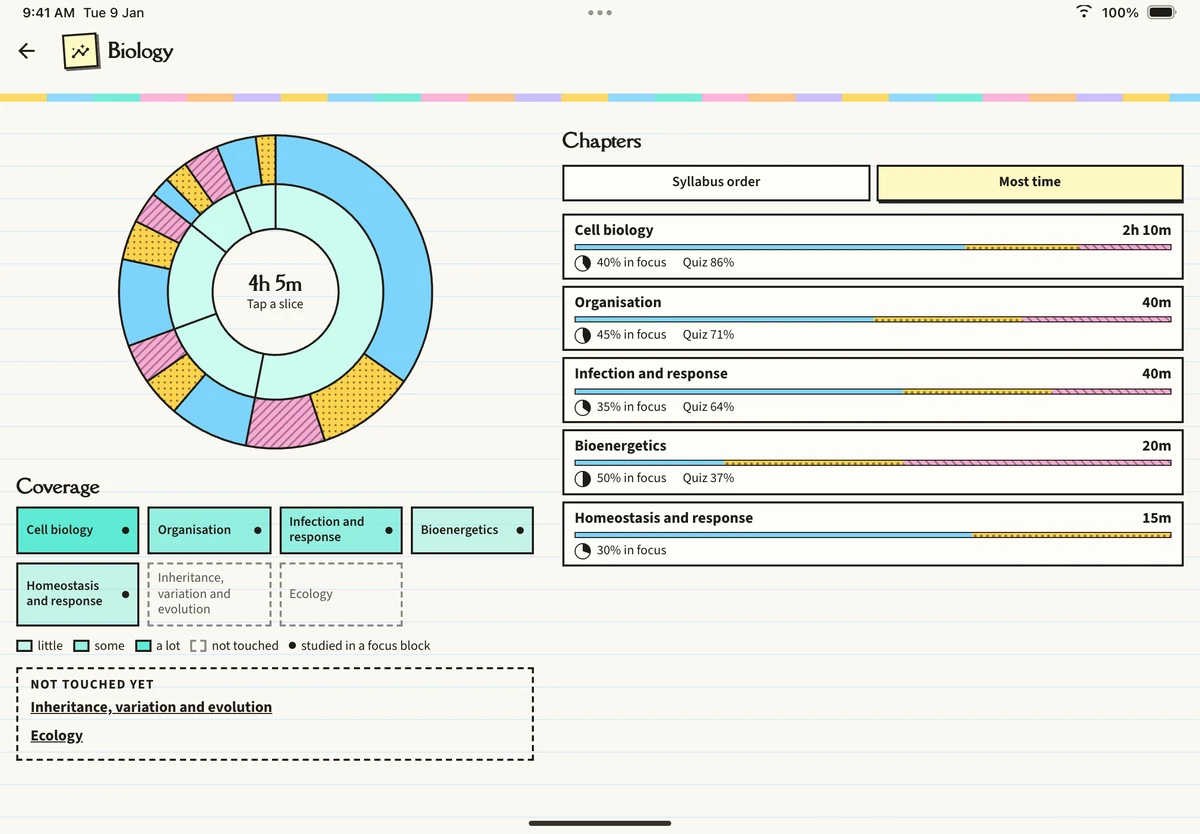
Drill into a subject and you get the chapters list with quiz percentages, a coverage map and a "Not touched yet" list. Drill into a chapter and you see time by activity, what you did, and an Effort vs result chart comparing minutes spent on a quiz with the score.
Can you trust the numbers?
Time counts only while you study in the app. It stops after a few minutes without touching the screen (five on reading pages, three on other study pages), and study within ten minutes of each other counts as one session. When the app is unsure, it under-counts rather than over-counts.
You control it. In Settings, under Study Settings, Track my study time is on by default and you can switch it off. Delete my study history clears it. The text you read or write is never saved. For a screen-by-screen tour, see the Study insights help article.
The 5-step gap-closing loop
This loop works with Study insights, with a spreadsheet, or with a notebook. The data just changes how fast you can run it.
Start with the big picture. Which subject took the most time? Which got almost none? Compare it with your 1 to 5 list from earlier. The first surprise is usually the point: you spent most of your week on what you already knew.
Look for three signals. A chapter with a low quiz score. A chapter in the "Not touched yet" list. A subject you haven't studied for a week or more. Any one of them is a candidate gap. Two together is almost always a real one.
Open the weakest chapter and ask one question: did I fail because I did too little, or because I did the wrong thing? Twenty minutes and three low scores means too little. Two hours and the same low scores means the method is wrong. Rereading is the usual culprit.
Review the questions you were sure about and still got wrong first. Butterfield and Metcalfe (2001) found that errors made with high confidence are the ones most likely to be corrected once you see the right answer. One explanation is that being surprised grabs your attention, though a later study suggests you may also partly know the right answer already (Metcalfe & Finn, 2011). And without feedback, errors don't fix themselves: in one of their experiments, final recall of the items people got wrong was only 4%.
Skip rereading. Instead:
- Quiz yourself on the gap chapter. A quick set from your notes, using the AI quiz maker, takes minutes.
- Make flashcards for the exact terms you missed with the PDF to flashcards tool, and read our AI flashcards guide for how to build good ones.
- Explain it blind. Close the notes and write what you know with the blurting method, or teach it simply with the Feynman technique.
- Come back on a schedule. One session isn't enough. Spacing matters, and the right gap depends on how long you need to remember. Cepeda and colleagues (2008) found the best gap was roughly 20 to 40% of the delay for a test one week away, falling to about 5 to 10% of the delay for a test a year away. Our rough reading: exam next week, revisit within a day or two. Exam in months, revisit every week or two. Put the revisit dates in a revision timetable so they actually happen.
A fix you don't measure is a hope. Next week, open the same chapter and check two things: did the quiz score move, and did the time look different? If the score hasn't moved, change the method, not just the hours. If it has, pick the next gap.
A worked example: Maya's three weeks
Maya is a fictional GCSE Biology student. Her numbers are invented to show how the loop reads, not to promise a result.
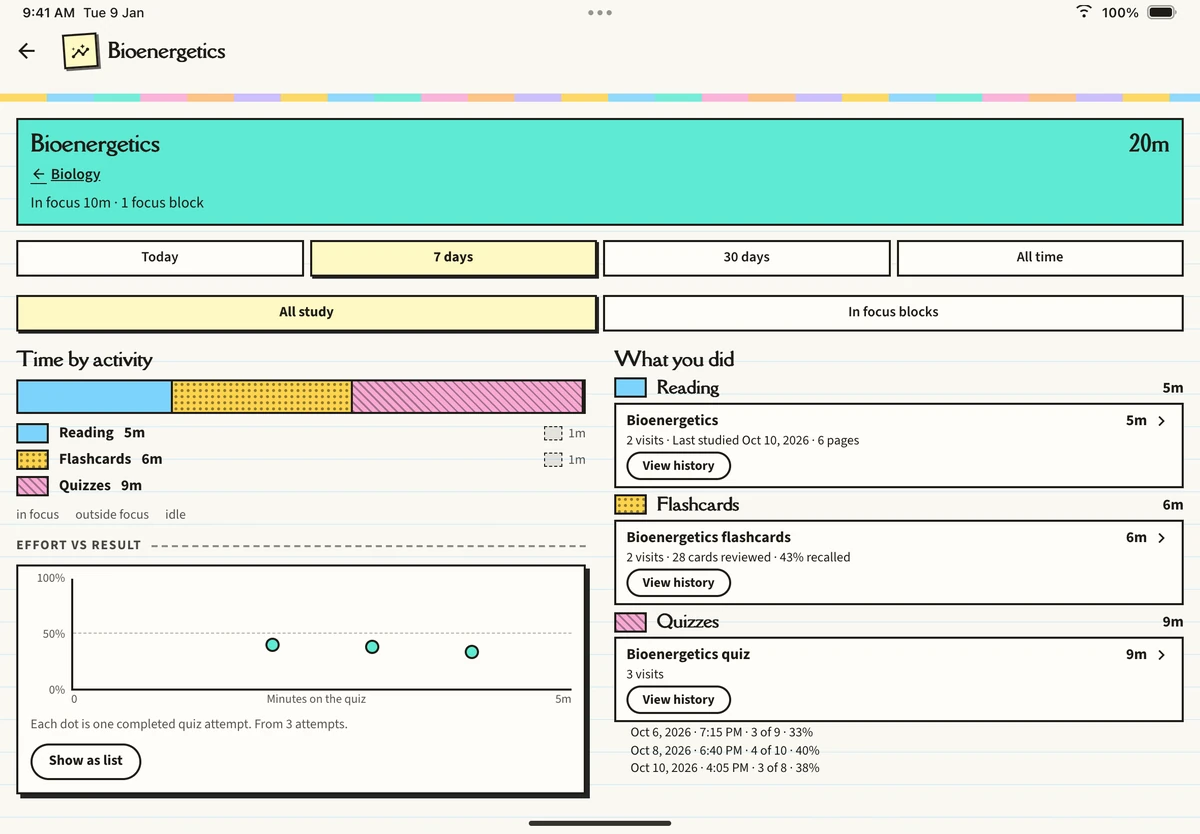
Week 1. She studied 6h 20m across Biology, Chemistry and Maths. Biology took 4h 5m, about 64% of her week. Of that, 2h 10m went into Cell biology, which she already knew well (quiz 86%). Bioenergetics got 20 minutes and three quiz scores of 33%, 40% and 38%, with flashcard recall at 43%. Two chapters, Inheritance and Ecology, were untouched.
Cell biology: 2h 10m, quiz 86%. Bioenergetics: 20m, quiz 38%.
Most of the time sat on the chapter she already knew. Her weakest chapter got the least attention, and two chapters weren't touched at all.
Bioenergetics: 1h 25m, latest quiz 81%. Biology quiz scores up 22 points.
She quizzed first, fixed the missed terms with flashcards, explained the process blind, and revisited it twice. Study insights showed the shift in both time and score.
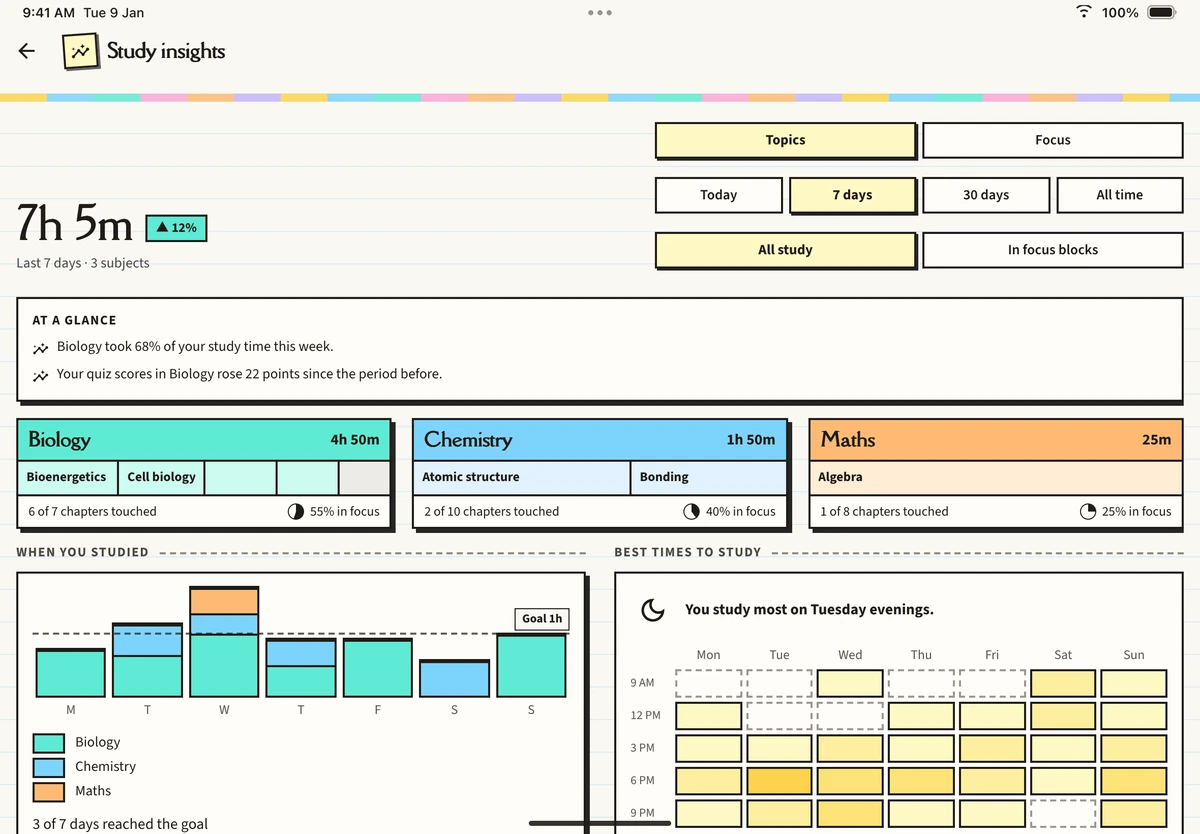
Example data for a fictional student, not a real account.
Notice what changed. Maya didn't study dramatically more: week 3 was 7h 5m against 6h 20m. She moved the same effort to a different place and swapped rereading for retrieval. The data didn't make her work harder. It told her where to point the work she was already doing.
Use the Focus tab to find your best block length
Timed study blocks are popular, and the 25-minute block is the famous one. But the 25-minute figure is a convention, not a law, and as far as we could find, research comparing block lengths directly is thin. In one controlled study of 87 university students, those who took their own breaks chose longer sessions and reported more fatigue and distraction and lower concentration and motivation than students on fixed schedules (24 minutes on, 6 off, or 12 on, 3 off). The groups did not differ in mental effort or task completion (Biwer et al., 2023). The takeaway isn't that 25 minutes is magic. It's that a planned break beat a self-chosen one in that study, and that the best block for you is something to test.
The Focus tab helps you test it. It shows how each Focus Timer block went, how much of each block you spent on a study page, and, once you have enough blocks, it compares your block lengths and your best times of day.
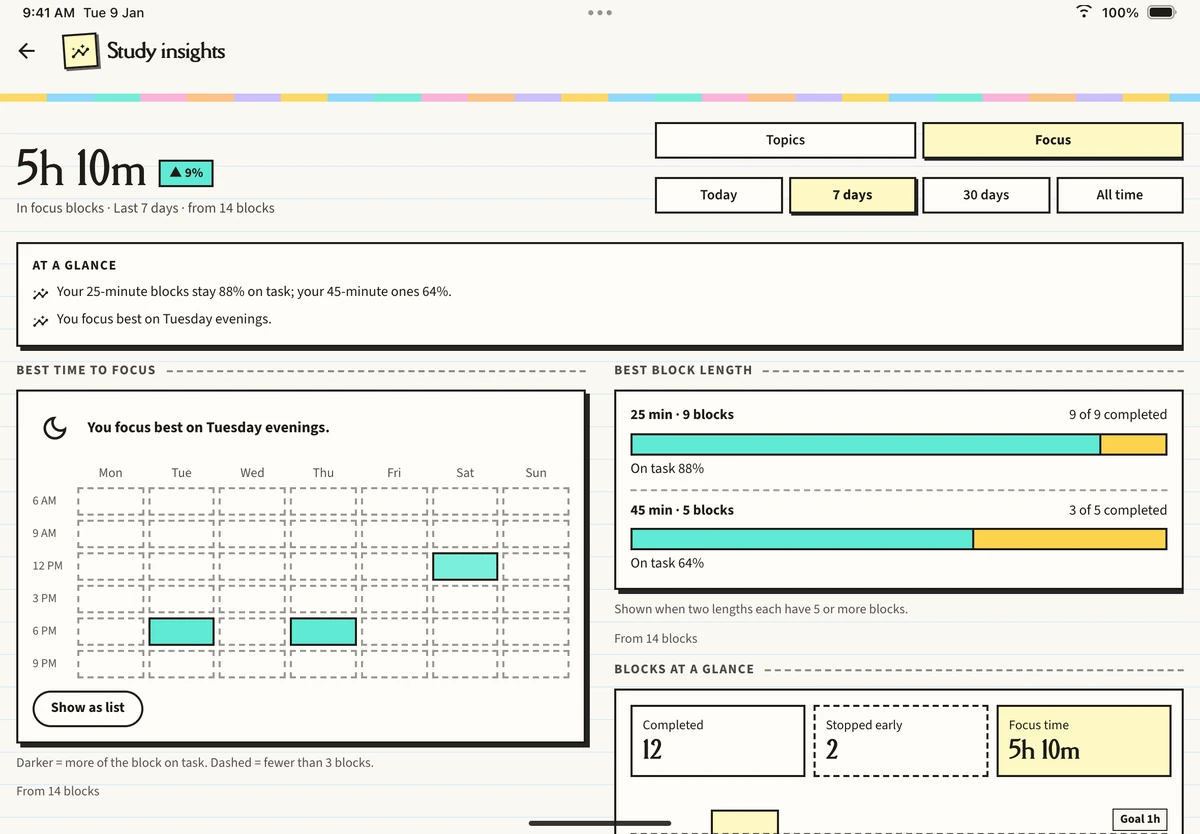
Example data for a fictional student, not a real account.
In Maya's example, her 25-minute blocks stayed 88% on task and her 45-minute blocks 64%. She also focused best on Tuesday evenings. So she planned her hardest topic for a 25-minute block on a Tuesday evening and kept longer blocks for lighter review.
Here is a two-week experiment you can run:
- Use 25-minute blocks for one week and a longer length for the next.
- Do similar work in both weeks, such as quizzing and flashcards.
- Compare the on-task share and how many blocks you stopped early.
- Keep the length that holds your attention, then adjust again next month.
Customising block lengths and the Focus analytics are part of a paid plan. Free users get the classic 25/5/15 cycle. For more on the technique itself, see our guides to the Pomodoro technique, a Pomodoro timer for studying and how to focus while studying.
Your 10-minute weekly review
The loop only works if you run it on a schedule. A short weekly review does that. It borrows from two ideas. Zimmerman (2002) describes self-regulated learning as a cycle of forethought (plan), performance (do and monitor) and self-reflection (review and adjust). And teachers use "exam wrappers", short reflections after a test about how you prepared, what errors you made and what you'll change. The evidence on them is mixed: the effect varies, especially for students with little practice at reflecting.
| Minute | What to do | Where to look |
|---|---|---|
| 1-2 | Read the summary: where did the week's time go? | Topics tab, 7 days |
| 3-4 | Pick one gap: lowest score or a "Not touched yet" chapter | Subject page |
| 5-6 | Check effort against result for that chapter | Chapter page |
| 7-8 | Choose the fix: quiz, flashcards, blurting or Feynman | Your notes |
| 9-10 | Book two revisit dates and set one reminder | Calendar or timetable |
Common mistakes (and how to avoid them)
Mistake 1: Chasing total hours
A bigger number feels like progress. The fix: Treat time as a cost, not a score. Ask what each hour bought: a higher quiz result, a covered chapter, a fixed gap.
Mistake 2: Only studying what you're good at
Strong chapters feel rewarding, so you return to them. The fix: Start each session with the weakest chapter while your energy is highest, and finish with something comfortable.
Mistake 3: Reading the chart once
One look tells you where you are. It doesn't tell you whether anything changed. The fix: Compare the same range week to week and look at the direction, not the single number.
Mistake 4: Ignoring the quality of your time
An hour with your phone beside you isn't an hour on task. The fix: Use Focus blocks for hard topics and check how much of each block was actually spent studying.
Mistake 5: Fixing a gap with rereading
If a chapter's score didn't move after a lot of time, more reading won't help. The fix: Switch to retrieval: quiz, flashcards, blurting, then space your revisits.
Mistake 6: Treating the data as the goal
Numbers are a mirror, not a prize. The fix: The goal is the exam, or the skill. Use the data to decide what to do next, then close the app and do it.
Quick reference: what the signal means
| Signal in your data | What it usually means | What to do next |
|---|---|---|
| Lots of time, low quiz score | Method problem, probably rereading | Switch to quizzing and blurting |
| Little time, low quiz score | Not enough exposure yet | Add short, spaced sessions |
| Chapter in "Not touched yet" | Hidden gap | Take a quiz first to size it |
| Strong score, still a lot of time | Over-studying a strength | Move the time elsewhere |
| Blocks often stopped early | Block is too long, or distractions | Test a shorter block |
| Score up, time down | The method is working | Keep it, add spacing |
Watch: more on studying with evidence
Two videos that sit well alongside this guide.
Justin Sung on metacognition
This one is about the habit behind the whole loop: noticing how you learn and changing what isn't working.
Ali Abdaal on evidence-based revision
A good cross-check for the techniques in this guide: testing yourself and spacing your study.
The research behind it
- Practice testing and spacing (Dunlosky et al., 2013): Of ten common techniques, practice testing and distributed practice received the highest utility ratings, while rereading, highlighting and summarising were rated low. Psychological Science in the Public Interest, 14(1), 4-58.
- The testing effect (Roediger & Karpicke, 2006): Taking recall tests produced better retention after two days and one week than restudying, even though restudying felt more confident. Psychological Science, 17(3), 249-255.
- Spacing (Cepeda et al., 2008): The best gap between study sessions rises with how long you need to remember, and falls as a share of that delay. Psychological Science, 19(11), 1095-1102.
- Hypercorrection (Butterfield & Metcalfe, 2001): Errors committed with high confidence are more likely to be corrected after feedback. Journal of Experimental Psychology: Learning, Memory, and Cognition, 27(6), 1491-1494.
- Errors need feedback (Metcalfe & Finn, 2011): Without feedback, final recall of high-confidence errors stayed very low, so they did not correct themselves. Journal of Experimental Psychology: Learning, Memory, and Cognition, 37(2), 437-448.
- Self-regulated learning (Zimmerman, 2002): Learning as a cycle of forethought, performance and self-reflection. Theory Into Practice, 41(2), 64-70.
- Planned breaks (Biwer et al., 2023): Fixed break schedules improved mood and efficiency compared with self-chosen breaks in a small study. British Journal of Educational Psychology, 93(S2), 353-367.
An honest limit: we could not find a controlled trial showing that tracking study time on its own raises grades. The case for this method rests on the techniques above, which are well tested. Your study data makes it easier to apply them to the right chapter.
How Notesmakr helps you close gaps
Notesmakr is a notes maker built around the techniques in this guide. You can turn a PDF, pasted text, a scan or a YouTube video into a plain-language note, then generate flashcards, a quiz and a mind map from it. AI generation is free within the free plan's limits (5 notes and 40 generations, lifetime). Quizzes show you where you are weak. Flashcards fix the exact terms you missed. Revision plans and reminders put your revisit dates on a calendar.
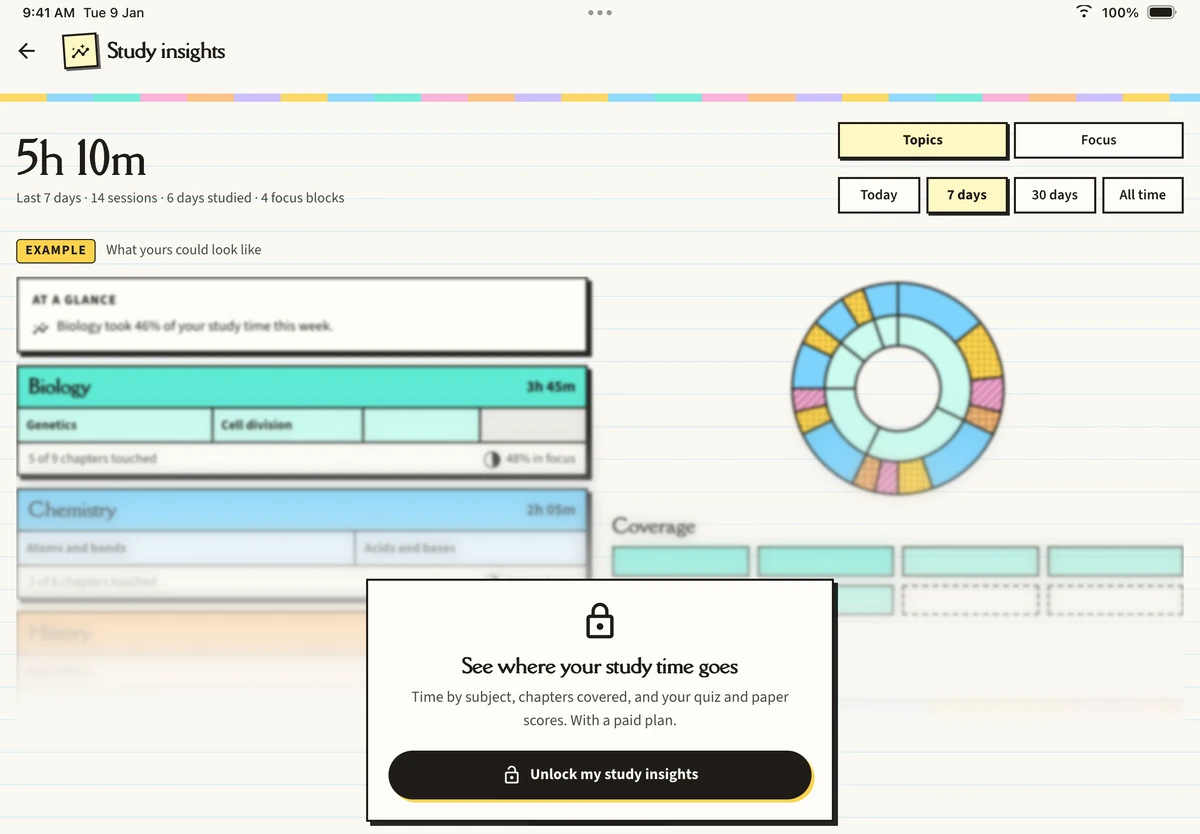
Study insights ties it together by showing where your time went and how it lined up with your quiz results. It is part of a paid plan, with a free preview of your real totals. You can start the loop today with nothing more than a quiz and a notebook.
Frequently asked questions
How do I find my knowledge gaps when studying?
Test yourself without your notes, then compare scores with the time you spent. Chapters with low scores, chapters you haven't touched and subjects you've left alone for a week are your gaps. Rate your confidence first, then check it against a quiz, so you can see where feeling and facts disagree.
What is the fastest way to fix a weak topic?
Switch from rereading to retrieval. Take a short quiz on the topic, review every missed question, and make flashcards for the terms you got wrong. Then revisit it after a day or two and again after a week. Short, spaced retrieval beats one long reread, because it targets what you actually forgot.
How do I know if I'm studying the wrong things?
Compare time with results. If most of your hours sit on chapters where you already score well, and your lowest scores sit on chapters with little time, your effort is pointed at comfort. Move the next study sessions to the lowest-scoring chapter and see whether the score changes the following week.
How long should a study session be?
There isn't one proven length. The 25-minute block is a convention, and the research directly comparing lengths is limited. A small study found planned breaks beat self-chosen ones. Try 25 minutes for a week and a longer block for another week, then keep whichever holds your attention best.
Can tracking study time improve my grades?
Tracking alone is not proven to raise grades. What helps is using the numbers to apply well-tested techniques: testing yourself, spacing your revision and reviewing errors. Your study data shows which chapter needs those techniques. Without that step, a dashboard is just a record of how busy you were.
Start today
- Write your chapters down and rate each from 1 to 5, honestly.
- Take a quick quiz on your lowest-rated chapter with your notes closed.
- Circle every question you were sure about and got wrong.
- Fix those with flashcards, then explain the topic blind from memory.
- Book two revisit dates, one in a day or two and one in about a week.
- Next week, re-check the same chapter. If the score moved, pick the next gap. If it didn't, change the method.
"The first principle is that you must not fool yourself—and you are the easiest person to fool."
— Richard Feynman, Caltech commencement address, 1974