
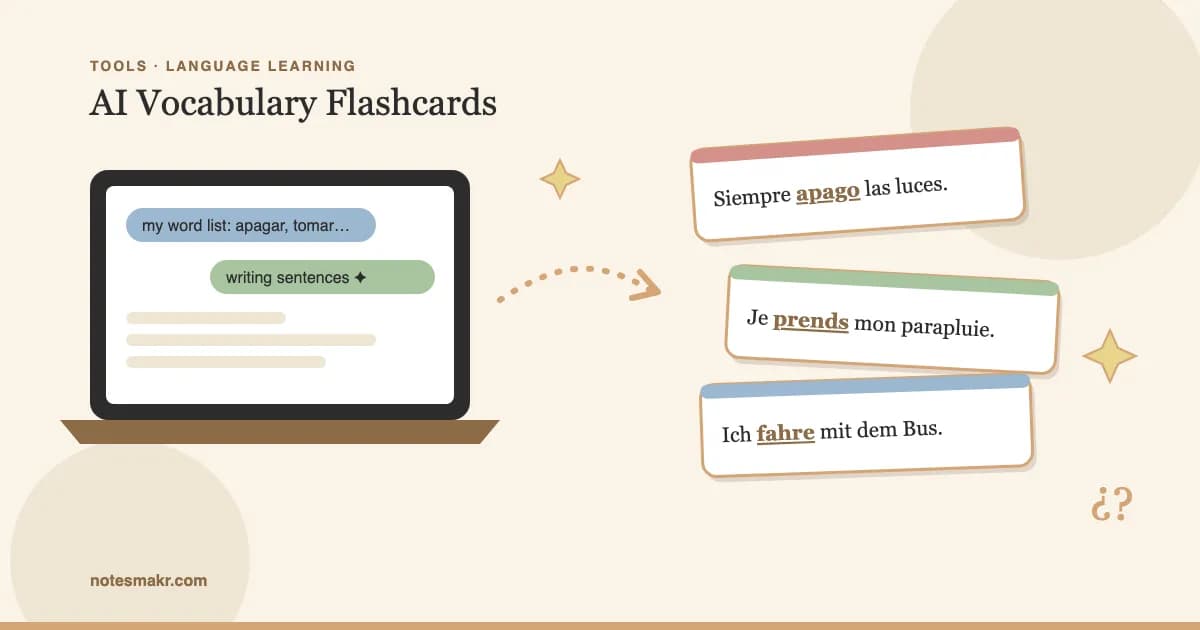
AI vocabulary flashcards are easy to make and easy to make badly. Ask an AI for "50 Spanish words for food" and you get 50 neat pairs: la manzana / apple, el pan / bread. You'll recognise every one of them by Friday, and you still won't be able to say "can you pass the bread?" in class.
Here's the uncomfortable part. A word pair teaches you to recognise a word. Your speaking exam, your writing task and your AP free-response questions ask you to use it. That needs the word in a sentence, with its gender, its preposition and its verb ending.
This guide shows you how to get an AI assistant to write those sentences for you, how to check them so you don't learn a mistake, and how to save them as fill-in-the-blank cards that come back on a schedule. It works for Spanish, French, German and any other language your class covers. If you want the wider memory method first, read our guide to memorizing vocabulary.
What Are AI Vocabulary Flashcards?
AI vocabulary flashcards are review cards for a foreign language that an AI assistant writes from your word list, usually as example sentences with the target word hidden. You give the assistant the words; it writes the cards; you check them and review them on a schedule.
There are two shapes of card, and the difference matters more than which AI you use:
| Card type | Front | Back | What it trains |
|---|---|---|---|
| Word pair | apple | la manzana | Recognising the word |
| Sentence cloze | Cada mañana como una ____ con el desayuno. | manzana | Producing the word in use, with its grammar around it |
A cloze card (from "cloze deletion") is a sentence with a word blanked out. You read the sentence, recall the missing word, then check. It's the format the rest of this guide uses. Our guide to cloze deletion flashcards covers how it works in more depth.
The Science: Sentences, Pairs and Retrieval
It would be neat to say research proves sentences beat pairs. It doesn't quite say that, and the honest version is more useful.
Context and word drills help in different ways. Vandenberghe et al. (2021) taught twenty French verbs to 313 Dutch-speaking learners under three conditions: words in context with meaning-focused tasks, words in context with word-focused tasks, and words out of context with word-focused tasks. Word-focused practice helped learners recognise and recall the words, and context helped with meaning. The authors concluded that word-focused practice with and without context "benefit vocabulary learning in a complementary way."
A cloze card is word-focused practice inside a sentence. It puts the word in context and makes you produce the exact word.
Recalling beats rereading. Retrieval practice, testing yourself instead of looking again, is one of the most reliable findings in memory research (Roediger & Karpicke, 2006). Van den Broek et al. (2022) open their study by noting that retrieval practice of isolated words, such as with flashcards, already improves foreign vocabulary learning. In their experiments with Dutch secondary students, reading new words in a story improved retention compared with words that only appeared on the word list.
A good sentence has to be consistent. Lowell, Pender and Binder (2020) found that when a new word appeared in contexts that suggested different meanings, readers slowed down and remembered it less well than when the contexts agreed. That's the case for checking AI sentences: a sentence where the word is used loosely or wrongly teaches you a muddled meaning.
Word pairs teach you to recognise a word. Sentence cloze cards teach you to recognise it and produce it with its grammar. You need both, and the cloze card gives you both in one review.
How to Make Vocabulary Flashcards With AI in 5 Steps
Use the list your class is tested on: this week's textbook chapter, the AP theme you're on, or your GCSE or A-Level vocabulary list. Copy 15 to 20 words. Don't ask the AI to pick the words. It doesn't know your syllabus, and a deck of words you'll never be tested on is wasted review time.
"Spanish 2, high school" or "GCSE French, Foundation tier" changes everything. It keeps the sentences at a level you can read, so the only new thing in each card is the target word. Name the tense you're working on too, if you have one.
One word per card, one blank per sentence, and sentences short enough to read in a few seconds. Ask for the English meaning as a hint, not as the answer.
Before the assistant writes the whole deck, make it show you five cards. Check each one: look the word up in a dictionary your teacher trusts (WordReference, Collins or your textbook glossary), and ask your teacher or a native speaker about any sentence that feels off. AI makes grammar and usage mistakes, and OpenAI's own help page for ChatGPT flashcards says it "can make mistakes" and tells you to check your cards against your notes.
A deck that lives in a chat window gets reviewed once. Move it into an app that schedules reviews: Anki, Quizlet or Notesmakr. The next section covers the route with no copy and paste.
The AI Vocabulary Flashcards Prompt (Copy and Paste)
Paste this into your assistant and fill in the brackets:
I'm studying [Spanish / French / German] at [Spanish 2 high school / AP / GCSE Higher / A-Level / first-year university] level. Here is my vocabulary list: [paste 15 to 20 words].
For each word, write one natural sentence in [language], 8 to 15 words long, using only vocabulary at my level apart from the target word. Use the [present / preterite / passé composé / Perfekt] tense where it fits.
Make each one a cloze card: wrap the target word in double braces, like {{manzana}}. Hide only the target word. For nouns, show the gender through the article or an adjective in the sentence. For verbs, conjugate the verb in the sentence and hide the conjugated form.
Give each blank a short English hint that describes the meaning without translating the whole sentence.
Show me 5 cards first and wait. Don't write the rest until I say they're right.
Here's what good output looks like:
- Spanish: Antes de salir, siempre {{apago}} las luces de la cocina. Hint: to switch off, I form.
- French: Il pleut, alors je {{prends}} mon parapluie. Hint: to take, I form.
- German: Ich {{fahre}} jeden Morgen mit dem Bus zur Schule. Hint: to travel by vehicle, I form.
Notice that each sentence teaches more than the word. Apago comes with las luces. Fahre comes with mit dem Bus, the preposition and case that trip up German learners.
Save Your AI Vocabulary Flashcards to Notesmakr
Notesmakr is a notes maker and flashcard app that turns study material into plain-language notes, flashcards, quizzes and mind maps, and schedules your flashcard reviews. It can also receive cards straight from an AI assistant through an MCP connection. New to MCP? Our plain-English explainer on MCP for students covers what it is.
The assistants that can connect today include Claude Code, Cursor and Claude Desktop (Desktop through a small helper, which needs Node.js installed). The full list and setup steps are on the Notesmakr MCP page. The Claude.ai website, the Claude phone apps and ChatGPT can't connect yet.
- Create a token in the app, under Settings, Connect AI assistants.
- Connect your assistant with the guide for it, for example the Claude Code guide or the Cursor guide.
- Once the five samples look right, add: "Save these to Notesmakr as a standalone cloze deck called [Spanish 2: Unit 4 food]."
Your assistant writes the cards and Notesmakr runs no AI on this path. Saving a standalone deck is free and doesn't use a note from your plan. A deck holds up to 200 cards and appears in the app as a hand-made deck. Your assistant may have its own costs.
What happens to the cards in the app:
- Each blank gets its hint. The English meaning you asked for shows when you ask for help, so you're nudged without being handed the word.
- Diminishing Cues give letter hints on cloze cards that fade as you get better, so a word you're still learning starts easier than one you know well. Fiechter and Benjamin (2018) found that retrieval practice with fading cues improves memory.
- Spaced repetition (SM-2), free, brings each card back on the day it's due. Our spaced repetition guide explains how the intervals grow.
One rule for languages: a hidden word needs at least 3 letters, except in Chinese, Japanese, Korean, Hindi, Tamil and Thai, where any length works. So you can't blank el, le or der on their own. Hide the noun and let the article show its gender, or hide an article together with its noun as a short phrase.
The honest limits: the connection can only add cards. It can't read, change or delete your existing decks. Notesmakr uses SM-2, while Anki now offers the newer FSRS scheduler, and Anki has far more add-ons. You're not locked in: any deck exports as Anki-compatible text.
Watch: How Language Learners Use Flashcards
Machová, an interpreter who has studied how polyglots learn, explains why the method you enjoy and repeat beats the method that looks most efficient. It's a good antidote to building a deck so big you dread opening it. Key insight: a small deck you review daily beats a perfect deck you abandon.
If you already use Claude Code, this walkthrough shows how an assistant and a flashcard app can split the work: the assistant writes and organises, the app schedules. Key insight: let each tool do the job it's good at.
Word Pairs vs Sentence Cards
- "Give me 50 French words about school."
- The AI picks words your course may never test.
- Cards are le cahier / exercise book.
- No gender practice, no verb endings, no prepositions.
- The deck stays in the chat and you review it once.
- Paste this week's 15 words from your textbook.
- The AI writes one short sentence each, at your level.
- You check five samples against a dictionary.
- Cards hide the word in use: J'ai oublié mon {{cahier}} à la maison.
- The deck goes to a spaced repetition app and comes back on schedule.
Common Mistakes With AI Vocabulary Flashcards
1. Letting the AI choose the words. It will pick common words you may know already, or rare ones your exam never uses. Always start from your course list.
2. Sentences that are too hard. If a sentence has three words you don't know, you can't work out the blank from context and the card becomes a guessing game. Ask for your level by name.
3. Hiding two things at once. One blank per card for vocabulary. If you hide both the verb and its object, you won't know which one you got wrong.
4. Skipping the check. A sentence with a wrong gender or a false friend teaches you the mistake. Check five samples properly; spot-check the rest.
5. Making 300 cards on day one. You'll face 300 reviews within days. Add 15 to 20 new words a week, about one class vocabulary list, and keep up with the reviews.
6. Never saying the sentence aloud. For speaking exams, read each card's full sentence out loud after you answer. It turns a recall card into speaking practice for free.
No Assistant? Two Other Routes
You don't need an AI assistant to get sentence cards into Notesmakr. If your vocabulary list is in a PDF or a scanned handout, the PDF to flashcards tool can make cards from it, and the AI quiz maker can turn the same material into a practice quiz. In-app AI generation is free within the free plan's limits of 5 notes and 40 generations. For the bigger picture of what AI cards can and can't do, see our complete guide to AI flashcards.
Already using Claude for other subjects? Our guide to making flashcards with Claude covers the brief-first prompt for any topic, and how to learn a language fast puts vocabulary review inside a full weekly plan.
The Research Behind It
- Vandenberghe, B., Montero Perez, M., Reynvoet, B. & Desmet, P. (2021): "Combining explicit and sensitive indices for measuring L2 vocabulary learning through contextualized input and word-focused instruction." Studies in Second Language Acquisition. Context and word-focused practice help in complementary ways. Read the paper.
- van den Broek, G. S. E., Wesseling, E., Huijssen, L., Lettink, M. & van Gog, T. (2022): "Vocabulary Learning During Reading: Benefits of Contextual Inferences Versus Retrieval Opportunities." Cognitive Science. Read the paper.
- Lowell, R., Pender, K. W. & Binder, K. S. (2020): "Impact of Informative Context's Meaning Consistency During Incidental Vocabulary Acquisition." Reading Research Quarterly. Inconsistent contexts slowed reading and reduced recall. Read the paper.
- Roediger, H. L. & Karpicke, J. D. (2006): "Test-Enhanced Learning." Psychological Science. Self-testing beats rereading on delayed tests. Read the paper.
- Fiechter, J. L. & Benjamin, A. S. (2018): "Diminishing-Cues Retrieval Practice: A Memory-Enhancing Technique That Works When Regular Testing Doesn't." Psychonomic Bulletin & Review. Read the paper.
FAQ
Can AI make vocabulary flashcards?
Yes. Give an AI assistant your word list, your level and your course, and ask for one short example sentence per word with the word blanked out. Make it show five samples first, check them against a dictionary, then save the full deck to a flashcard app that schedules reviews, such as Anki, Quizlet or Notesmakr.
Are sentence flashcards better than word pairs?
They train more at once. Research suggests context helps with meaning while word-focused practice helps you recall the word itself, and that word drills in and out of context complement each other. A cloze sentence does both: it shows the word in use and makes you produce it, with its gender, ending and preposition.
Can ChatGPT make vocabulary flashcards?
Yes. ChatGPT has a built-in flashcards feature that creates cards you can flip and mark as known or not. OpenAI's help page says it can make mistakes and suggests checking cards against your notes. ChatGPT can't connect to Notesmakr yet; Claude Code, Cursor and Claude Desktop can.
How many new vocabulary words should I add a day?
Add what your reviews can keep up with. For most students that means following the class list, around 15 to 20 new words a week, with a short daily review session. If your daily reviews start taking too long, pause new words until they shrink, rather than skipping reviews.
Are AI flashcards accurate for languages?
Not always. AI can produce a wrong gender, an unnatural phrase or a false friend that looks fine. Check every sample card against a trusted dictionary or textbook glossary, ask your teacher about anything that feels off, and spot-check the rest of the deck before you start reviewing it.
Start Today
AI vocabulary flashcards work when the AI writes the sentences and you stay in charge of the words and the checking.
- Copy this week's word list from your course.
- Paste the prompt with your language and level.
- Stop at five samples and check them in a dictionary.
- Save the deck to an app that brings it back on schedule.
- Review daily and say each sentence aloud.
"Do not learn if you do not understand."
— Piotr Wozniak, Twenty Rules of Formulating Knowledge