

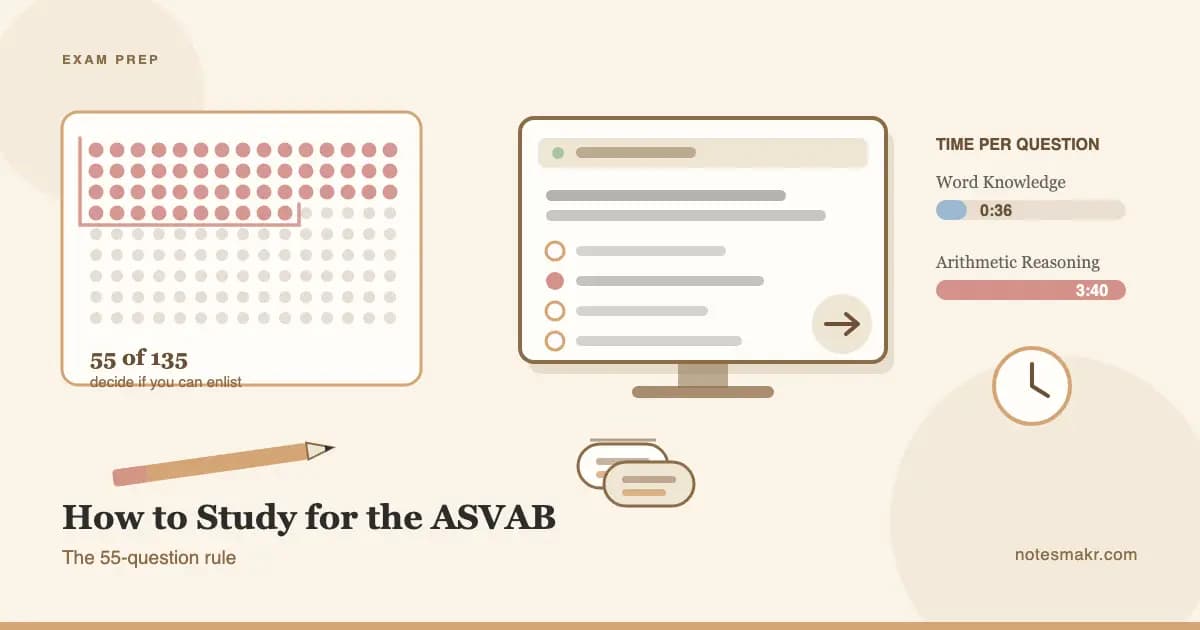
Here is the uncomfortable truth nobody tells you when you start figuring out how to study for the ASVAB. The computer version has 135 scored questions across ten subtests. Only 55 of them decide whether you are allowed to enlist at all. The other 80 decide which job you get.
Almost every ASVAB study plan splits your time evenly across all ten subtests. The test itself does not split its time evenly. It never has. The official time limits give one subtest almost four minutes per question and another subtest thirty-six seconds, and those two numbers are telling you, in plain language, to study them in completely different ways.
This guide walks you through the actual structure of the exam, the four subtests that control your enlistment score, a six-week plan built around the clock rather than around a prep book, and the retake rules that make a bad first attempt genuinely expensive.
What Is the ASVAB?
The ASVAB (Armed Services Vocational Aptitude Battery) is the multiple-choice aptitude test used to determine whether you qualify to enlist in the US military and which military jobs you are eligible for. It has ten subtests covering verbal, math, science and technical, and spatial reasoning. Four of those ten produce your AFQT score, the number that controls enlistment eligibility.
Most testing happens at a Military Entrance Processing Station (MEPS) on a computer. If you live far from a MEPS, you may take a paper version at a satellite Military Entrance Test (MET) site. According to the official ASVAB fact sheet, roughly 70% of applicants test by computer, and the average examinee finishes the computer version in about an hour and a half.
| Subtest | CAT questions | CAT minutes | Paper questions | Paper minutes |
|---|---|---|---|---|
| General Science (GS) | 15 | 12 | 25 | 11 |
| Arithmetic Reasoning (AR) | 15 | 55 | 30 | 36 |
| Word Knowledge (WK) | 15 | 9 | 35 | 11 |
| Paragraph Comprehension (PC) | 10 | 27 | 15 | 13 |
| Mathematics Knowledge (MK) | 15 | 31 | 25 | 24 |
| Electronics Information (EI) | 15 | 10 | 20 | 9 |
| Auto Information (AI) | 10 | 7 | 25 (AS) | 11 (AS) |
| Shop Information (SI) | 10 | 6 | combined | combined |
| Mechanical Comprehension (MC) | 15 | 22 | 25 | 19 |
| Assembling Objects (AO) | 15 | 18 | 25 | 15 |
| Total | 135 | 197 | 225 | 149 |
Bold rows are the four AFQT subtests. Source: Official ASVAB Fact Sheet, Enlistment Testing Program.
Auto Information and Shop Information are separate tests on the computer but report as one combined score (AS), the same score the paper version produces from a single subtest.
There is no such thing as "the AFQT test." The AFQT is a score pulled out of four subtests inside the one exam you sit. You do not sign up for it separately and you cannot skip the rest of the battery.
Only 55 Questions Decide Whether You Can Enlist
Your AFQT score is computed from four subtests: Arithmetic Reasoning, Mathematics Knowledge, Word Knowledge, and Paragraph Comprehension. On the computer version that is 15 + 15 + 15 + 10 questions. Fifty-five out of 135. Just under 41% of the exam.
Now look at what those four subtests own on the clock: 55 + 31 + 9 + 27 minutes, or 122 of the 197 available minutes. That is 62% of your testing time spent on 41% of the questions.
The AFQT subtests take 41% of the questions and 62% of the clock. If your study plan gives all ten subtests equal weight, you have already misallocated your prep before you open a single book.
The scoring formula weights verbal even harder than the question count suggests. The military computes a raw AFQT as 2VE + AR + MK, where VE (Verbal Expression) is built from Word Knowledge and Paragraph Comprehension together, then doubled. That raw number gets converted to a percentile from 1 to 99.
And a percentile is not a percentage correct. The official ASVAB scores page is explicit: an AFQT percentile tells you the percentage of a reference group who scored at or below you, and that reference group is a nationally representative sample of 18 to 23 year olds who took the ASVAB in a 1997 norming study. A 62 does not mean you got 62% right. It means you outscored 62 out of 100 people in that sample.
What score do you actually need?
Published minimums move, they differ by education tier, and each branch sets its own. Military.com's ASVAB questions page lists these AFQT minimums, with the explicit warning that requirements are subject to change without notice:
| Branch | Listed minimum AFQT |
|---|---|
| Army | 30 |
| Air Force | 31 |
| Marine Corps | 32 |
| Navy | 35 (26 with a waiver) |
| Coast Guard | 36 (32 with a waiver) |
Treat that table as a floor, not a target, and confirm the current number with a recruiter before you plan around it. A bare pass gets you in the door and locks most of the door frame behind you, because the interesting jobs are gated by line scores built from the other six subtests. Aiming at 50 keeps every branch open and keeps your job list long.
Which means the first thing to do is not open a book. It is to find out where you currently stand, and the only honest way to do that is a timed practice test taken before you study anything.
The Clock Tells You How to Study Each Subtest
This is the section every other ASVAB guide skips, and it takes about two minutes of division to produce.
Divide each computer subtest's time limit by its number of questions:
| Subtest | Time per question | What it is really measuring | So study it by |
|---|---|---|---|
| Word Knowledge | 36 seconds | Do you already own this word | Spaced flashcard retrieval |
| Shop Information | 36 seconds | Do you know this tool | Spaced flashcard retrieval |
| Electronics Information | 40 seconds | Do you know this term | Spaced flashcard retrieval |
| Auto Information | 42 seconds | Do you know this part | Spaced flashcard retrieval |
| General Science | 48 seconds | Do you know this fact | Spaced flashcard retrieval |
| Assembling Objects | 1 min 12 sec | Can you rotate it mentally | Timed puzzle reps |
| Mechanical Comprehension | 1 min 28 sec | Do you understand the principle | Worked examples |
| Mathematics Knowledge | 2 min 4 sec | Can you execute the procedure | Worked problems on paper |
| Paragraph Comprehension | 2 min 42 sec | Can you find and hold the point | Timed passage reps |
| Arithmetic Reasoning | 3 min 40 sec | Can you translate words into an equation | Worked problems on paper |
Arithmetic Reasoning gives you six times more time per question than Word Knowledge. That is not an accident of scheduling. It is the test telling you what kind of thinking it wants.
Word Knowledge in 36 seconds is a pure ownership test. You either have the word or you do not, and there is no time to reason your way to it. Vocabulary has to be automatic, which makes it the single best fit for flashcards and spaced repetition on the whole exam. If vocabulary is your weak subtest, the techniques in how to memorise vocabulary apply almost unchanged here.
Arithmetic Reasoning in 3 minutes 40 seconds is the opposite. Nobody needs 220 seconds to recall a formula. You need that time to read a messy paragraph, work out what is being asked, and set up the equation. No flashcard deck in the world trains that. Worked problems do.
This flips completely on the paper version. On the P&P-ASVAB, Arithmetic Reasoning gives 30 questions in 36 minutes, which is 72 seconds per question, not 220. Same subtest, a third of the thinking time. Ask your recruiter which version you are taking before you build your pacing plan.
The Science: Why Reading a Prep Book Does Not Move Your Score
Most people prepare for the ASVAB by reading a 500-page prep book front to back. It feels like work. It produces a warm sense of familiarity that collapses the moment a screen asks you to produce an answer with nothing in front of you.
In a review of ten common study techniques, Dunlosky and colleagues (2013) rated only two as high utility across subjects and learners: practice testing and distributed practice. Re-reading, highlighting and summarising were all rated low utility. Those three are exactly what a prep book invites you to do.
The effect behind practice testing is old and stubborn. Roediger and Karpicke (2006) showed that retrieving material from memory produces better long-term retention than restudying it, even when restudying feels more productive at the time. Spreading that retrieval out multiplies the benefit: Cepeda and colleagues (2006) reviewed 184 experiments on spacing and found distributed practice reliably beat massed practice on delayed tests.
For math, mixing matters as much as spacing. Rohrer and Taylor (2007) had students practise maths problems either blocked by type or shuffled together. On a test one week later, the shuffled group scored 63% against 20% for the blocked group. Blocked practice teaches you to apply a method you have already been told to apply. The ASVAB never tells you which method to apply, which is precisely the skill interleaving builds.
And for Word Knowledge specifically, structure beats memorising word lists. Goodwin and Ahn (2013) meta-analysed 30 studies of morphological instruction, which is the teaching of roots, prefixes and suffixes, and found a moderate overall effect (d = 0.32) with a vocabulary effect of d = 0.34. Learning that "bene" means good and "loqu" means speak buys you more coverage per hour than memorising 500 individual definitions.
Try this now: Close this tab for 60 seconds. On a blank page, write down every word you can think of that starts with "circum" and what the prefix means. Then do "mal". If you produced fewer than four words total, that is your Word Knowledge score talking, and it is the cheapest thing on this entire exam to fix.
A 6-Week ASVAB Study Plan Built Around the Clock
Six weeks at roughly an hour a day is enough for most people to move the AFQT meaningfully. Compress it to three weeks by doubling the daily block if your test date is already booked.
Sit a complete timed practice test before you study anything. Not to feel good. To get a number for each of the four AFQT subtests. Then split your results into two piles: questions you did not know, and questions you knew but got wrong because you rushed or misread. Those two piles need completely different fixes, and mixing them is how people study for six weeks and move three points. This diagnostic-first order is the same one that works on other entrance exams, including the TEAS.
Word Knowledge, General Science, Electronics, Auto and Shop are all sub-45-second ownership tests. Build cards, review them daily, and let the schedule space the ones you already know. Add roots, prefixes and suffixes as their own cards, not just whole words. Fifteen minutes a day for six weeks is more than 10 hours of spaced retrieval, and it costs you nothing on the days you are tired.
Arithmetic Reasoning and Mathematics Knowledge together are half of the AFQT formula. Work problems on paper, with no calculator, because calculators are not permitted on the ASVAB. Shuffle problem types inside every session rather than doing twenty percentage problems in a row. It will feel worse and score better. If fractions, ratios and percentages are genuinely rusty, rebuild them first using the approach in how to study maths, because no amount of test strategy compensates for a shaky foundation.
Timed sections train pacing, which is the failure mode nobody studies for. After each one, write a single line next to every wrong answer: did not know it, or knew it and blew it. Restudy only the first pile. Fix the second pile with pacing rules, not more content.
Sit one more complete timed test five or six days out. Then stop adding new material. Spend the last three days on review of your existing cards and on sleep, which does more for a recall test than a final cram session ever will. Turning up rested is a scoring strategy, not a comfort measure.
How Many Hours a Day Should You Study for the ASVAB?
Between one and two hours a day for four to six weeks is the range that works for most applicants. The right number depends entirely on the gap between your first practice score and your target, not on how motivated you feel.
| Your situation | Daily block | Total runway |
|---|---|---|
| Practice AFQT already above target | 30 min | 2 weeks, maintenance only |
| Within 10 points of target | 1 hr | 4 weeks |
| 10 to 25 points below target | 1.5 hr | 6 to 8 weeks |
| Rusty on fractions, decimals, percentages | 2 hr | 8 to 12 weeks, math first |
| Test booked in 7 days | 2 hr | AFQT subtests only, nothing else |
Notice what changes across those rows. It is the runway, not the daily block. Doubling your daily hours does not double your score, because the constraint is how many spaced review cycles you can fit before test day, and you cannot compress a spacing schedule the way you can compress a reading list.
CAT-ASVAB vs Paper: Four Rules That Change Your Strategy
The two versions of the exam are scored to be comparable, but they behave differently in the room, and the official guidance on guessing is genuinely opposite between them.
1. On the computer, you cannot go back. The fact sheet states plainly that you cannot review or change an answer once submitted. Every question is final the moment you commit. On paper you can review inside a section, though you cannot return to an earlier section.
2. The computer version penalises end-of-section guessing. Official guidance is that if you are running out of time on the CAT-ASVAB, you should keep answering as carefully as you can rather than filling in random guesses, because the CAT-ASVAB has a penalty for guessing. On the paper version, the advice reverses completely: if you run out of time, fill in random guesses, because there is no penalty.
3. The computer adapts to you. Answer correctly and the next item gets harder. Answer wrong and it gets easier. This is why a computer test with 135 questions can measure the same thing as a paper test with 225.
4. PiCAT exists and it has strings. The PiCAT is an unproctored version you take at home from a recruiter-issued code, with no per-subtest time limits. It can only be taken once, only by people who have never taken the ASVAB, and it must be confirmed by a short proctored verification test at a military facility. Pass verification and the PiCAT scores become your official record. Fail to verify and you sit the full test.
The no-going-back rule punishes one specific habit: reading half the question, spotting a familiar number, and clicking. On paper that mistake is recoverable. On the computer it is scored and gone.
Watch: ASVAB Prep in Action
Two videos worth 20 minutes of your prep time, one for each kind of thinking the test wants.
ASVAB Arithmetic Reasoning Word Problems: 3 Easy Steps
Duran Learning walks through translating ASVAB word problems into equations
Duran Learning breaks down the step most people skip, which is turning a paragraph into an equation before touching any arithmetic. Key insight: on Arithmetic Reasoning your marks are lost in the translation, not in the calculation.
ASVAB Word Knowledge Study Guide
Mometrix covers the Word Knowledge subtest structure and strategy
Mometrix covers how the Word Knowledge items are built, including synonym-in-context questions. Key insight: context clues rescue some items, but at 36 seconds a question the only reliable strategy is already owning the word.
Two Recruits, Thirty Hours Each
Same hours. Same book. The difference is that Recruit B let the test's own structure decide where the hours went.
Quick Reference: What to Study When
| Situation | Best move |
|---|---|
| You have not taken a practice test yet | Stop everything and take one timed |
| Your math score is the gap | Mixed worked problems, no calculator, on paper |
| Your vocabulary score is the gap | Daily spaced cards plus roots and prefixes |
| You keep running out of time | Timed single sections, not full tests |
| You know the content but miss questions | Slow down and re-read the question stem |
| Aiming for a specific job, not just entry | AFQT first, then the line-score subtests it needs |
| Test is in 7 days | Only AR, MK, WK, PC. Ignore the other six |
| You already passed but want a better job | Read the retake section below before booking |
Try this now: Open a timer and give yourself 9 minutes for 15 Word Knowledge questions from any free practice set. Do not pause it. That is the exact pace of the real subtest, and one rep will tell you more about your vocabulary than an hour of reading a word list.
Retaking the ASVAB: The Math Nobody Runs
The retake rules are strict and the cost of a careless first attempt is higher than most applicants realise.
- You must wait one calendar month to retake after your initial ASVAB.
- Another calendar month before a second retake.
- Six calendar months for every retake after that.
- Scores are valid for enlistment for two years from the test date.
- The most recent score is the one that counts, not your highest. Military.com states this directly.
That last rule is the one that bites. Retaking after a good score to chase a specific job can leave you with a worse number and no way back for six months. The floor for booking a retake should be a clear, repeated improvement on timed practice tests, not a hopeful feeling.
Before you book a retake, take two full timed practice tests on different days. If both land above your previous official score by a comfortable margin, book it. If only one does, that was variance, not progress.
Common Mistakes (And How to Fix Them)
Mistake 1: Studying all ten subtests equally
Four subtests decide whether you can enlist. Six decide which job you get. Those are not the same priority.
The fix: Get the AFQT four to your target first. Only then spend time on the subtests that feed the line scores for the job you actually want.
Mistake 2: Reading the prep book instead of answering questions
Reading builds recognition. The exam demands recall. This is the single most common way to spend six weeks and move four points.
The fix: Every session must contain a moment where you produce an answer with nothing in front of you. See active recall for the underlying method.
Mistake 3: Practising math problems in blocks
Twenty percentage problems in a row teaches you to recognise a page heading, not a problem.
The fix: Shuffle problem types inside every session. It feels harder because it is doing more.
Mistake 4: Never practising with a timer
Pacing is a separate skill from content. You cannot discover you are slow at Arithmetic Reasoning on the day.
The fix: At least one timed section per week from week three. Time single sections rather than full tests, since the clock is enforced per subtest.
Mistake 5: Mass-guessing the end of a section on the computer version
Official guidance says the CAT-ASVAB penalises exactly this behaviour, and you cannot go back to fix it.
The fix: Keep working questions honestly to the buzzer. On the paper version, do the opposite and fill in every remaining bubble.
Mistake 6: Booking a retake on a hunch
You get one retake after a month, one more after another month, then a six-month wall. The newest score replaces the old one whether it is better or not.
The fix: Treat two consistent timed practice results as your permission slip. Anything less is a coin flip with a six-month penalty attached.
The Research Behind It
- Practice testing and distributed practice (Dunlosky et al., 2013): Of ten common study techniques, only these two earned a high utility rating across subjects and learners. Re-reading and highlighting were rated low.
- Testing effect (Roediger & Karpicke, 2006): Retrieving information from memory produces stronger long-term retention than restudying it, even when restudying feels more effective at the time.
- Spacing effect (Cepeda et al., 2006): A review of 184 experiments found distributed practice reliably outperformed massed practice on delayed tests.
- Interleaved maths practice (Rohrer & Taylor, 2007): Students who shuffled problem types scored 63% on a test one week later against 20% for students who practised in blocks.
- Morphological instruction (Goodwin & Ahn, 2013): A meta-analysis of 30 studies found teaching roots, prefixes and suffixes produced a moderate overall literacy effect (d = 0.32) and a vocabulary effect of d = 0.34.
How Notesmakr Helps You Prepare for the ASVAB
Straight answer first: no app will teach you to set up an Arithmetic Reasoning word problem. That happens on paper, with a pencil, one problem at a time. Anyone selling you a shortcut around that is selling you a worse score.
What software is genuinely good at is the other half of the exam, the sub-45-second ownership subtests where the only question is whether the fact is already in your head.
Notesmakr is a notes maker that turns your study material into flashcards, quizzes, mind maps and plain-language summaries. For ASVAB prep specifically:
- Free: manual and cloze (fill-in-the-blank) flashcards with Diminishing Cues, which reveal progressively fewer letters as you learn a term, SM-2 spaced repetition scheduling, Anki
.apkgimport and Anki-compatible export, study streaks, and a Focus Timer running the classic 25/5/15 cycle for your daily block. - Scholar (paid): AI-generated flashcards, multiple-choice quizzes, study guides, mind maps, Feynman-style simplification and Pippy chat, built from a prep-book PDF, a photo of a page, an audio recording or your own typed notes. Free accounts can use the AI features on up to 5 notes.
Cloze cards fit Word Knowledge unusually well, because a blanked word in a real sentence is closer to the actual subtest than a bare definition on the back of a card. See cloze deletion flashcards for how to write them properly, and the complete guide to AI flashcards for turning a chapter into a deck without typing every card by hand.
Two honest limits. The AI quiz generator produces multiple-choice questions, which matches the ASVAB format but will not train the paper working that Arithmetic Reasoning rewards. And a generated deck is only as good as what you feed it, so feed it your practice-test misses, not the whole book.
Turn the pile you built in step 1 of the plan (questions you did not know) into your deck. A deck built from your own wrong answers is worth ten times a generic 500-word ASVAB list, because every card in it is a proven gap.
Related tools: the AI quiz maker for turning a chapter into practice questions, the study guide generator for condensing a prep-book section, and PDF to flashcards if your prep material is already a PDF.
Frequently Asked Questions
How long should you study for the ASVAB?
Four to six weeks at one to two hours a day suits most applicants. If you are within ten points of your target AFQT, four weeks is usually enough. If your maths fundamentals are rusty, plan eight to twelve weeks. The limiting factor is how many spaced review cycles fit before test day, not total hours.
Can you fail the ASVAB?
Technically no. The ASVAB has no pass mark because it measures aptitude rather than achievement. In practice, you can score below your chosen branch's minimum AFQT, which makes you ineligible to enlist until you retake it. Published minimums sit in the low thirties, though they vary by branch and change without notice.
What is a good ASVAB score?
An AFQT of 50 is average against the reference group and keeps every branch open. Anything in the sixties or above widens your job list considerably, since specific roles are gated by line scores rather than the AFQT alone. Branch minimums are much lower than 50, but a bare pass severely limits which jobs you can choose.
Can you use a calculator on the ASVAB?
No. Calculators are not permitted on any version of the ASVAB. The official reasoning is that the test measures practical problem-solving ability, not just learned procedure. Practise every maths problem on paper without one, because arriving with calculator habits is how people run out of time on Mathematics Knowledge.
How many times can you take the ASVAB?
You must wait one calendar month after your first ASVAB to retake it, then another calendar month for a second retake, then six calendar months for any retake after that. Scores stay valid for enlistment for two years. Your most recent score is the one that counts, not your highest.
Start Today
- Book or download one full timed practice test and sit it this week, before you study anything.
- Split your wrong answers into two piles: did not know it, and knew it but rushed.
- Build cards from the first pile only, starting with Word Knowledge, and review them daily.
- Put 30 minutes of mixed Arithmetic Reasoning and Mathematics Knowledge problems on paper into your calendar, four days a week.
- Add one timed single section per week from week three, and write a one-line autopsy next to every miss.
- Ask your recruiter whether you are sitting the computer or the paper version, and set your pacing rules accordingly.
- Sleep properly the week of the test. It is worth more than the last cram session.
Everything above is one hour a day. The applicant who scores 62 instead of 38 is rarely the smarter one. They are the one who let the test's own clock decide where the hours went.
"A good plan violently executed now is better than a perfect plan executed next week."
— General George S. Patton