
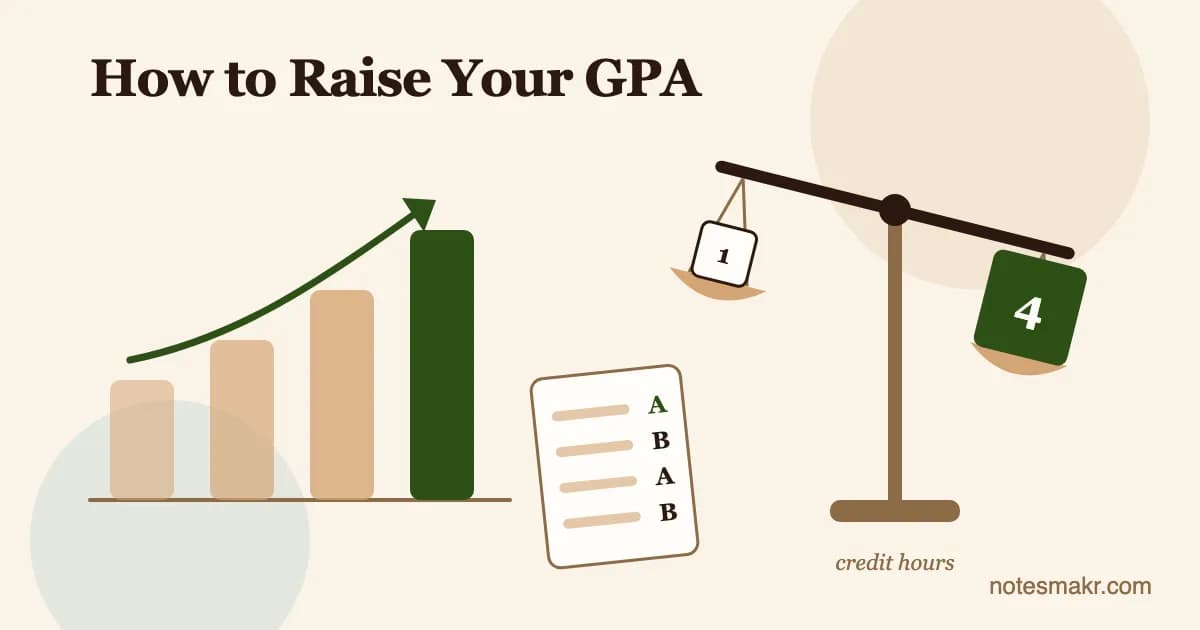
Here's the uncomfortable truth about how to raise your GPA: working harder in every class at once is the slowest way to do it. Your GPA is an average weighted by credit hours, so some grades move it a lot and some barely move it at all. Spread your effort evenly and most of it lands where it changes nothing.
The students who raise their GPA fastest do two things. First, they do ten minutes of arithmetic to find the one or two courses where a better grade moves the number most. Then they put their best study hours into the exams and papers in those courses, using methods with real research behind them. This guide walks you through both, with worked examples you can copy using your own grades. If finals are close, pair it with our guide on how to study for finals.
What Is GPA, and How Is It Calculated?
GPA (grade point average) is the average of your course grades, converted to points and weighted by how many credit hours each course carries. On the common 4.0 scale, an A is 4 points, a B is 3, a C is 2, a D is 1 and an F is 0. Many schools also use plus and minus values in between.
The calculation has three steps:
- Multiply each course's grade points by its credit hours. The result is called quality points (some schools say grade points).
- Add up the quality points for all your courses.
- Divide by the total number of credit hours you attempted.
For example, an A (4.0) in a 3-credit course and a B (3.0) in a 4-credit course give (4.0 × 3) + (3.0 × 4) = 24 quality points over 7 credits. That's a GPA of 24 ÷ 7 ≈ 3.43, not the 3.5 you'd get by averaging the two grades. The heavier course pulls harder.
The one-sentence version: a grade counts in proportion to its credit hours, so the fastest way to raise your GPA is a better grade in your heaviest course.
Your cumulative GPA works the same way, pooling every quality point and every credit hour you've ever attempted. That's why it gets harder to move each semester: the pile of old credits grows, and each new semester is a smaller share of it.
How to Raise Your GPA in One Semester: Find Your Biggest Lever
Start by listing this semester's courses, their credit hours and the grade you're honestly on track for right now. Here's a typical college schedule:
| Course | Credits | On track for | Quality points |
|---|---|---|---|
| Calculus I | 4 | C (2.0) | 8 |
| General Biology | 4 | B (3.0) | 12 |
| English Composition | 3 | B (3.0) | 9 |
| US History | 3 | A (4.0) | 12 |
| First-Year Seminar | 1 | B (3.0) | 3 |
| Total | 15 | 44 |
That's a semester GPA of 44 ÷ 15 ≈ 2.93. Now ask what one letter grade up in each course would add:
- Calculus, C to B: +4 quality points, so the semester GPA rises by 4 ÷ 15 ≈ 0.27.
- Biology, B to A: also +4, another 0.27.
- English, B to A: +3, or 0.20.
- Seminar, B to A: +1, or about 0.07.
- History: already an A, so there's nothing to gain, only something to protect.
The rule falls straight out of the math: gain per letter grade = credit hours ÷ total credits. A 4-credit course is worth four times a 1-credit course. So the first place to spend extra hours is the heavy course with a grade that can still move, which here is Calculus or Biology.
Which one first? Check what's left to earn
A course only moves if there are enough points left in it. Open each syllabus and check how much of the final grade is still to come. A 4-credit course with a cumulative final worth a big share of the grade is a much better bet than one where most of the marks are already in. In most courses, exams and major papers carry the bulk of the grade, so that's where your hours should go.
How Much Can I Raise My GPA? The Cumulative Math
Before you set a target, check it's possible. This formula tells you the semester GPA you need:
Semester GPA needed = (target GPA × total credits after this semester − quality points you already have) ÷ credits this semester
Say you have a 2.8 after 45 credits, which is 2.8 × 45 = 126 quality points, and you want a 3.0 after a 15-credit semester:
- Target × total credits: 3.0 × 60 = 180
- Minus what you have: 180 − 126 = 54
- Divided by this semester's credits: 54 ÷ 15 = 3.6
So a 3.6 semester takes you to 3.0. That's demanding but possible. A perfect 4.0 semester would take you to (126 + 60) ÷ 60 = 3.1.
Now try the same target from a 2.5 after 90 credits (225 quality points): 3.0 × 105 = 315, minus 225 is 90, divided by 15 is 6.0. That's impossible in one semester, because the maximum is 4.0. It isn't a reason to give up. It's a reason to plan over two or three semesters and to treat every semester as a fresh 15 credits you can control.
How to Raise Your GPA in College: Study the Exams That Count
Once you know your lever course, the question is how to turn study hours into points. Three methods have the strongest evidence behind them.
1. Test yourself instead of rereading
Rereading notes feels productive because the material looks familiar. But familiarity isn't recall, and exams ask for recall. Students who practiced retrieving material remembered more a week later than students who spent the same time restudying it (Roediger & Karpicke, 2006). In a review of ten common study techniques, practice testing was one of only two rated as high utility (Dunlosky et al., 2013). Our guide to active recall shows how to set this up.
2. Spread your review out
Cramming the night before can get you through tomorrow's quiz, but the cumulative final will ask for it all again. Spacing the same study time over several days improves long-term retention (Cepeda et al., 2006). Starting your lever course's final review three or four weeks out turns a cram into short daily sessions. See our spaced repetition guide for a schedule.
3. Practice in the format of the exam
If the exam is problem sets, do problems. If it's essays, write timed outlines. Old exams from your professor, end-of-chapter problems and review sheets are the closest thing you'll get to the real test. Our post on practice tests covers how to use them without just memorizing answers.
The basics that still count
- Go to every class. A meta-analysis found class attendance strongly related to college grades, and it explained differences in grades that SAT scores and high school GPA did not (Credé, Roch & Kieszczynka, 2010).
- Use office hours early. Ask your professor what a strong answer looks like before the exam, not after.
- Read the rubric for every paper and check your draft against it line by line.
- Same extra hour in every class
- Reread notes before each exam
- Start final review the week before
- Find out the grading rules after the grade
- Extra hours in the heavy course with points left
- Test yourself on every topic
- Start final review three to four weeks out
- Read the syllabus and rubric first
How to Raise Your GPA in High School
The same arithmetic applies in high school, with a few differences.
- Weighted vs unweighted GPA. An unweighted GPA treats every class on the same 4.0 scale. A weighted GPA gives extra points for honors, AP or IB classes, and your school decides how much. Colleges often recalculate GPAs their own way, so focus on earning strong grades in the classes you take rather than on the weighting formula.
- Credits can be equal. Many high schools give most full-year classes the same credit, so your lever is the class where your grade can move most, not the one with the most credits.
- Semester grades often stand alone. Some schools record a grade each semester, so a bad fall semester doesn't have to drag down your spring one. Check your handbook.
- Upward trends count. If your GPA started low, a steady rise in later years tells an admissions reader something too. Our guide to studying in high school covers the habits that keep grades climbing.
Watch: Studying Smarter, Not Longer
This lecture is long, but it's full of practical habits for college students, such as studying in short focused blocks and testing yourself instead of rereading.
A shorter overview of active recall and spaced repetition, the two methods in the plan above.
A 4-Week Plan for Your Lever Course
List every exam, paper and assignment still to come in your lever course, with its share of the grade. Book office hours and ask which topics the final will stress.
Go through your notes one topic at a time and turn each fact, formula or definition into a flashcard or a question. Review the cards a little every day rather than all at once.
Do one old exam or problem set under timed conditions, mark it honestly and spend your next session only on what you got wrong.
Mix topics in each session so you practice choosing the right method. Two days before the exam, do a full practice exam, then review cards and sleep.
Keep your other courses ticking over while you do this. The plan doesn't mean ignoring them. It means your extra hours go to the course where they buy the most.
How Notesmakr Helps You Raise Your GPA
Notesmakr is a notes maker app that turns your study material into plain-language notes, flashcards, quizzes and mind maps. It doesn't track your grades or calculate your GPA. It handles the daily studying that earns them.
- Spaced repetition (free): The SM-2 scheduler brings each flashcard back just before you're likely to forget it, so your finals material gets reviewed for weeks instead of crammed. Flashcards you make yourself have no limit.
- Study streaks (free): A daily streak counter makes a short review session every day easier to keep up.
- Focus Timer (free): The built-in Pomodoro timer runs the classic 25-minute focus, 5-minute break cycle, with a 15-minute break after every four blocks.
- AI from your lecture notes: Upload lecture slides or a PDF to create a note, then generate flashcards and a quiz from it. AI is free within the free plan's limits (5 notes and 40 generations, lifetime), so use it on your lever course first. See the PDF to flashcards and AI quiz maker pages, and our complete guide to AI flashcards for how to check what the AI makes.
Common Mistakes When Trying to Raise Your GPA
Mistake 1: Taking on more credits to "catch up." More credits only help if you earn good grades in all of them. An overloaded semester can lower your GPA instead. The fix: Take a load you can do well in, and talk to your advisor before adding courses.
Mistake 2: Spreading effort evenly. An extra hour in a 1-credit course is worth a quarter of the same hour in a 4-credit course. The fix: Do the lever math above and put most of your extra hours where it points.
Mistake 3: Guessing at your school's rules. Retakes, grade replacement and withdrawals help in some schools and do nothing, or show on your transcript, in others. The fix: Read your registrar's policies and ask your advisor before you rely on any of them.
Mistake 4: Waiting for the final. By finals week most of the grade is often already decided. The fix: Start with the next exam or paper, and start your final review weeks ahead. If you keep putting it off, read our guide on how to stop procrastinating.
Mistake 5: Rereading instead of testing. It's the most common study habit and one of the least effective. The fix: Close your notes and quiz yourself. If you can't answer, that's the topic to study.
The Research Behind It
- Testing effect (Roediger & Karpicke, 2006): Practicing retrieval beat restudying on a test one week later. Read the paper.
- Learning techniques review (Dunlosky et al., 2013): Practice testing and distributed practice earned the highest utility ratings of ten techniques. Read the review.
- Spacing (Cepeda et al., 2006): A review of verbal recall studies found that spaced practice improves long-term retention. Read the review.
- Class attendance (Credé, Roch & Kieszczynka, 2010): A meta-analysis found class attendance strongly related to class grades and GPA, beyond what SAT scores and high school GPA predicted. The link is correlational. Read the paper.
FAQ
How do you raise your GPA fast?
Find the course where a better grade moves your GPA most: the one with the most credit hours and the most of its grade still to earn. Put your extra study hours into its remaining exams and papers, test yourself instead of rereading, and start reviewing weeks early. One letter grade in a 4-credit course counts four times a 1-credit course.
Can you raise your GPA in one semester?
Usually yes, by some amount, but how much depends on how many credits you've already completed. Use the formula: target GPA times total credits after this semester, minus quality points you have, divided by this semester's credits. If the answer is above 4.0, the target needs more than one semester.
How much can one semester raise your GPA?
It depends on your credits so far. For example, a 2.8 after 45 credits becomes about 3.1 after a perfect 4.0 semester of 15 credits. The more credits you've completed, the smaller the change one semester can make, because each new semester is a smaller share of your cumulative total.
What is the difference between weighted and unweighted GPA?
An unweighted GPA puts every class on the same 4.0 scale, so an A is 4 points whether the class is regular or advanced. A weighted GPA adds extra points for honors, AP or IB classes, with the amount set by your school. Colleges often recalculate applicants' GPAs using their own method.
Does retaking a class raise your GPA?
It depends on your school. Some replace the old grade with the new one, some average the two, and some count both attempts. Policies can also differ for high school and college, and limits on retakes are common. Check your registrar's page or student handbook, and ask your advisor before you register.
Start Today
- List this semester's courses with credits and the grade you're on track for.
- Work out the lever: credit hours ÷ total credits for one letter grade in each course.
- Check the syllabus of your top course for what's still left to earn.
- Book office hours this week and ask what the next exam will stress.
- Make flashcards from one topic tonight and review them tomorrow before you add more.