
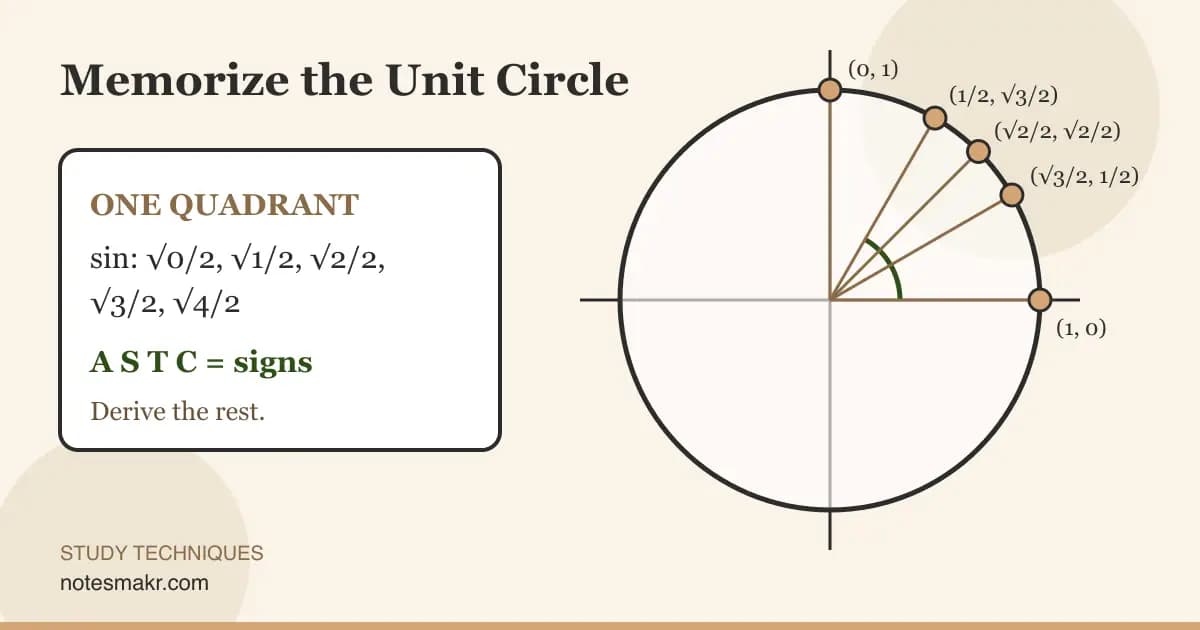
Here is the uncomfortable truth about how to memorize the unit circle: if you try to memorize all of it, you are doing far more work than you need to. The circle has sixteen special points, and nearly every worksheet, quiz and textbook table presents them as sixteen separate facts to burn into your head. That is why it feels impossible, and why the values fade within a week.
You only need to learn one quadrant. The other three are mirror images, and the only thing that changes is the sign. Learn the first quadrant from two special triangles, learn four letters for the signs, and you can rebuild any point in under ten seconds. If your precalculus or trig final is coming up, this is the method. It sits alongside the broader advice in the guide to how to study math, and it pays off again when you reach limits and derivatives in calculus.
How to Memorize the Unit Circle: The Short Version
Three moves: learn the axes, learn quadrant one, derive the rest. Everything below is the detail.
What You Actually Need to Know
The unit circle is a circle of radius 1 centered at the origin. Every point on it has coordinates (cos θ, sin θ), where θ is the angle measured counterclockwise from the positive x-axis. That one sentence is worth memorizing word for word, because it tells you which number is which: x is cosine, y is sine.
Your course most likely wants these angles, in both degrees and radians:
- The four axis angles: 0, 90°, 180°, 270° (0, π/2, π, 3π/2)
- The 30° family: 30°, 150°, 210°, 330° (π/6, 5π/6, 7π/6, 11π/6)
- The 45° family: 45°, 135°, 225°, 315° (π/4, 3π/4, 5π/4, 7π/4)
- The 60° family: 60°, 120°, 240°, 300° (π/3, 2π/3, 4π/3, 5π/3)
That is sixteen points, but only three values that matter: 1/2, √2/2 and √3/2. Every coordinate on the circle is one of those, or 0, or 1, with a plus or minus sign in front. The job is not to learn sixteen points. It is to learn three numbers and a sign rule.
Sixteen points, three values, one sign rule. That is the whole unit circle.
Step 1: Learn the Four Axis Points
Start with the easy ones. These sit on the axes, so one coordinate is 0 and the other is 1 or −1:
| Angle | Radians | Point (cos, sin) |
|---|---|---|
| 0° | 0 | (1, 0) |
| 90° | π/2 | (0, 1) |
| 180° | π | (−1, 0) |
| 270° | 3π/2 | (0, −1) |
Picture the circle as a clock face. Right, top, left, bottom. A quarter turn counterclockwise each time. You already know where these points are before you memorize anything, which makes them a good warm-up for the harder ones.
Step 2: Build Quadrant One From Two Triangles
Do not memorize the first-quadrant values. Derive them. You only need two shapes, and each takes about thirty seconds to rebuild from scratch.
The 45-45-90 triangle
A right triangle with two equal angles has two equal legs. Call each leg a. On the unit circle the hypotenuse is 1, so by the Pythagorean theorem a² + a² = 1. That gives 2a² = 1, so a = √2/2. At 45°, the point is (√2/2, √2/2).
The 30-60-90 triangle
Draw an equilateral triangle with side 1 and cut it in half. The hypotenuse is 1, the short leg is 1/2, and the long leg is √3/2 (check: 1/4 + 3/4 = 1). The short leg sits opposite the 30° angle. So at 30° the point is (√3/2, 1/2), and at 60° the two numbers swap: (1/2, √3/2).
The Pattern Trick for Sine and Cosine
Once the triangles make sense, add a pattern so you never have to think. Write the sine values for 0°, 30°, 45°, 60° and 90° like this:
| Angle | 0° | 30° | 45° | 60° | 90° |
|---|---|---|---|---|---|
| sin | √0/2 | √1/2 | √2/2 | √3/2 | √4/2 |
| simplified | 0 | 1/2 | √2/2 | √3/2 | 1 |
The number under the root counts 0, 1, 2, 3, 4, always over 2. Cosine is the same list backwards: √4/2, √3/2, √2/2, √1/2, √0/2. That is the whole first quadrant in two lines.
Some students prefer the left-hand trick. Hold up your left hand with the palm facing you and the pinky as 0°, ring finger as 30°, middle finger as 45°, index finger as 60° and thumb as 90°. Fold down the finger for your angle. For sine, count the fingers on the pinky side of it and put that number under the root, over 2. For cosine, count the fingers on the thumb side. At 30° there is one finger on the pinky side, so sin = √1/2 = 1/2, and three on the thumb side, so cos = √3/2. It works, and it is handy in a test, but it only covers the first quadrant. The triangles teach you why, which is what lets you recover from a slip.
Step 3: Derive the Other Three Quadrants
This is the step most guides skip, and it is the one that saves you the most memory. Every point in quadrants II, III and IV is a reflection of a first-quadrant point. The reflection changes signs, never sizes.
Find the reference angle
The reference angle is the acute angle between the terminal side of your angle and the x-axis. It tells you which first-quadrant point to borrow.
| Quadrant | Angle range | Reference angle |
|---|---|---|
| II | π/2 to π | π − θ |
| III | π to 3π/2 | θ − π |
| IV | 3π/2 to 2π | 2π − θ |
Apply the ASTC sign rule
The sign of each coordinate depends only on the quadrant. Use ASTC, a mnemonic for which function is positive where, moving counterclockwise from quadrant I:
- All are positive in quadrant I
- Sine is positive in quadrant II
- Tangent is positive in quadrant III
- Cosine is positive in quadrant IV
A common way to remember the order is "All Students Take Calculus." The functions that are not named in a quadrant are negative there. You can also just reason from the picture: cosine is x, so it is negative anywhere left of the y-axis, and sine is y, so it is negative anywhere below the x-axis.
A Worked Example: Memorizing vs Deriving
Take the question: find sin(5π/6) and cos(7π/4).
Try to picture the chart you stared at last night.
You see a blur of √3/2s and 1/2s. You guess sin(5π/6) = √3/2 and cos(7π/4) = −√2/2. Both are wrong. Without a method, a single memory slip has no way to be caught.
sin(5π/6): Quadrant II, so the reference angle is π − 5π/6 = π/6. Sine of π/6 is 1/2. Sine is positive in quadrant II, so the answer is 1/2.
cos(7π/4): Quadrant IV, so the reference angle is 2π − 7π/4 = π/4. Cosine of π/4 is √2/2. Cosine is positive in quadrant IV, so the answer is √2/2.
The second approach takes about fifteen seconds and cannot drift. If you want more reps like this one, the SAT-style set on right triangles and trigonometry uses the same special triangles.
Radians and Degrees Without the Chart
Radians cause as many mistakes as the coordinates. The shortcut is to read the denominator:
- Denominator 6 means the 30° family (π/6, 5π/6, 7π/6, 11π/6)
- Denominator 4 means the 45° family (π/4, 3π/4, 5π/4, 7π/4)
- Denominator 3 means the 60° family (π/3, 2π/3, 4π/3, 5π/3)
- Denominator 2 or none means an axis angle
The numerator tells you the quadrant. For example, 7π/6 is just past π (180°), so it is in quadrant III, and its reference angle is π/6.
For conversions, use one fact: π radians = 180°. To go from degrees to radians multiply by π/180, and to go the other way multiply by 180/π. So 225° is 225π/180 = 5π/4, and 7π/6 is 7 × 180/6 = 210°.
Watch: Remembering the Unit Circle Fast
Sometimes a second voice makes it click. This video from The Organic Chemistry Tutor is a quick take on remembering the unit circle. Watch it after you have built quadrant one yourself, so it reinforces the method instead of replacing it.
Study this topic three ways
Reading is the slowest way to learn the unit circle. Once the method makes sense, switch to active recall:
- Unit circle flashcards: 34 cards covering every special point, radian conversions, reference angles and the sign rules, each with a worked example.
- Unit circle practice questions: 25 questions that make you apply the values to quadrants, signs and identities, rather than just recognize them.
How to Practice So It Sticks
Deriving a value is not the same as owning it. In the exam you want the common values to arrive automatically so your attention is free for the actual problem. Three habits build that.
Test yourself instead of rereading. Active recall means pulling an answer out of memory before you check it. Roediger and Karpicke (2006) found that students who practised retrieving a passage remembered more a week later than students who spent the same time restudying it. For you, that means a blank circle and a pencil. The guide on the active recall study method goes deeper.
Space your practice. Cepeda and colleagues (2006) reviewed many experiments and found that spreading study over several days beat cramming it into one sitting for long-term recall. Draw the circle from memory today, tomorrow, in three days and next week. The spaced repetition guide explains how to set the gaps.
Mix it with other topics. Once you can rebuild the circle, practise it alongside identities, graphs and triangle problems instead of in a block. That is called interleaving, and the interleaving technique is worth ten minutes. For a wider toolbox on memorizing math, see how to memorize formulas.
Quick Reference: Rebuilding the Circle
| Step | What to do | Time |
|---|---|---|
| 1. Axis points | Write (1, 0), (0, 1), (−1, 0), (0, −1) | 10 seconds |
| 2. Quadrant I | Sine: √0/2 to √4/2 for 0°, 30°, 45°, 60°, 90°. Cosine reversed | 30 seconds |
| 3. Reference angle | Quadrant II: π − θ. III: θ − π. IV: 2π − θ | 5 seconds |
| 4. Sign | ASTC: All, Sine, Tangent, Cosine | 5 seconds |
| 5. Combine | Borrow quadrant I values, add the sign | 5 seconds |
Supercharge Your Unit Circle Practice With Notesmakr
Notesmakr is an AI notes maker and flashcard app for iPhone, iPad and Android. It cannot sit your trig test for you, but it handles the repetition and scheduling that make the values stick.
- Cloze cards: Write cards such as "sin(π/6) = {1/2}". Cloze cards are free, and their progressive letter hints, called Diminishing Cues, reveal fewer letters as you learn each card. Keep the deck small: cards for the first quadrant only, because you derive the rest.
- Spaced repetition: Reviews are scheduled with the SM-2 algorithm, so values you learned this week come back before you forget them.
- Focus Timer: The free Focus Timer runs 25-minute focus blocks with 5-minute breaks. Use one block for mixed trig practice.
- AI from your own materials: Upload your teacher's worksheet as a PDF to get a simplified note, then generate flashcards and quizzes from it. AI is free within the free plan's limits (5 notes and 40 generations, lifetime). You can also make as many cards by hand as you like.
Already have the worksheet? Turn it into flashcards or build a self-test with the AI quiz maker. For more on making decks, read the AI flashcards guide.
Common Mistakes When Memorizing the Unit Circle
Mistake 1: Memorizing all sixteen points as separate facts
Sixteen unrelated facts are far more than you need, and any one slip has no way to be caught.
The fix: Learn quadrant one and derive the rest with reference angles and signs.
Mistake 2: Swapping sine and cosine
Writing (sin, cos) instead of (cos, sin) flips every answer.
The fix: Remember that x comes before y, and cosine comes before sine in the alphabet and in the point.
Mistake 3: Forgetting the sign
Students get the size right and the sign wrong, for example writing cos(5π/6) = √3/2.
The fix: Say the quadrant and ASTC out loud before writing the answer.
Mistake 4: Mixing up 30° and 60°
Both use 1/2 and √3/2, so it is easy to put them in the wrong order.
The fix: Picture the angle. A shallow 30° has a long x and a short y. A steep 60° has a short x and a long y.
Mistake 5: Cramming the night before
A chart you only read the night before fades fast, and nothing was ever recalled.
The fix: Draw the circle from memory in short sessions across a week.
Research and Citations
- The testing effect (Roediger and Karpicke, 2006): Practising retrieval beat restudying for recall a week later. Read the paper.
- Distributed practice (Cepeda, Pashler, Vul, Wixted and Rohrer, 2006): Spaced study beat massed study for long-term retention across many experiments. Read the paper.
- Learning techniques review (Dunlosky, Rawson, Marsh, Nathan and Willingham, 2013): Practice testing and distributed practice rated high utility; the keyword mnemonic and rereading rated low. Read the paper.
Frequently Asked Questions
What is the easiest way to memorize the unit circle?
Learn only the first quadrant, then derive the rest. Build the 30°, 45° and 60° points from two special triangles, or from the pattern √0/2, √1/2, √2/2, √3/2, √4/2. Reflect them into other quadrants with reference angles and fix the signs with ASTC. This replaces sixteen facts with three values and one rule.
How do you remember the unit circle values for sine and cosine?
Sine is the y-coordinate and cosine is the x-coordinate. For 0°, 30°, 45°, 60° and 90°, sine runs √0/2 to √4/2, which simplifies to 0, 1/2, √2/2, √3/2, 1. Cosine is the same list in reverse. A shallow angle has a big cosine, and a steep angle has a big sine.
How do you memorize the unit circle in radians?
Read the denominator. Denominator 6 belongs to the 30° family, 4 to the 45° family and 3 to the 60° family. The numerator tells you the quadrant. To convert from degrees multiply by π/180, and from radians multiply by 180/π, using π radians = 180°.
What does ASTC mean on the unit circle?
ASTC tells you which trig functions are positive in each quadrant, counterclockwise from quadrant I: All in I, Sine in II, Tangent in III, Cosine in IV. A popular mnemonic is "All Students Take Calculus." Functions not named in a quadrant are negative there, so it fixes the sign of any value you derive.
Do you need to memorize the unit circle for the SAT or AP exams?
Not usually the whole circle, and requirements differ by test and course. Check your syllabus or test guide. The special 30-60-90 and 45-45-90 triangles give you the values for common angles, and precalculus and calculus courses typically expect exact values quickly, so learn the first quadrant and derive the rest.
Start Today
- Today: Draw a circle and mark the four axis points with their coordinates.
- Tonight: Derive the 45-45-90 and 30-60-90 values from scratch. Write sine as √0/2 up to √4/2 and cosine in reverse.
- Tomorrow: Write ASTC at the top of a page and compute five values in quadrants II to IV, naming the reference angle each time.
- This week: Take the practice questions and drill the flashcards for ten minutes a day.
- Next week: Redraw the full circle from memory, then do it again three days later.
You do not need to memorize the unit circle. You need to be able to build it faster than you can forget it.
"What I cannot create, I do not understand."
— Richard Feynman, from his blackboard at the time of his death