
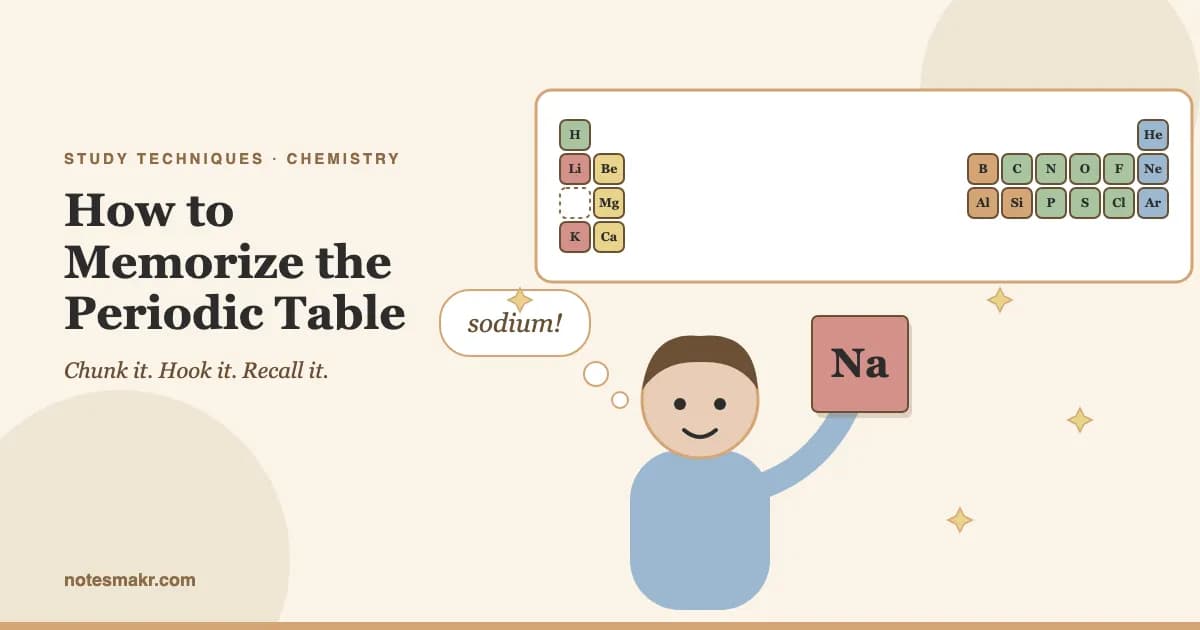
If you want to know how to memorize the periodic table, start with a question most guides skip: do you actually need to? There are 118 named elements, according to the International Union of Pure and Applied Chemistry (IUPAC), and almost no chemistry exam asks you to write them all from memory. What exams do ask is that you read symbols instantly, know where the main groups sit, and never confuse Na with N or Sn with S.
So this guide does two things. First, it shows you what your course really expects, which for most students is the first 20 elements and a short list of symbols that come from Latin. Then it gives you a method to lock those in: chunk the table, attach a hook to each chunk, and test yourself on a schedule. If you are working on chemistry more broadly, the guide on how to study chemistry covers the rest of the course.
How to Memorize the Periodic Table: The Short Version
Understand the layout, learn in chunks, recall rather than reread. Everything below is a detailed version of those three moves.
Do You Need to Memorize the Periodic Table?
For most exams, no. You need to know your way around it, not hold all of it in your head.
- AP Chemistry: College Board gives you a periodic table, along with the equations and constants sheet, for the whole exam. Its AP Chemistry equations sheet is the official version to practise with.
- AQA GCSE Chemistry: The AQA specification states that students will be given a periodic table in the exam, printed on the data sheet.
- Classroom quizzes: Many high school teachers set a quiz on the first 20 elements early in the course. This is the one place where pure memorization is often the whole task.
Here is a sensible target for most US high school and UK GCSE students:
- The first 20 elements, hydrogen to calcium, with names, symbols and order.
- The common elements with odd symbols: Na, K, Fe, Cu, Ag, Sn, Au, Hg and Pb.
- The group names and positions: alkali metals, alkaline earth metals, transition metals, halogens and noble gases.
If your teacher wants more, such as the first 36 elements, use the same method and add one more chunk at a time.
Understand the Layout Before You Memorize Anything
The periodic table is not a random grid. Elements are arranged in order of atomic number, the number of protons in the nucleus. Rows are called periods and columns are called groups, and elements in the same group behave in similar ways.
Knowing the layout cuts down what you have to memorize. If you know sodium is in group 1, you already know it behaves like lithium and potassium, so it is one fact, not three. The GCSE periodic table flashcards cover these group trends in depth if your course tests them.
How chemical symbols work
Every symbol follows two rules:
- One or two letters. The first is always a capital. The second, if there is one, is always lowercase. So chlorine is Cl, never CL.
- Capitals start new symbols. That is how you read formulas. CO is carbon and oxygen, carbon monoxide. Co is cobalt, a single element.
Most symbols come straight from the English name: C for carbon, Ca for calcium, Mg for magnesium. A few come from Latin or Greek names, and these are the ones students get wrong.
| Symbol | Element | Comes from |
|---|---|---|
| Na | Sodium | Latin natrium |
| K | Potassium | Latin kalium |
| Fe | Iron | Latin ferrum |
| Cu | Copper | Latin cuprum |
| Ag | Silver | Latin argentum |
| Sn | Tin | Latin stannum |
| Au | Gold | Latin aurum |
| Hg | Mercury | Latinized Greek hydrargyrum |
| Pb | Lead | Latin plumbum |
Nine symbols cause most of the trouble. Learn the Latin-origin set as its own chunk and the rest of the common symbols mostly follow the English names.
Chunk the Periodic Table Into Small Groups
Your working memory, the part of your mind that holds information while you use it, is small. Miller (1956) described it as holding around seven items, and later work by Cowan (2001) put the limit closer to four meaningful chunks. Either way, a list of 20 element names is far beyond it.
Chunking gets around the limit by grouping items into bigger units you can handle as one. Instead of 20 separate names, you learn two sentences of ten words each. The guide to the chunking study technique explains why this works for any long list.
For the periodic table, the natural chunks are:
- Chunk 1: elements 1 to 10, hydrogen to neon (periods 1 and 2)
- Chunk 2: elements 11 to 20, sodium to calcium (period 3 plus potassium and calcium)
- Chunk 3: the Latin-origin symbols in the table above
- Chunk 4 (if needed): elements 21 to 36, the first row of transition metals up to krypton
Learn one chunk until you can recall it cold, then add the next. Do not start chunk 2 while chunk 1 still needs prompting.
Periodic Table Mnemonics That Work
A mnemonic is a memory aid that links new information to something easier to recall, such as a sentence, a picture or a place. Mnemonics work best for lists that have no meaning of their own, and the order of element names is exactly that kind of list. The guide on mnemonic devices for studying covers the main types.
A sentence for each chunk
Take the first letter (or letters) of each element and build a sentence you can picture. Two examples:
- Elements 1 to 10 (H, He, Li, Be, B, C, N, O, F, Ne): "Happy Hens Live Beside Brown Cows, Nibbling Oats For Neighbors."
- Elements 11 to 20 (Na, Mg, Al, Si, P, S, Cl, Ar, K, Ca): "Naughty Magpies Always Sit Perched, Singing Clearly, Arguing, Kicking, Cackling."
A sentence you invent yourself usually sticks better than one you borrow, because building it makes you think about every element. Make it silly or vivid.
A story for the Latin symbols
The Latin set does not need an order, it needs a reason for each odd symbol. Give every one a hook:
- Pb, lead: Romans made water pipes from lead, plumbum, which is where the word plumber comes from.
- Ag, silver: Argentina is named after argentum, silver.
- Fe, iron: iron is ferrous, from ferrum.
- Cu, copper: the Romans mined copper on Cyprus, cuprum.
Songs and memory palaces
Songs are a popular option for the full table. AsapSCIENCE's periodic table song below runs through all 118 elements in order, which is a fun way to get the sequence familiar. If you have used the memory palace technique, you can place one element at each spot along a familiar route.
How to Memorize Element Symbols With Active Recall
Reading the table over and over feels productive but mostly builds familiarity. Active recall, pulling the answer out of memory before you check it, is what builds memory you can use in a test. Roediger and Karpicke (2006) found that students who tested themselves on a passage remembered more of it a week later than students who spent the same time restudying.
Here is how to apply that to the periodic table:
For each element, make one card from symbol to name ("Na → ?") and one from name to symbol ("Sodium → ?"). Exams test both directions, and recalling one direction does not guarantee the other.
On a blank page, write chunk 1 in order with symbols. Check it against a real table. Circle every mistake and drill only those.
Once names and symbols feel solid, practise reading formulas like KNO3, CuSO4 and CaCO3 aloud. This is the skill exams use, and it shows up gaps that flashcards hide.
Review the next day, then after a few days, then after a week. Cepeda and colleagues (2006) reviewed hundreds of experiments and found spaced study beat massed study for long-term recall. The spaced repetition guide explains how to set the intervals.
Use cloze cards for symbols
Cloze cards, fill-in-the-blank sentences, suit symbols well. A card such as "Na is the symbol for {sodium}, from the Latin natrium" makes you produce the name and gives you the reason in one go. The guide to cloze deletion flashcards shows how to write good ones.
A Worked Example: Two Ways to Learn the First 20 Elements
Monday to Thursday, 20 minutes a day reading the first two rows.
By Friday the table looks familiar. In the class quiz, the student writes "So" for sodium and "P" for potassium, because recognising a symbol on a page is not the same as producing it from nothing.
Monday: learn chunk 1 with a mnemonic sentence. Tuesday: write it from memory, fix mistakes, start chunk 2. Wednesday: two-way flashcards for both chunks. Thursday: read ten formulas aloud.
Every review starts with recall, so every gap shows up before the quiz. The Latin symbols get their own hooks, so Na and K stop being traps.
The second student spends no more time. They spend it producing answers instead of looking at them.
Study this topic three ways
Reading is the slowest way to learn element symbols. Once the method makes sense, switch to active recall:
- Element names and symbols flashcards: 30 cards covering the first 20 elements plus the Latin-origin symbols, each with where its name comes from and a real-world example.
- Element symbols practice questions: 25 questions that make you read formulas, spot wrong symbols and place elements, rather than just recognise names.
Quick Reference: How to Memorize the Periodic Table Fast
| Step | What to do | Time |
|---|---|---|
| Check your course | Find out which elements your exam or teacher expects | One evening |
| Learn the layout | Groups, periods, how symbols are written | One session |
| Chunk 1 and 2 | Elements 1 to 20, one mnemonic sentence each | A few days |
| Latin set | Na, K, Fe, Cu, Ag, Sn, Au, Hg, Pb with hooks | One or two sessions |
| Recall and space | Two-way flashcards, write from memory, read formulas | 10 minutes most days |
Supercharge Your Element Practice With Notesmakr
Notesmakr is an AI notes maker and flashcard app for iPhone, iPad and Android. It won't sit your chemistry quiz for you, but it handles the recall and scheduling that make symbols stick.
- Cloze cards with hints: Write cards like "Na is {sodium}". Cloze cards are free, and their progressive letter hints, called Diminishing Cues, reveal fewer letters as you learn each card.
- Spaced repetition: Reviews are scheduled with the SM-2 algorithm, so the chunk you learned in week one comes back before you forget it.
- Study streaks: A daily streak counter keeps the 10-minute habit going.
- AI from your own materials: Upload a chemistry chapter as a PDF to get a simplified note, then generate flashcards and quizzes from it. AI is free within the free plan's limits (5 notes and 40 generations, lifetime). You can also make as many cards by hand as you like.
Already have your class handout as a PDF? Turn it into flashcards, or build a self-test with the AI quiz maker. For more on building decks with AI, read the AI flashcards guide.
Common Mistakes When Memorizing the Periodic Table
Mistake 1: Trying to learn all 118 at once
Most of the table is never tested from memory, and a giant list overwhelms working memory.
The fix: Check what your course needs and learn it in chunks of about ten.
Mistake 2: Learning only one direction
Knowing that Na is sodium does not mean you will write Na when a question says sodium.
The fix: Make a card for each direction and mix them in every review.
Mistake 3: Ignoring capital letters
Writing CO for cobalt or CL for chlorine changes the meaning or makes the symbol wrong.
The fix: Practise reading and writing formulas, not just lone symbols.
Mistake 4: Guessing Latin symbols from English names
Sn is not sulfur or sodium, and Ag is not argon.
The fix: Learn the Latin-origin set as its own chunk with a hook for each.
Mistake 5: Cramming the night before
Massed review fades quickly. For more ways to make facts last, see how to memorize things fast.
The fix: Ten minutes a day across a week beats an hour the night before.
Research and Citations
- Working memory span (Miller, 1956): The classic paper describing a short-term memory span of about seven items. Read the paper.
- Working memory chunks (Cowan, 2001): A review arguing working memory holds about four meaningful chunks. Read the paper.
- The testing effect (Roediger and Karpicke, 2006): Self-testing beat restudying for recall a week later. Read the paper.
- Distributed practice (Cepeda, Pashler, Vul, Wixted and Rohrer, 2006): Spaced study beat massed study for long-term retention across hundreds of experiments. Read the paper.
- Learning techniques review (Dunlosky, Rawson, Marsh, Nathan and Willingham, 2013): Practice testing and distributed practice rated high utility; the keyword mnemonic and rereading rated low. Read the paper.
Frequently Asked Questions
Do you need to memorize the periodic table?
Usually not the whole thing. AP Chemistry and AQA GCSE Chemistry both give you a periodic table in the exam. What you do need is to read symbols quickly, know the main groups, and recall the first 20 elements and common Latin-origin symbols such as Na, K, Fe and Pb without searching the table.
How do you memorize the first 20 elements?
Split them into two chunks of ten, hydrogen to neon and sodium to calcium. Build a vivid mnemonic sentence for each chunk using the first letters of the elements. Then write each chunk from memory, check it, and review with two-way flashcards over several days until every symbol comes back instantly.
How long does it take to memorize the periodic table?
The first 20 elements take most students a few days of short daily sessions with a mnemonic and flashcards. The whole table takes much longer and is rarely needed. Learning one chunk at a time and reviewing it on a spaced schedule is faster overall than trying to learn everything in one long session.
Why is sodium Na and potassium K?
Their symbols come from Latin names rather than English ones. Sodium was called natrium and potassium was called kalium, so their symbols are Na and K. Iron (Fe, ferrum), copper (Cu, cuprum), silver (Ag, argentum), tin (Sn, stannum), gold (Au, aurum) and lead (Pb, plumbum) follow the same pattern.
What is the best way to memorize element symbols?
Use active recall, not rereading. Make flashcards in both directions, symbol to name and name to symbol, and review them on a spaced schedule. Add a short hook for each odd symbol, such as plumbing for lead, and practise reading real formulas like CuSO4 so you can use the symbols, not just recognise them.
Start Today
- Today: Ask your teacher or check your syllabus for which elements you must know.
- Tonight: Write a mnemonic sentence for elements 1 to 10 and say it out loud three times.
- Tomorrow: Write chunk 1 from memory before looking at anything. Fix what you missed.
- This week: Add chunk 2 and the Latin set, with two-way flashcards for all of them.
- Next week: Read ten formulas a day and keep your flashcard reviews going.
You don't need to know all 118 elements. You need the ones your course uses, recalled without hesitation. Start with ten tonight.