
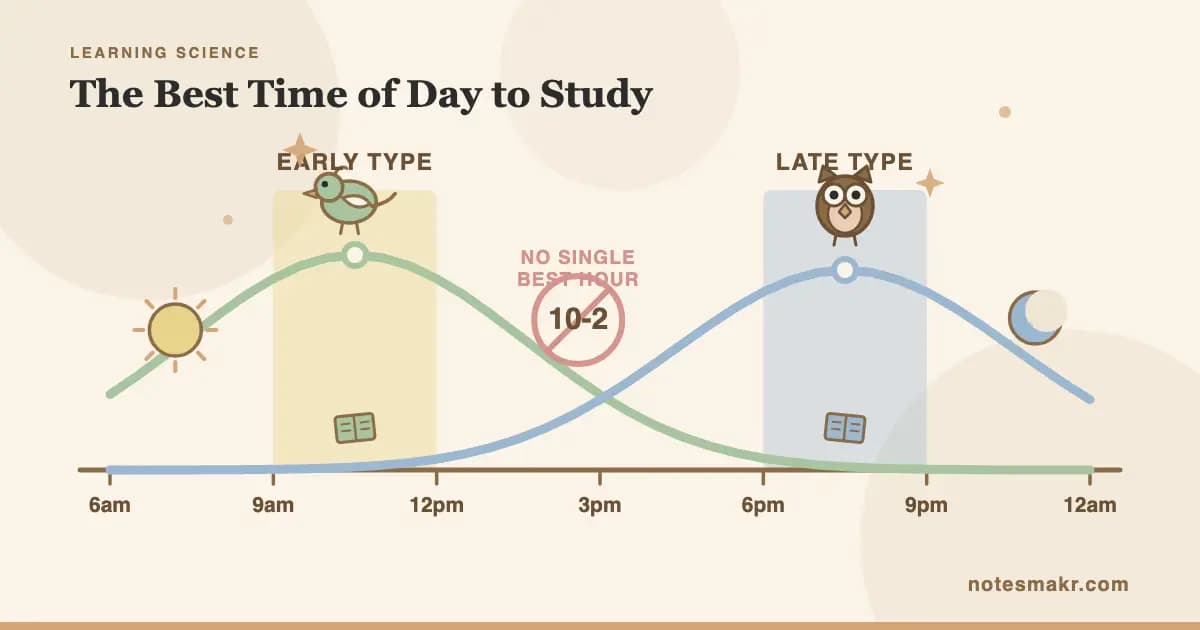
Search for the best time of day to study and you will get the same answer from a dozen sites: 10am to 2pm. Sometimes 4pm to 10pm gets a mention. Almost none of those pages cite a single study.
Here is the uncomfortable truth. There is no universally best hour. Nobody has ever found one, because the research that actually exists is not looking for one. It is looking at something more useful: the gap between when you are sharp and when your timetable says you should be.
That gap is measurable, it predicts grades, and it is fixable. This post is about closing it.
What "best time of day to study" actually means
Chronotype is your body's natural preference for when to sleep and when to be alert. Early types (larks) hit their peak in the morning. Late types (owls) hit theirs in the late afternoon or evening. Most people sit somewhere in the middle.
The synchrony effect is the finding that people tend to perform better on demanding cognitive tasks when they are tested at their own peak time rather than off it. That is the real research claim. Not "10am is best." Instead: your best hour beats your worst hour, and your best hour is not the same as your neighbour's.
Chronotype is also not fixed for life. Roenneberg and colleagues (2004) surveyed around 25,000 people aged 10 to 90 and found that sleep timing gets progressively later through adolescence, peaks in lateness at roughly age 20, then reverses. If you are a university student who cannot function before 10am, you are sitting at the biological extreme of the entire population. That is normal, and it is temporary.
Once you know your own peak, the next job is protecting it, which is what a proper study schedule is for.
The science: a synchrony effect, not a magic hour
May, Hasher and Healey reviewed this literature in 2023 in Perspectives on Psychological Science. Across attention, memory, judgment, decision-making and neuropsychological assessment, they report that optimal outcomes cluster around peaks in circadian arousal. You can read the full review here.
Now the part every listicle leaves out.
The synchrony effect is contested. Rey-Mermet and Rothen (2023), publishing in Collabra: Psychology, pointed out that much of the earlier evidence came from underpowered studies using a single task each. They ran a better-powered test across two constructs, short-term maintenance and attentional control, and found no general or robust cognitive boost. Their title says it plainly: the interplay of time-of-day and chronotype results in no general and robust cognitive boost.
So the honest position is this. Timing effects are real and repeatedly observed in older adults and in real-world academic outcomes. They are shakier for young adults doing short lab tasks. Anyone selling you a precise golden hour is going well past the evidence.
The effect that survives every study is the mismatch effect. Being forced to perform far from your peak costs you. That is a scheduling problem, and scheduling is something you control.
Why "10am to 2pm" keeps getting repeated
That range is not made up, exactly. It is roughly the average peak of a population that is mostly intermediate chronotypes. The problem is what averaging does.
Evans, Kelley and Kelley (2017) asked 190 undergraduates to rate their fitness for cognitive work in every hour of the day, then modelled optimal start times. For a single fixed start time, 11am to 1pm came out close to optimal. But the individual spread was enormous. Morning types peaked between roughly 9am and noon. Students who identified as definitely evening types did not peak until somewhere between 6:30pm and 10:30pm.
Their conclusion is the sentence the SERP forgot: every single start time disadvantages one or more chronotypes. Personalised timing reached about 88% optimality. The best possible fixed time topped out at 81%. You can read the study on PubMed Central.
Averaging 190 different peaks into "10am to 2pm" and handing it to an owl is like averaging shoe sizes and telling everyone to wear a size 8.
Your timetable is doing more damage than your alarm clock
This is where the research stops being abstract.
Zerbini and colleagues (2017) analysed 40,890 grades collected across a full school year at a Dutch secondary school. Comparing the earliest 20% of chronotypes with the latest 20%, grades dropped from roughly the 55th percentile to the 43rd. The effect was concentrated in science subjects, which lean on fluid cognition, and it was worst when exams were scheduled early in the day. Humanities subjects, which lean more on crystallised knowledge, showed no chronotype correlation. The full paper is open access in Scientific Reports.
Then there is the paradox that should end the "night owls are lazy" argument for good. Preckel and colleagues (2011) meta-analysed chronotype against both cognitive ability and academic achievement. Eveningness correlated slightly positively with cognitive ability (r = .08) and negatively with achievement (r = -.14). Morningness ran the other way: slightly negative with ability, positive with achievement (r = .16). The meta-analysis record is on ERIC.
Read that twice. Evening types are not less capable. They are being assessed at the wrong hour.
The task matters as much as the hour
Here is the finding that breaks the whole "peak hour" framing, and it is my favourite result in this literature.
Wieth and Zacks (2011) had people solve insight problems (the kind needing a sudden reframe) and analytic problems (the kind needing steady step-by-step work) at their optimal and non-optimal times. Analytic performance showed no consistent time-of-day effect. Insight performance was consistently better at the non-optimal time. Their paper is titled, accurately, "Time of day effects on problem solving: When the non-optimal is optimal."
The proposed mechanism: at your peak you have tight attentional control, which is exactly what you want for grinding through a proof and exactly what stops you noticing the odd association that cracks a creative problem.
Time-of-day effects on memory split the same way. Folkard, Monk, Bradbury and Rosenthall (1977) read a story to schoolchildren at either 9am or 3pm. The morning group did better on immediate recall. The afternoon group did better on recall a week later.
"Everything important goes in the 10am to 2pm block."
10am, first read of a hard chapter. 11am, flashcard review. 12pm, essay outline. 1pm, practice problems. Evening left empty because "the brain is done by then."
This student is a confirmed owl. They spend four hours pushing a rock uphill, then throw away the four hours when the rock rolls by itself.
"Hard encoding at my peak. Everything else fills the rest."
10am, flashcard review (low control needed, the scheduler decides what appears). 12pm, admin and tidying notes. 4pm, essay outline while control is loose and connections come easily. 6pm to 8pm, peak block: first read of the hard chapter and the practice problems.
Same eight hours. The two tasks that genuinely need peak cognition now sit at the peak.
Watch: how the body clock actually works
How does your body know what time it is? - TED-Ed
A four-minute primer on the master clock in your hypothalamus and the light cues that set it. Key insight: your clock runs on a cycle close to but not exactly 24 hours, so it is re-set every day by light. That is why your peak drifts when your light exposure changes.
The Power of When - Michael Breus, Talks at Google
Breus makes the practical case for scheduling around chronotype rather than fighting it. Key insight: the same task done at two different hours is effectively two different tasks in difficulty terms. Treat his four-animal chronotype taxonomy as a communication device rather than a validated instrument. The underlying morningness-eveningness distinction is the part with the research behind it.
How to build a schedule around your real peak
Use the free-day sleep midpoint from the challenge above. Then log your actual focus for one week: rate each study hour 1 to 5 for how hard it felt to concentrate. Seven days of honest ratings beat any online chronotype quiz.
Two hours, not eight. Circadian arousal is a slow wave, not a switch, and defending one block is achievable in a real timetable. This block is for new and difficult material only.
High control (learning new theory, working problems, timed practice) goes in the peak block. Low control (review, formatting, sorting notes, listening back to a lecture) goes anywhere. Brainstorming and essay planning can go deliberately off-peak.
Do not schedule revision by when you feel sharp. Schedule it by when you are about to forget. That is a different question entirely, and it is what spaced repetition exists to answer.
Timetable it like a lecture you cannot skip. Time blocking works here precisely because the decision gets made once, in advance, instead of every day at 6pm.
Quick reference: which hour for which task
| Task | Best window | Why |
|---|---|---|
| First encounter with hard material | Your peak block | Highest attentional control, best encoding |
| Timed practice and past papers | Your peak, or the exam's hour | Match the conditions you will be tested in |
| Spaced repetition review | Whenever the schedule says | The algorithm picks the day; the hour barely matters |
| Essay planning and idea generation | Off-peak | Looser control aids insight (Wieth & Zacks, 2011) |
| Admin, formatting, note tidying | Off-peak trough | Low cognitive cost, do not waste a peak on it |
| Light review before sleep | Evening | Overnight consolidation, see sleep and learning |
One caveat on the exam row. If your exam is at 9am and you are an owl, some peak-block practice should be moved to 9am in the fortnight beforehand. You are not training your chronotype. You are removing the novelty of doing hard work at an unfamiliar hour.
Common mistakes to avoid
Mistake 1: Trying to become a morning person before an exam
Shifting a chronotype takes weeks of consistent light exposure and sleep timing, and it partially reverses the moment the pressure stops.
The fix: shift by 15 to 20 minutes per day, start at least three weeks out, and get bright light in the first hour after waking. If you have less than three weeks, do not attempt it. Practise at the exam hour instead and leave your sleep alone.
Mistake 2: Calling the afternoon dip a personal failing
Most people get a slump in the early-to-mid afternoon. It is a normal feature of the circadian and homeostatic system interacting, not evidence you are undisciplined.
The fix: schedule the dip. Put low-control work there deliberately. If you are genuinely exhausted rather than just dipping, studying when tired is a separate problem with separate tactics.
Mistake 3: Stealing peak hours from sleep
An owl who studies until 2am and still has a 9am lecture is not using their peak. They are running a sleep debt that erases the advantage.
The fix: your peak block has to fit inside a schedule that still gives you a full night. If it cannot, the timetable is the thing that needs to change, not the sleep.
Mistake 4: Optimising the hour and ignoring the method
An hour of re-reading at your peak still loses to twenty minutes of retrieval practice at your trough. Timing is a multiplier on your method, not a substitute for it.
The fix: get the method right first, then time it well. Start with a routine you can actually repeat.
The research behind it
- Synchrony effect review (May, Hasher & Healey, 2023): across attention, memory, decision-making and academic outcomes, performance peaks align with peaks in circadian arousal.
- The null result (Rey-Mermet & Rothen, 2023): a better-powered test across short-term maintenance and attentional control found no general or robust synchrony boost, and flagged that earlier evidence was largely underpowered.
- Insight versus analysis (Wieth & Zacks, 2011): insight problem solving was consistently better at non-optimal times of day; analytic problem solving showed no consistent effect.
- Chronotype and grades (Zerbini et al., 2017): across 40,890 grades, the latest 20% of chronotypes sat around the 43rd percentile against the earliest 20% at the 55th, with the effect concentrated in science subjects and early exams.
- The eveningness paradox (Preckel et al., 2011): meta-analysis found eveningness positively related to cognitive ability (r = .08) but negatively to achievement (r = -.14), while morningness showed the reverse pattern.
- Immediate versus delayed recall (Folkard, Monk, Bradbury & Rosenthall, 1977): schoolchildren read a story at 9am recalled more immediately; those read it at 3pm recalled more a week later. Summarised in this ASCD review of the time-of-day literature.
- Chronotype across the lifespan (Roenneberg et al., 2004): in a survey of around 25,000 people, sleep timing grows later through adolescence, peaks in lateness at about age 20, then reverses. Nature's write-up is here.
- Optimal university start times (Evans, Kelley & Kelley, 2017): among 190 undergraduates, every single fixed start time disadvantaged at least one chronotype group.
How Notesmakr helps you protect your peak
Notesmakr is a notes maker and study app that turns your material into flashcards, quizzes and simplified explanations using the Feynman Technique. Three parts of it are directly useful once you know when your peak is.
The Focus Timer marks the block. Free accounts get the classic 25/5/15 cycle: 25 minutes of focus, a 5 minute break, and a 15 minute long break every fourth block. Two of those cycles is a two-hour peak block with breaks already built in.
SM-2 spaced repetition removes the hour from the review decision. Notesmakr schedules flashcard reviews with the SuperMemo 2 algorithm, tracking interval, repetition count and ease factor per card. The scheduler decides which cards are due today regardless of how sharp you feel, which is precisely the point. Free accounts get manual cards, cloze cards with Diminishing Cues, and Anki .apkg import and export, so a deck you already own can come with you.
Study streaks make consistency visible. The peak block only pays off if it happens more than twice.
On a paid Scholar plan, focus analytics and session history let you stop guessing entirely. Instead of estimating your peak from a sleep midpoint, you can look at when your completed sessions actually cluster. Scholar also raises the limits on AI generation of flashcards, quizzes, mind maps and Feynman-style simplification (free accounts get 5 AI notes and 40 AI generations), and adds Focus Timer customisation if 25/5/15 is not your rhythm.
If you want a starting structure for the peak block itself, the study guide generator will lay one out from your material, and the AI quiz maker turns it into retrieval practice. For the wider system this plugs into, start with the complete guide to AI flashcards.
Frequently asked questions
What is the best time of day to study?
There is no single best hour for everyone. Research supports a synchrony effect: you perform better on demanding tasks near your own circadian peak. Morning types typically peak between 9am and noon, evening types between late afternoon and 10pm. Measure your own peak rather than adopting a generic range.
Is it better to study at night or in the morning?
It depends on your chronotype and the task. Morning study favours immediate encoding of new material. Evening study suits late chronotypes and benefits from overnight consolidation. Folkard et al. (1977) found morning learners recalled more immediately, while afternoon learners recalled more one week later.
Are night owls worse students?
No. Preckel et al. (2011) found eveningness correlated slightly positively with cognitive ability but negatively with grades. Evening types are not less capable. They are typically assessed at hours that suit early types, which Zerbini et al. (2017) showed costs them roughly twelve percentile points in grades.
How do I find my chronotype?
Calculate your sleep midpoint on days with no alarm. Take your sleep onset time and wake time, then find the middle. A midpoint before 3:30am leans early, after 5:30am leans late. Confirm it by rating your concentration hourly for one week of normal study.
Can I change my chronotype before an exam?
Partially and slowly. Shifting sleep timing by 15 to 20 minutes per day with bright morning light can move your clock over about three weeks, and it tends to drift back afterwards. With less than three weeks, practise at the exam hour instead and protect your sleep.
Start today
- Calculate your free-day sleep midpoint tonight. Two minutes.
- Rate your concentration 1 to 5 for every study hour this week.
- Pick the two-hour window that scores highest and name it your peak block.
- Move one hard task into it tomorrow and one easy task out.
- Put review on a spaced repetition schedule so its timing stops competing with your peak.
- Re-measure next term, because the answer moves.
Stop looking for the hour that works for everyone. Find the two hours that work for you, and then defend them.
"The phase of an individual's body clock in relationship to a zeitgeber is a biological phenomenon and not a matter of discipline."
— Till Roenneberg, Internal Time: Chronotypes, Social Jet Lag, and Why You're So Tired