

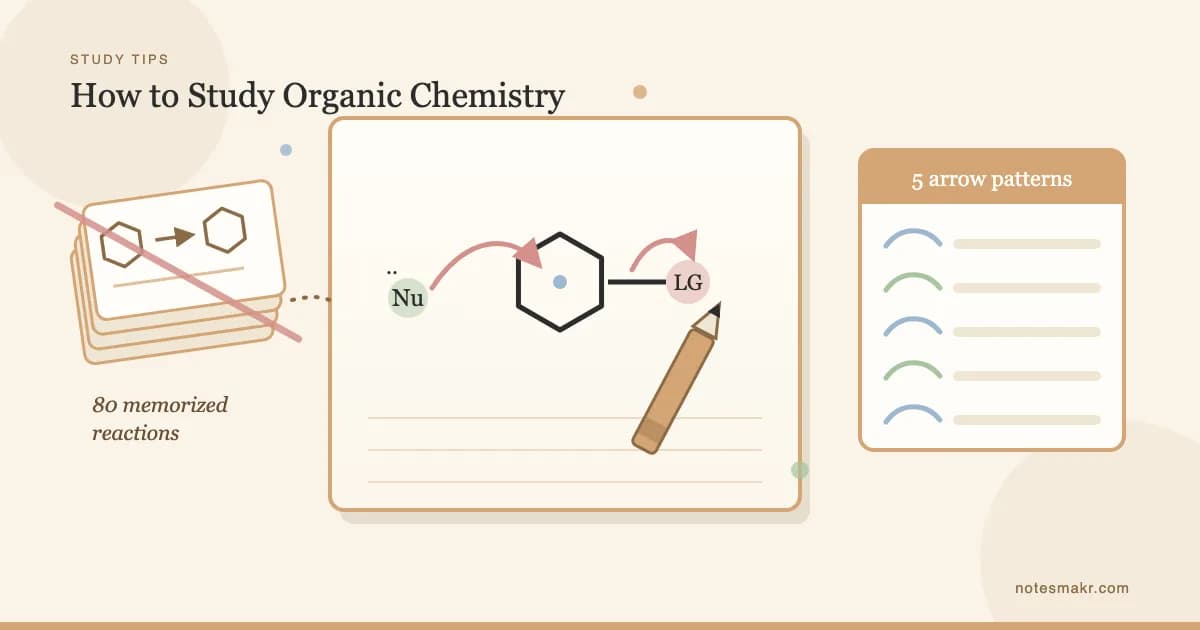
Here is the uncomfortable truth about how to study organic chemistry: you can memorize all 80 reactions on the syllabus, walk into the midterm, and still fail. Not because you forgot them. Because the reaction on question 4 is not one of the 80. It uses a reagent your professor mentioned once, on a substrate you have never drawn, and the question asks for the full mechanism with curved arrows.
That is the whole course in one sentence. Organic chemistry does not test what you stored. It tests what you can produce on a blank page under time pressure, for a molecule you are meeting for the first time.
Most study advice for this class is wrong because it optimizes for storage. Read the chapter. Make cards for the reactions. Rewatch the lecture. Those are input activities, and orgo grades output. This guide is about the switch, and what a week actually looks like when you make it.
What Studying Organic Chemistry Actually Means
Studying organic chemistry means practicing the production of mechanisms and syntheses on paper, from memory, for reactions you have not seen before. It is a drawing skill built on a small set of electron-flow patterns, not a recall skill built on a long list of named reactions. Reading, highlighting, and rewatching lectures do not train it.
Three things separate this course from the chemistry you have already survived.
The unit of work is a drawing, not an answer. In general chemistry, you calculate a number. In organic chemistry, you draw a structure, then a second structure, then the arrows that connect them. Partial credit lives in the arrows.
Novelty is the point. Exams deliberately include substrates and reagent combinations from outside the problem sets. Your professor is not being cruel. They are testing whether you learned the underlying reactivity or just the answer key.
It compounds. Week 9 assumes weeks 1 through 8 are still in your hands, not in your notes. Fall behind by two weeks and you are not behind by two weeks, you are lost, because every new mechanism is written in the vocabulary of the old ones.
Organic chemistry is a production course wearing a memorization costume. The exam asks you to generate something, so your study time has to be spent generating things.
Why Students Fail Organic Chemistry (It Is Not Intelligence)
The failure rates are real. Attrition across the two-semester organic sequence runs roughly 30 to 50% at many large institutions. A decade-long analysis of two introductory organic courses covering 9,254 students and 18 instructors found that moving to active learning studios cut the D, F, and withdrawal rate by 59% for non-underrepresented-minority students and 49% for underrepresented-minority students (Heeren et al., 2025). Read that finding backwards and it tells you something useful about your own desk. The variable that moved outcomes at scale was not more lecture. It was more student production.
The mechanism of failure is documented too, and it is uncomfortably specific.
The "it gets me to the product" trap
Bhattacharyya and Bodner (2005) watched graduate students propose mechanisms for two-step to four-step reactions. What they found is now one of the most cited results in chemistry education: students drew arrows that got them to the product, even when those arrows did not represent the likely mechanism. The arrows were reverse-engineered from the answer, not derived from the electrons.
If graduate students do this, you are doing it. And it works right up until the moment the product is not given to you.
Nicole Graulich's 2015 review of the research on how students actually experience organic chemistry classes reaches the same place from a different direction. Across studies of problem solving, arrow pushing, and conceptual knowledge, the recurring finding is that students operate on the visible surface of the notation while the reasoning underneath stays invisible.
The rote-to-meaningful continuum
Grove and Bretz (2012) mapped where organic students actually sit between rote memorization and meaningful learning, and found it is not two categories but a continuum with three positions worth naming: unaware learners, transitional learners, and meaningful learners. The finding that matters for you is what moves people along it. Not talent. Metacognition. Noticing what you do not understand, and treating that gap as the assignment.
Recognition is not production. You recognize the E2 mechanism when you see it worked out. That feeling is not the same as being able to draw it on an empty page, and only one of those two things is on the exam.
Try this now: Close every tab. Get a blank sheet. Set a 4-minute timer. Draw the complete mechanism for the last reaction your class covered, including every curved arrow, every formal charge, and every intermediate. No peeking. When the timer ends, compare with your notes. The gap you just found is your actual study list for tonight, and it is almost certainly shorter and more specific than "review chapter 7."
The Blank Page Rule
Here is the rule the rest of this guide hangs on.
A study session only counts if something came out of your head onto blank paper. Not a highlighted page. Not a rewatched video. Not a re-copied mechanism with the textbook open beside you. A drawing you produced with the book closed.
This is the same principle behind active recall, applied to a subject where the recalled item is a picture. Dunlosky et al. (2013) reviewed ten common study techniques and rated only two as high utility across subjects and learners: practice testing and distributed practice. Highlighting, re-reading, and summarizing all landed in the low-utility bin. In organic chemistry the gap is even wider than usual, because the re-reading feels so productive. Mechanisms are beautiful. Watching one unfold is genuinely satisfying. That satisfaction is the illusion of competence wearing a lab coat.
The Weekly Cycle That Works
Five steps. Run this every week from week one, not from the week before the midterm.
The night before class, skim the slides or the chapter section. You are not learning it. You are buying yourself a map so that lecture is your second exposure instead of your first. Twenty minutes is enough. Write down the two things that look most confusing and take those questions into the room.
Same day if possible. Close the notes. On blank paper, redraw every mechanism from that lecture, arrows included. Then open the notes and mark your errors in a different color. The color-marked errors are the only part worth reviewing again. This single habit does more than any other on this list, and it takes about 25 minutes.
Do the assigned problems, then keep going into the unassigned ones in the same chapter. The assigned set teaches you the pattern. The unassigned set is where you find out whether you learned the pattern or just the specific molecules. Aim to end every problem session on a question you have never seen.
Every study block starts with five minutes of drawing something from two or three weeks ago. Cepeda et al. (2006) synthesized 184 spacing experiments and found distributed practice reliably beats massed practice for durable retention. In orgo this is not optional polish. Chapter 11 is built out of chapter 6.
Pick 6 to 8 problems, set a timer matched to your real exam pace, and work with no notes. Then grade yourself and sort every lost point into two piles: "did not know the chemistry" and "knew it but drew it wrong or ran out of time." Those two piles get completely different fixes, and students who never separate them keep re-studying content when the real problem was pacing.
Build a Mechanism-First Index, Not a Reaction List
This is where most students lose the semester. They keep a running list of named reactions, and by finals that list is 80 items long and unusable.
Flip the organization. Flynn and Ogilvie (2015) redesigned the entire first-year organic curriculum at the University of Ottawa around exactly this idea, teaching mechanisms and the electron-pushing formalism before students learned a single reaction, and then arranging the reactions of the first two semesters by their governing mechanism rather than by functional group, in order of increasing difficulty: acid-base first, then simple additions to pi electrophiles, aromatic chemistry, eliminations, and substitutions.
You can do the same thing to your own notes even if your professor teaches functional group by functional group. Every reaction on your syllabus is built from a handful of elementary steps.
| Elementary step | What the arrow does | Shows up in |
|---|---|---|
| Proton transfer | Lone pair or pi bond grabs H | Almost everything, acid-base first |
| Nucleophilic attack | Electron-rich attacks electron-poor | SN1, SN2, additions, acyl substitution |
| Loss of a leaving group | Bonding pair leaves with the group | SN1, E1, acyl substitution |
| Rearrangement | Hydride or alkyl shift to a better cation | Carbocation chemistry |
| Deprotonation to form a pi bond | Base removes H, electrons make a double bond | E1, E2, enolate chemistry |
Five rows. Eighty reactions. When a novel reaction appears on an exam, you are no longer searching a list of 80 for a match. You are asking a much smaller question: where are the electrons rich, where are they poor, and which of these five steps can happen first?
Keep one page in the front of your binder titled "arrow patterns." Every time you meet a new reaction, do not add the reaction to a list. Add a tick mark next to the elementary steps it uses. By November you will have a physical record showing how few distinct moves the course actually contains.
Nomenclature, pKa values, and reagent identities are genuinely list-shaped, and those belong on flashcards. Mechanisms are not, and that distinction gets its own section below. If you want the general version of this idea for other sciences, our guide on how to study chemistry covers the general and AP-level course, and how to memorize formulas handles the pure recall layer. The same list-shaped-versus-drill split runs through how to study calculus: rules and theorem conditions go on cards, problem-solving only comes from reps.
For the list-shaped half specifically, we have built the two artifacts to match: a 39-card organic chemistry reactions deck covering leaving groups, carbocation stability, stereochemistry vocabulary and the SN1/SN2/E1/E2 conditions, and a 25-question organic chemistry practice quiz that makes you pick the mechanism and predict the major product rather than recognize a definition.
How Many Hours a Week Should You Study Organic Chemistry?
Plan on 10 to 15 hours per week outside of class for a standard four-credit organic chemistry course. That is roughly two hours a day, six days a week, and it is the figure most university chemistry departments and successful students converge on. But hours are the wrong unit to obsess over. The ratio inside those hours decides your grade.
| Phase of the semester | Hours per week | Input (read, watch) | Output (draw, solve) |
|---|---|---|---|
| Weeks 1 to 3, foundations | 8 to 10 | 40% | 60% |
| Normal weeks | 10 to 15 | 25% | 75% |
| Week before an exam | 15 to 18 | 10% | 90% |
| Finals period | 15 to 20 | 5% | 95% |
Hours ranges reflect typical university chemistry department guidance for a four-credit organic course. Ratios are the study allocation this guide recommends.
Two students both log 12 hours. One spends 9 of them reading and rewatching, 3 drawing. The other spends 3 reading and 9 drawing. They have not done the same amount of work, and the exam will say so out loud.
You cannot cram organic chemistry. This is the one subject where that advice is literal rather than motivational. The material is cumulative and procedural, and procedural skills need repetitions spread across days. If you are already behind, do not try to catch up by reading faster. Go back to the earliest mechanism you cannot draw from memory and rebuild forward from there. Our guide on how to cram for an exam is honest about what cramming can and cannot rescue.
Practice Synthesis Problems Backwards
Multi-step synthesis is where students who did fine on mechanisms suddenly stall. The question gives you a starting material and a target, and you have to invent the route.
The reason forward practice fails here is that a synthesis problem is a search problem. Searching forward from the starting material, every reaction you know is a legal move, and the branches explode. Searching backwards from the target, the question is much tighter: what single bond in this molecule is the last one formed, and what two pieces would make it?
Work the retrosynthesis explicitly.
- Draw the target. Circle the carbon skeleton that came from the starting material.
- Find the bonds that are new. Those are the ones your route has to create.
- For the last new bond, ask which reaction in the course forms that bond type.
- Draw the immediate precursor. Now treat that as your new target and repeat.
- Stop when the precursor is the starting material, then write the route forwards with reagents and conditions.
A second drill that works: take any reaction from your problem set, cover the starting material, and try to reconstruct it from the product and reagents. Do this with a study partner and it turns into a game. The partner names a product, you name plausible starting materials. This is the exact cognitive move a synthesis question asks for, and almost nobody practices it deliberately.
Mixing reaction types while you practice matters too. Rohrer and Taylor (2007) found that mixed problem sets produced dramatically better delayed test performance than blocked practice of one type at a time, because sorting out which method applies is itself the skill being tested. Doing 20 SN2 problems in a row teaches you nothing about recognizing an SN2 problem. Our guide on interleaving explains how to build a mixed set without making your practice feel like chaos.
Watch: Organic Chemistry Thinking in Action
Do Not Be Afraid of Organic Chemistry: Jakob Magolan (TEDx)
Chemistry professor Jakob Magolan teaches the core logic of organic chemistry in one talk
Magolan, a chemistry professor, compresses the conceptual core of the course into a single talk aimed at people who think they cannot do it. Key insight: organic chemistry is a language with a small grammar, and the fear comes from being taught vocabulary before grammar.
Intro to Reaction Mechanisms: Crash Course Organic Chemistry
Crash Course Organic Chemistry #13 on reading and writing reaction mechanisms
This episode walks through what the curved arrows actually mean rather than how to copy them. Key insight: an arrow is a claim about where a pair of electrons goes, so if you cannot say which electrons and why, you have drawn decoration rather than a mechanism.
Two Students, Same 12 Hours
Quick Reference: What To Do In Each Situation
| Situation | What to do |
|---|---|
| Two weeks behind | Find the earliest mechanism you cannot draw blind, rebuild forward from there |
| Mechanisms feel fine, synthesis does not | Switch to retrosynthesis drills, work backwards from targets |
| You know reactions but freeze on new substrates | Stop naming reactions, start labeling nucleophile, electrophile, leaving group |
| Running out of time on exams | Timed sets. This is a pacing problem, not a content problem |
| Cannot keep 80 reactions straight | Rebuild your notes around the five elementary steps, not the reaction names |
| Blanking on reagents and pKa values | This part genuinely is recall. Cloze flashcards, spaced |
| Exam in 3 days | Timed mixed problem sets only, then fix just the misses |
Try this now: Take the last problem set you completed with the solutions open. Cover the answers. Redo three problems from it cold, with a timer, on blank paper. If your score drops sharply from the version you did with help, you have just measured the exact difference between recognition and production. That difference is your grade.
What Flashcards Are Actually For in Organic Chemistry
Time for the honest section, because most study apps will not tell you this.
Flashcards cannot teach you mechanisms. A mechanism is a multi-step production task performed on paper. Compressing it onto a card front and back trains you to recognize the finished picture, which is exactly the failure mode Bhattacharyya and Bodner documented. If you make one card per named reaction, you are building the 80-item list this guide has been arguing against.
Flashcards are excellent for the list-shaped half of the course, and orgo has a genuine list-shaped half that trips up students who ignore it:
- Reagent to transformation: what does mCPBA do, what does LiAlH4 reduce, what does NBS with light do
- pKa values worth knowing cold
- Nomenclature rules and priority sequences
- Functional group identification
- Stereochemistry vocabulary: R and S assignment rules, meso, enantiomer versus diastereomer
That is a real chunk of exam points, and it is pure retrieval. Run it with spaced repetition and it takes ten minutes a day instead of a Sunday.
Notesmakr is an AI-powered notes maker for exactly that split. Free, with no subscription, you get manual and cloze fill-in-the-blank cards with Diminishing Cues (progressive letter hints that fade as you learn a card, based on Fiechter and Benjamin's 2017 finding on retention), SM-2 spaced repetition scheduling, Anki .apkg import if you already have a deck, Anki-compatible export, a Focus Timer on the classic 25/5/15 cycle, and study streaks. Cloze cards suit reagent chemistry unusually well: blank the reagent, keep the transformation, and you are retrieving rather than recognizing.
On the paid Scholar plan, AI generation turns a lecture PDF, your typed notes, an audio recording, or a phone scan of the board into flashcards, multiple-choice quizzes, mind maps, study guides, and plain-language explanations, and Pippy will answer follow-up questions about your own material. The free plan includes AI features on up to 5 notes so you can see whether the output is any good on your actual course before paying. The AI quiz is multiple choice, so treat it as a recall check, not a mechanism check. Nothing in the app will draw arrows for you or grade a synthesis route, and any tool claiming otherwise is selling you the easy half of the course.
Use the PDF to flashcards tool on your reagent tables, the AI quiz maker on nomenclature and stereochemistry, and the study guide generator to compress a chapter before you start drawing. Then close the app and pick up a pencil. If you want the wider picture on where automated cards help and where they do not, our complete AI flashcards guide covers it, and cloze deletion flashcards explains why the fill-in-the-blank format outperforms plain two-sided cards for reagent chemistry.
Common Organic Chemistry Study Mistakes
Mistake 1: Studying with the solutions manual open
You follow along, everything makes sense, you conclude you know it. You have practiced reading, not solving.
The fix: Solutions manual closed until you have produced a full attempt, including a wrong one. A wrong attempt you can diagnose is worth more than a correct answer you watched.
Mistake 2: Making one flashcard per named reaction
Eighty cards, each showing a complete transformation. You will learn to recognize all eighty and produce none.
The fix: Cards for reagents, pKa, and nomenclature. Blank paper for mechanisms.
Mistake 3: Memorizing arrows instead of electrons
You know the E2 arrows point that way because that is how they looked in the notes.
The fix: Say out loud which lone pair or bonding pair moves and why it is attracted. If you cannot narrate it, you have not learned it.
Mistake 4: Practicing one reaction type at a time
Twenty SN2 problems in a row feel great and teach you nothing about identifying an SN2 problem.
The fix: Mix types in every practice set. Recognizing which mechanism applies is a separate skill and it is the one the exam grades first.
Mistake 5: Treating the first three weeks as review
Acid-base, resonance, and formal charge look like general chemistry, so people coast. Then carbocation stability arrives and there is nothing underneath it.
The fix: Overinvest in weeks 1 to 3. Everything later is written in that notation.
Mistake 6: Waiting for office hours to clarify confusion
You collect confusions all week and hope Thursday fixes them.
The fix: Draw first, then bring the specific broken drawing. "Why does this arrow start at the pi bond and not the lone pair" gets you a real answer. "I don't get chapter 8" does not.
The Research Behind It
- How students propose mechanisms (Bhattacharyya & Bodner, 2005): Graduate students drew curved arrows that reached the product without representing the likely mechanism, reverse-engineering the notation from the known answer. Read the study record
- Rote to meaningful learning continuum (Grove & Bretz, 2012): Organic students occupy positions along a continuum from rote memorization to meaningful learning, and metacognition is what moves them along it. Read the study record
- Mechanisms before reactions (Flynn & Ogilvie, 2015): A first-year organic curriculum that taught the electron-pushing formalism before any reaction, then organized reactions by governing mechanism rather than functional group. Read the study record
- The tip of the iceberg (Graulich, 2015): A review of organic chemistry education research showing recurring student difficulty with problem solving and the arrow-pushing formalism beneath the visible notation. Read the review record
- Effective learning techniques (Dunlosky et al., 2013): Of ten widely used study techniques, only practice testing and distributed practice earned a high utility rating. Highlighting, re-reading, and summarizing were rated low. Read the paper
- Test-enhanced learning (Roediger & Karpicke, 2006): Retrieval practice produced substantially better long-term retention than repeated studying of the same material. Read the paper
- Distributed practice (Cepeda et al., 2006): A synthesis of 184 spacing experiments confirming that spreading practice across sessions beats massing it.
- Interleaved practice (Rohrer & Taylor, 2007): Mixed practice sets produced far better delayed test performance than blocked practice, because choosing the right method is a distinct skill.
- Performance trends in introductory organic chemistry (Heeren et al., 2025): Across 9,254 students and 18 instructors, active learning studios cut D, F, and withdrawal rates by 59% and 49% for two student groups.
- Diminishing cues (Fiechter & Benjamin, 2017): Retrieval practice with progressively reduced hints improved retention compared with standard cued recall.
Frequently Asked Questions About Studying Organic Chemistry
Is organic chemistry really the hardest class?
Organic chemistry is unusually difficult for a specific structural reason rather than a mysterious one. It is cumulative, it is tested through production rather than recognition, and exams include reactions students have not seen. Attrition across the two-semester sequence runs roughly 30 to 50% at many large institutions. Study methods that work for other courses fail here.
How many hours a week should I study organic chemistry?
Plan on 10 to 15 hours per week outside class for a four-credit organic chemistry course, which works out to around two hours a day, six days a week. The ratio matters more than the total. Aim for at least 75% of that time spent producing mechanisms and solving problems on blank paper, and no more than 25% reading or watching.
How do you memorize organic chemistry reactions?
Do not memorize reactions individually. Organize them by the elementary steps they use: proton transfer, nucleophilic attack, loss of a leaving group, rearrangement, and deprotonation to form a pi bond. Memorize the list-shaped parts separately with spaced flashcards, meaning reagents, pKa values, and nomenclature rules. Mechanisms get drawn, not stored.
Can you cram for organic chemistry?
No, and this is one of the few cases where that answer is literal. The skill being tested is procedural and cumulative, and procedural skills need repetitions distributed across days. Cramming can rescue reagent recall and nomenclature the night before. It cannot build the pattern recognition that novel mechanism questions require.
Do flashcards work for organic chemistry?
Flashcards work for the recall half of organic chemistry and fail on the production half. Use them for reagents, pKa values, nomenclature, functional groups, and stereochemistry vocabulary. Do not use them for mechanisms or synthesis routes, because a card trains you to recognize a finished drawing rather than generate one under exam conditions. Our organic chemistry reactions flashcards are scoped deliberately to that recall half.
Start Today
- Do the 4-minute blank page test from the top of this guide on your most recent lecture. Note exactly where you blanked.
- Rebuild your notes around the five elementary steps instead of a list of reaction names. One page, front of the binder.
- Move the list-shaped material to cards. Reagents, pKa values, nomenclature, stereochemistry rules. Ten minutes daily, spaced.
- Close the solutions manual for the next problem set. Produce a full wrong answer before you check anything.
- Schedule one timed mixed problem set per week and sort every lost point into "did not know" and "knew but misdrew."
- Start every session with five minutes of old mechanisms drawn from memory. This is the habit that keeps week 3 alive in week 12.
Organic chemistry rewards preparation of a very particular kind. Not more hours, and not more reading. More reps of the exact thing the exam will ask you to do, on paper, with nothing in front of you. Premed students heading toward the MCAT or the DAT get this back twice, because both tests reward mechanistic reasoning over reaction lists, and the same habit carries into medical school.
"In the fields of observation, chance favors only the prepared mind."
— Louis Pasteur, University of Lille lecture, 1854